Marie Antoinette remains one of the most popular historical figures. She simultaneously draws criticism and sympathy to this day, and will often illicit debates. (Flashback to one of my undergraduate history seminars…) And with the new Marie Antoinette series finally premiering here in North America after airing in Europe last year, she is seeing another surge in popularity again. Much of her life gets lost in the drama and exaggerations, and as it is Georgian History Month on the blog, I thought it was the perfect time to look at this eighteenth-century queen. Onto our Consort of the Month: Queen Marie Antoinette!

Consort of the Month: Marie Antoinette Fast Facts
Birth Date: 2 November 1755
Death Date: 16 October 1793
Tenure: 10 May 1774 – 21 September 1792
Birth Name: Maria Antonia Josefa Johanna
Spouse: King Louis XVI of France
House: Habsburg-Lorraine (birth); Bourbon (marriage)
Father: Francis I, Holy Roman Emperor
Mother: Maria Theresa
Why Do We Know Queen Marie Antoinette?
“Let them eat cake.” Need I say more?
I will say just a tad more, though. Marie Antoinette is a marquee name in history- like Anne Boleyn, I would say that pretty much everyone in the Western world has at least heard her name and can say that she was a historic queen. There was a resurgence in interest in Marie Antoinette with Sofia Ford Coppola’s 2006 film, and there has been another with the new BBC/ Canal + series (that has been granted a second season).
There is something about this oblivious and tragic queen that keeps bringing all of us in. I suspect that it has something to do with the extreme approaches to her life that draw all of us in. In any case, we are all drawn to Marie Antoinette for one reason or another.

Queen Marie Antoinette’s Early Life
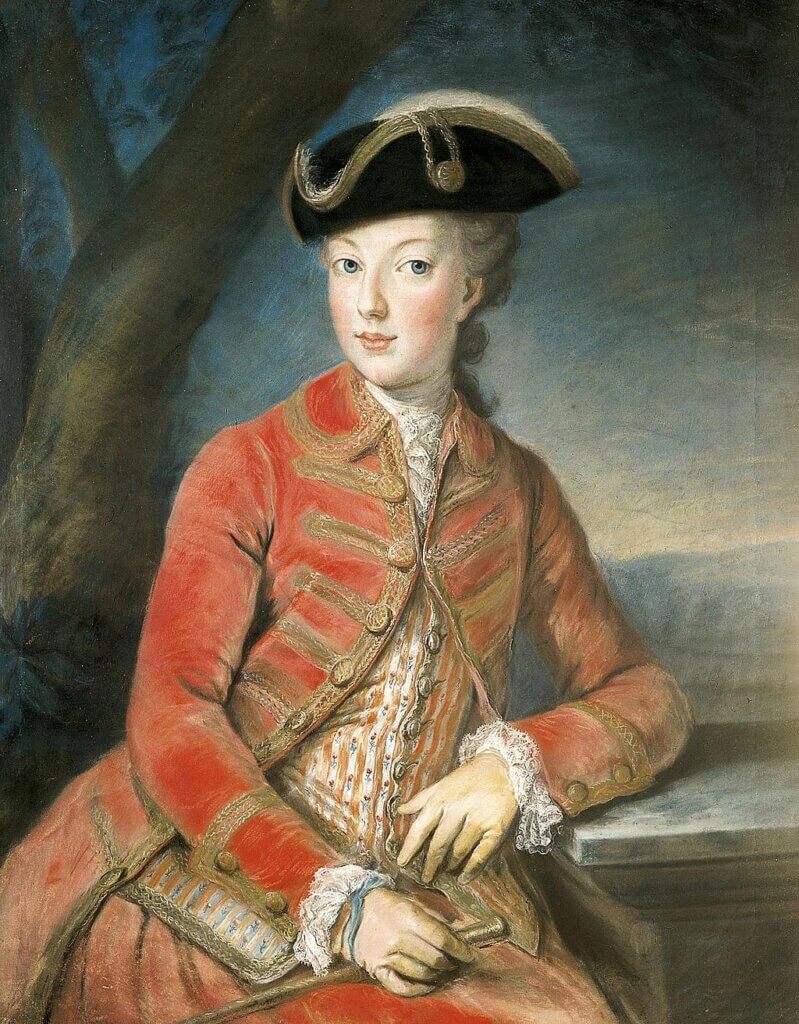
Maria Antonia was born to Francis I, the Holy Roman Emperor, and Maria Theresa. (Her mother would go on to be the Holy Roman Empress in her own right.) She was their youngest daughter and second youngest child (out of seventeen). The Archduchess (a title specific to the daughters of the HRE) had a relatively carefree early childhood. While the Habsburg court in Austria was a fairly structured court, it was nothing like the court at Versailles that the teenager would encounter.
Maria Antonia was not particularly studious and up until her later childhood, she struggled to communicate in German, French, or Italian (languages needed for life at any European court). However, her studies in music were far more successful and she quickly became an accomplished singer, as well learning to play the harpsichord and the harp. And she excelled at another important skill for life at Versailles: dancing.
Engaged and Married to the Dauphin
In February of 1770, Maria Antonia was formally engaged to the Dauphin of France. Her mother had sought to create a lasting peace with King Louis XV of France after The Seven Years’ War, and as was common in the period, a diplomatic marriage was the best tool available.
The couple were married by proxy (with her brother standing in as the proxy) in April in Vienna, and then she set out with her entourage to journey to France. And it was no small entourage: it included 21 state coaches, 36 carriages, and almost 250 people. At the French border, she was forced to exchange her Austrian ladies, wardrobe, and even dog for a French group of ladies and French dress. (Never fear- she would get her dog back!)

A Chaste Marriage
Marie Antoinette (as she would be known going forward) and her new husband did not have the most successful start to their marriage. Although she was beautiful, she was only fourteen and Louis was only a year older than her. He was incredibly shy and preferred spending time with his clocks away from the hustle of court. They were married quickly in person, but they were in a marital sort of limbo for nearly seven years.
Although the French court followed the tradition of witnessing the consummation, the pair did not actually consummate their marriage. And were unable to for seven years. The BBC/ Canal + show this year did have this correct: Marie Antoinette’s brother, the Holy Roman Emperor, did actually visit Versailles to help his sister and brother-in-law sort out their issues.

Courtly… Struggles
Marie Antoinette struggled with the highly regimented and political atmosphere at Versailles. Given that she was in her young teens when she arrived, it is not surprising that she did not enjoy life at court.
Versailles was an extremely political environment, and various people had a lot of soft power at court. The young Dauphine was convinced by members of the French royal family that she should avoid the King’s mistress, Madame du Barry, and this made life at court awful for Marie Antoinette.
However, after the King’s death, her husband’s ascension, and finally giving birth to their daughter in the spring of 1778, court did become a more tolerable home for the now Queen.

Madame Deficit
If you know anything of Marie Antoinette, you probably know of her extravagant spending. I would say, she somewhat fairly earned her nickname of “Madame Deficit” as she spent widely on everything- fashion, gambling, gifts, it was all covered. (I will not lie, in researching this, I am now seeing connections to the amount of unfettered consumerism that comes with online shopping and addiction…) She had no concept of money, and she lived her life at two of the wealthiest courts.
However, the government laid France’s debt and monetary crisis on Marie Antoinette for her spending and that is absolutely not fairly earned. France’s spending has reached astronomical proportions by the 1780s- with numerous wars and a massive, titled class that took every monetary privilege possible (in addition to the royal family), the spending was much, much bigger than the Queen.

“Let them eat cake”- A Swift Revolution
Okay, if you have not been told that Marie Antoinette did not actually say “Let them eat cake”, you may have been living under a rock. It first appeared in a Jean-Jacques Rousseau work that was finished in the late 1760s and was published in 1782. Still, revolutionaries used Marie Antoinette as a symbol of everything wrong with Old Regime France.
The monarchy was formally abolished on 10 August 1792. The family was imprisoned three days later; the former king was tried and convicted of treason against the First French Republic and was executed by guillotine on 21 January 1793.
Marie Antoinette and her two surviving children remained imprisoned in poor conditions. In October of 1793, the former queen was tried and convicted of 1) spending France’s national funds, 2) working against the security of the state, and 3) treason against the state (based on her apparently helping the enemy). She was also charged with committing incest with her young son, but there is no evidence that anything close to that occurred. She was also guillotined- she was executed on 16 October 1793.

Marie Antoinette: Interesting Facts
-Queen Charlotte may have seen an eight-year-old Mozart play, but Marie Antoinette saw a six-year-old Mozart play!
-Another Queen Charlotte fact- Charlotte and Marie Antoinette corresponded regularly for years until the French Revolution began.
-She loved chocolate so much that she brought her chocolatier from Vienna with her to Versailles.
-While she was imprisoned, she saw her friend’s decapitated head paraded past her window.
Interested in more book previews, period dramas, royal news, and more? You can subscribe to my biweekly substack newsletter here: https://substack.com/profile/34734695-anhistorian-abouttown!
Further Readings on Queen Marie Antoinette
Fraser, Antonia. Marie Antoinette: The Journey. New York: Anchor Books, 2020.
Weber, Caroline. Queen of Fashion: What Marie Antoinette Wore to the Revolution. New York: Picador, 2007.
Zweig, Stefan, Eden Paul, and Cedar Paul. Marie Antoinette. London: Pushkin Press, 2010.
♠
Looking for my earlier Consort of the Month posts? Read about:
Empress Eugenie of France
Queen Charlotte of Mecklenburg-Strelitz
Interested in more monarchs?
Mary I
Anne
Edward the Confessor
William IV
Edward IV
James I
George V
Mary, Queen of Scots
George IV
Henry VII
Mary II
James II
Edward VII
George III
George I
Louis XIV of France
Elizabeth I
Catherine the Great
Edward VIII
Charles I
George VI
Victoria
Elizabeth II
I hope you have enjoyed our third Consort of the Month: Queen Marie Antoinette of France!
Cheers,
The Historian
Facebook | Twitter | Instagram | Pinterest