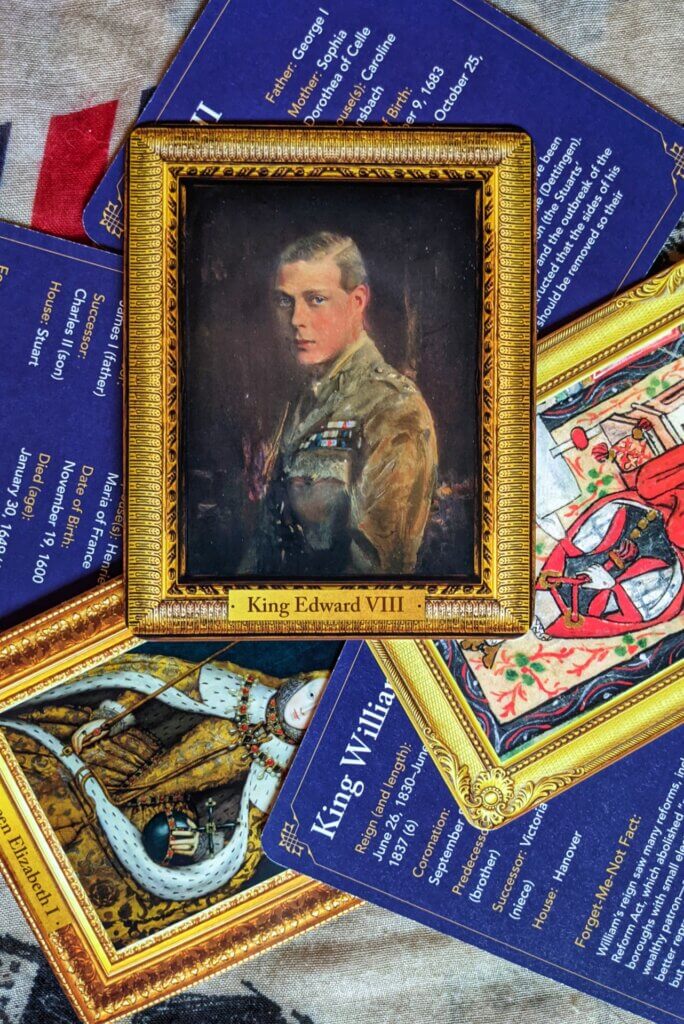
Although every monarch’s reign has a starting date and an ending date, many monarchs are known for one or the other. Edward VIII is absolutely known for the ending date- 11 December 1936. The memory of his shy brother taking the throne and fulfilling the familial duty is ingrained in national and international memory. However, there is a lot more to Edward’s life than solely his abdication- he was a complex person before his reign, like any of us are. So, ahead of the anniversary of his abdication on 11 December, our Monarch of the Month: King Edward VIII!

Monarch of the Month: Edward VIII Fast Facts
Birth Date: 23 June 1894
Death Date: 28 May 1972
Reign: 20 January 1936- 11 December 1936
Coronation Date: N/A
Predecessor: George V
Successor: George VI
House: Windsor
Father: George V
Mother: Mary of Teck
Spouse(s): Wallis, Duchess of Windsor

Why Do We Know Edward VIII?
Edward VIII is still largely known for his abdication and marriage to Wallis Simpson, almost a century later. When Prince Harry married Meghan Markle in 2018, many comparisons were made between Markle and Simpson (American divorcees) that brought Edward and Wallis back into the limelight. The first two seasons of The Crown also featured both Edward and Wallis, and a theory on their relationship with the royal family. Much on the Duke of Windsor’s wartime activities is still shrouded in secrecy (I don’t know that they will ever be revealed) but the idea that he colluded with the Nazis is quite widespread.

King Edward VIII’s Early Life
Edward was born as Edward Albert Christian George Andrew Patrick David in June of 1894 at White Lodge, Richmond Park, and went by David. His parents, the Duke and Duchess of York, were fairly typical parents of the period- they didn’t see their children a lot. This isn’t to say that they were bad parents, but they weren’t overly close with David and his siblings. Unfortunately, one of his first nannies would pinch him right before he was brought in to see his parents, meaning that he was always crying and upset when he saw them.
The problem nanny was removed immediately once it was discovered, though. George and Mary were known for being rather gruff and unemotional, at least in the public eye. However, they did love their children, including David. Mary in particular had a close relationship with David that would continue throughout much of his life.
An Incomplete Education
After being educated at home by private tutors to the age of 13, David went to the Royal Naval College, Osborne in 1907 and was joined by his younger brother Bertie (the future King George VI) in 1909. When his father ascended the throne in 1910, he automatically became the Duke of Cornwall, and was invested with the title of Prince of Wales in 1911. David did not complete his naval course, though- in 1912, he spent three months on HMS Hindustan as a midshipman. From 1912 to 1914, he attended university at Magdalen College, Oxford, where he read History and Modern Languages but left before he could complete a degree.

The Prince of Wales and The Great War
David was 16 when The Great War started in 1914, the minimum age to enlist. And like many other young men his age, David was set on signing up and doing his duty but the government would not consider it. He had joined the Grenadier Guards in June of 1914, and would visit the front lines often but did not actually serve. (And given that the Prince of Wales’ motto is Ich Dien– I serve- it was particularly rankling.) He was able to earn his pilot’s license, though, and took his first military flight in 1918. David remained popular amongst WWI veterans for his willingness to fight, despite having a limited role.

Touring the Empire
As The Prince of Wales, Edward undertook several tours of the Empire in the 1920s. He was young, good-looking, outgoing, and fashionable- much like his grandfather on his tours as Prince of Wales, David grew crowds wherever he went. In particular, young men watched his tours closely in the press to mimic his fashion choices. (He wasn’t unpopular with young women, either…)
In 1919 on a trip to Canada, he purchased the EP ranch in Alberta. The 41-acre ranch was a favourite destination for the prince when in Canada, and he continued to visit privately throughout the 1940s and 1950s until selling it in 1962.
Edward shared a common view of the period, that white people were superior. He made comments about Indigenous peoples on several different tours.

David and Women
Undoubtedly, much of the persistent interest in Edward VIII to this day is in his love life. Yes, David and Wallis’ relationship is infamous, but he had several mistresses prior to her. (Similar to Edward VII, his grandfather…) David had a penchant for married women. In 1917, he started an affair with a married French courtesan, Marguerite Alibert. He broke it off a year later, but that did not stop him getting dragged into a murder trial in 1923 after she shot her husband.
David quickly went into another affair, with Freda Dudley Ward (wife of Liberal MP William Dudley Ward). Their relationship lasted over a decade from 1918 to 1929, and he was notably in love with her from the beginning with onlookers commenting on it. He saw her every day in the evening, and would write to her and call her when they could not be together. Their friendship continued until 1934, when a certain Mrs. Simpson decided David no longer wanted to take her calls.
Dudley Ward was replaced by Thelma Furness (Viscountess Furness) in 1930. She was an American wife of a British peer, and ran in the same social circles. An outgoing woman who was an actress prior to her first marriage, she was the aunt of American designer Gloria Vanderbilt. Furness introduced David to Wallis in 1931, and while she was in the US visiting her family for a few months in 1934, Wallis cut Thelma out completely.

David and Wallis- An Abdication for the Ages
If you know nothing else about Wallis Simpson, you will know that she was a twice-divorced American who seemingly led the Prince of Wales and then King around by her little finger. Like his other relationships, David was entirely devoted to Wallis. However, after becoming king upon his father’s death in January 1936, he ran into one large issue- the sovereign is the head of the Church of England, and the Church did not recognise divorced persons. While some people in government had other concerns about David as sovereign, it was his relationship that gave the greatest issue.
The British press largely kept the royals out of the newspapers, but the world’s press took no such stance- US newspaper readers ate up the news about the King and Mrs. Simpson. The British government refused to budge on the relationship, though, and they weren’t the only government that mattered- each of the Dominions’ governments would also have to give their assent to changing the succession act to allow the marriage. Needless to say, Edward chose to abdicate the throne to marry Wallis, signing the instrument of abdication on 11 December 1936.

Der Herzog schreitet die Front der SS im Burghof ab.
Links: Robert Ley
The Duke and Duchess of Windsor
The couple were given the titles of The Duke and Duchess of Windsor, a crafty answer to “what do you call a living former king?”. As a royal, David retained his HRH title, but the royal family refused to give Wallis an HRH. They couldn’t exactly live in England; other than an assignment to the Bahamas as Governor of the Bahamas during the Second World War, the couple spent most of their time in France.
Embarrassingly for everyone, in October of 1937, David and Wallis visited Hitler in Germany (giving the horrible image of the couple giving the Nazi Salute) and David even reviewed SS troops. There are still a lot of rumours and questions about what Edward would have done during WWII had he still been on the throne, but I don’t think we will ever have an answer.
Throughout the years the couple gave various interviews, did photoshoots, and attended different events- they had relatively little money, and wanted to maintain quite an elaborate lifestyle.
David died of throat cancer on 28 May 1972 and is buried at Frogmore; Wallis died on 24 April 1986 and is buried beside her husband.

Edward VIII: Interesting Facts
-David was a fashion icon! He was a big fan of patterns- tartan in particular- and popularised patterns in men’s garments. For his entire life, he was a dedicated supporter of British tweed manufacturers!
-He loved his dogs- he and Wallis had several pugs, and they were treated like royalty themselves.
-In the late 1920s, David may have helped his younger brother, George (The Duke of Kent) , kick his cocaine and morphine addictions.
-He published his serialised autobiography, A King’s Story, in 1950 in Life Magazine.
-While at Oxford, the horse-loving David learned to play polo and remained a fan (much like many other members of the royal family)!
Further Readings on Edward VIII
Brendon, Piers. Edward VIII: The Uncrowned King. London: Allen Lane, 2016.
Larman, Alexander. The Crown in Crisis: Countdown to the Abdication. New York: St. Martin’s Press, 2021.
Trethewey, Rachel. Before Wallis: Edward VIII’s Other Women. Stroud: The History Press, 2020.
The Rex Factor podcast. Edward VIII episode.

Looking for my earlier Monarch of the Month posts? Read about:
Mary I
Anne
Edward the Confessor
William IV
Edward IV
James I
George V
Mary, Queen of Scots
George IV
Henry VII
Mary II
James II
Edward VII
George III
George I
Louis XIV of France
Elizabeth I
Catherine the Great
How do you feel about our Monarch of the Month: King Edward VIII?
Cheers,
The Historian
Facebook | Twitter | Instagram | Pinterest


.jpg)
.jpg)
.jpg)


