Back again, with another Monarch of the Month post! With 59 monarchs to be covered, I’m using a random number generator to choose who comes next. (Aside from Anne for Women’s History Month) And we finally move back into the medieval period- the high medieval period, to be specific. If you are going to recognise any medieval English king’s name, it is probably going to be this one. And I’m going to admit, although I knew the name, I actually knew very little about him. So, let’s dive into the Monarch of the Month: St. Edward the Confessor!
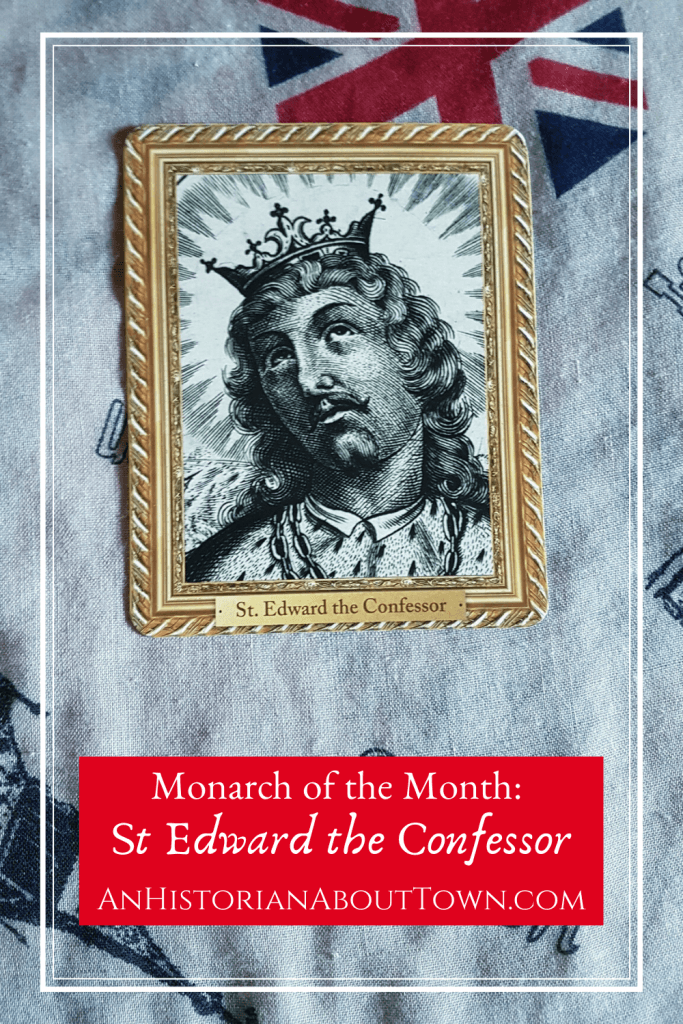
I’ve studied this period extensively in Irish history, but know relatively little about English history of the time. I was excited to dive in but also a little unsure- I’m used to having an excessive amount of information available for the monarchs I study. Much of the information available is from chronicles written by monks; some written while he was alive, but many after his life. And I will cover this later, but given that he is a Saint, there is an obvious religious focus in many sources.
Monarch of the Month: St Edward the Confessor Fast Facts
Birth Date: ~1003-1005
Death Date: 5 January 1066
Reign: 8 June 1042- 5 January 1066
Coronation Date: 3 April 1043
Predecessor:Harthacnut
Successor: Harold II
House: Wessex
Father: Æthelred II
Mother: Emma of Normandy
Spouse(s): Edith of Wessex

Why Do We Know St. Edward the Confessor?
The title alone probably gives it away… St. Edward the Confessor, the saint. Edward was actually one of England’s national saints (but was bumped in 1348 when St. George was made England’s patron saint…). Although various English monarchs have been known for being pious, Edward is pretty much remembered solely for it amongst the general population.
However, if you have spent any time in London, you will probably also have heard his name in connection with Westminster Abbey. And it is a fair connection, as Edward actually established his church there in 1060. He had vowed to make a pilgrimage to Rome if he reclaimed his throne, but after doing that in 1042, it was not safe to make the journey. The pope agreed that instead he could build a church in honour of St. Peter, and thus plans for the abbey were put in motion!

Edward’s Early Life
Edward was the seventh son of Æthelred II, also known as Æthelred the Unready and (the first child of his second wife) Emma of Normandy. He was born in Islip, but Danish raids forced Emma and then Edward to flee to Normandy in 1013 after Sweyn Forkbeard seized the throne. His father eventually fled to Normandy, but was invited back to reclaim the throne in 1014. After he died in 1016, Edward’s half-brother Edmund took the throne.
The family was forced to flee into exile again when Forkbeard’s son Cnut took the throne. And then quite awkwardly, Cnut married Emma (yes, Edward’s mother) and killed his half-brother, leaving Edward the sole family claimant. He spent quite a few years in exile, though there is no known record of where he was until the early 1030s.
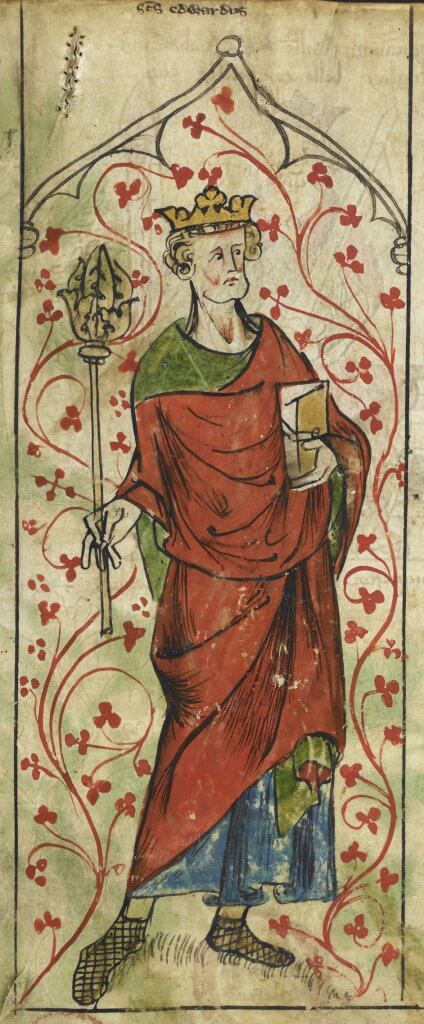
Edward’s Adulthood
When Edward does appear in the records in the early 130s, he signed two charters in Normandy as “King of England”. During this period, he did have the support of several Norman nobles, as well as various Continental abbots, for the English throne. Cnut died in 1035, and although Edward technically had a claim on the throne, Emma seems to have preferred her son by Cnut, Harthacnut. (I would love to have been at one of those family dinners…) and promoted him.
Harold, Cnut’s son from his first marriage, took the throne in 1035 while Harthacnut was away. He died though, in 1040, as Harthacnut was arriving to claim his throne. In 1041, Harthacnut knew that he was close to death, and invited Edward to return as his heir. When he died in 1042, Edward took the throne.

Edward’s Holiness (?)
As his name would imply, Edward was known for his holiness and piety. However, historians’ major question is whether or not that was actually true or a later creation of monks seeking his canonisation. In any case, it tends to be the main thing that he is remembered for. As I previously discussed, he founded and built Westminster Abbey.
The King’s Touch was said to begin with Edward. What is the king’s touch? Well, apparently the monarch, divinely appointed by God, had the ability to heal their subjects by simply touching them. Ælred of Rievaulx, a Cistercian monk, wrote about one of Edward’s miracles- a woman who had tumours on her neck begged Edward for his help. He washed the tumours and then made the sign of the cross, and then “the skin broke, woms gushed out with the infection, the swelling subsided, the pain disappeared.” (The really useful guide to Kings and Queens of England, 6.) Gross, but miraculous if you believe it. By the fourteenth century, monarchs would regularly claim this power.
And of course, his canonisation. He was made a saint in 1161, roughly a century after his death. Most historians recognise that this was a political sainthood, rather than a religious one. The monks at Westminster Abbey sought his canonisation to increase the funding for the Abbey and its prominence. They seized on the idea that he was celibate, as he and his wife Edith had no children, but there is no proof of this.
Edward the Confessor: Interesting Facts
-He was crowned at Winchester Cathedral.
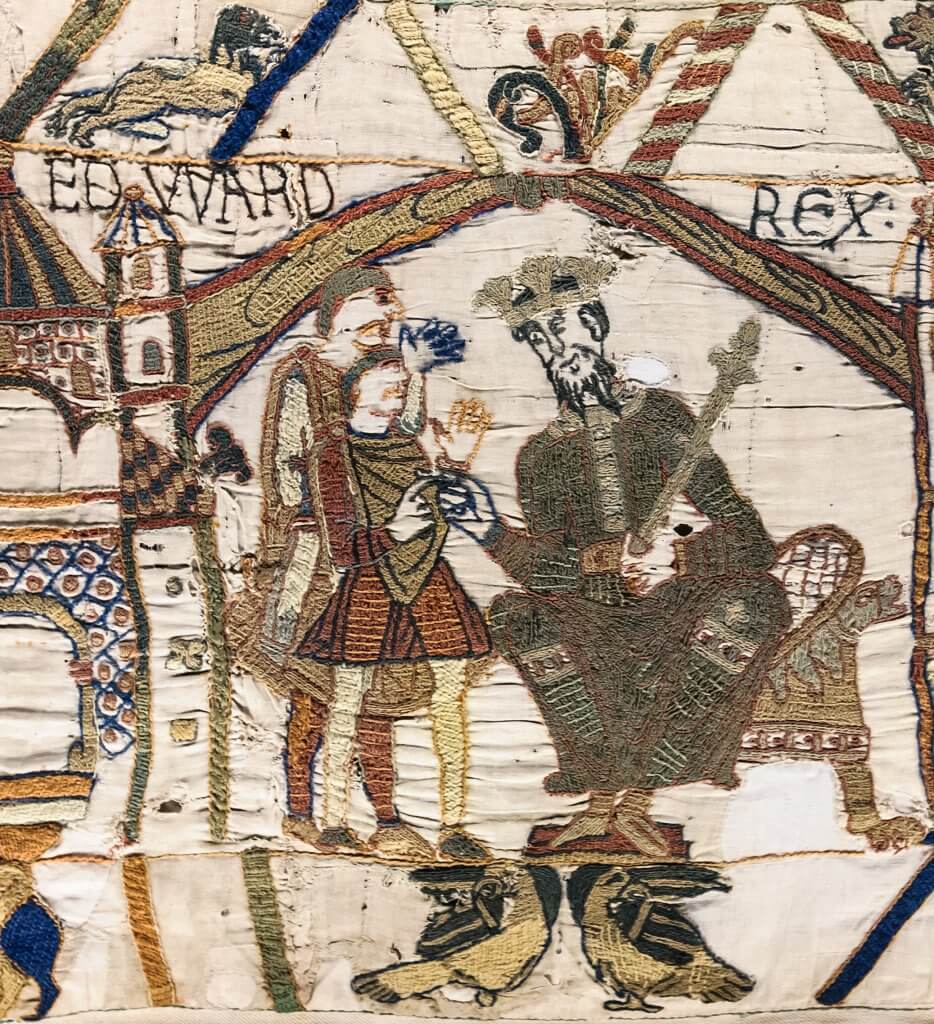
-Edward is the earliest monarch to appear in the Bayeux Tapestry.
-He is known as a “Confessor” rather than a martyr because he didn’t die for his faith.

Further Readings on Edward the Confessor
Barlow, Frank. Edward the Confessor. University of California Press, 1985.
Westminster Abbey: A Souvenir Guide. Scala Publishers, 2011.
Historic Royal Palaces. The really useful guide to Kings and Queens of England. Historic Royal Palaces, 2016.
Rex Factor Podcast. Edward the Confessor episode.
♠
Looking for my earlier Monarch of the Month posts? Read about Mary I here! And read About Anne here!
Cheers,
The Historian
Facebook | Twitter | Instagram | Pinterest | Bloglovin’