As I am sure that people have noticed, I am now regularly including ballet history on the blog. I know that some people consider it incredibly niche. However, my post numbers tell me that there are quite a few of you who enjoy it as well. It can feel a little overwhelming to jump into- a lot of ballet history is what is verbally told to you while you are in class. Interesting, yes, but much harder to look into. So, today I’m sharing the best history of ballet books available- books and guides to help you dig deeper into the history of ballet!

I need to be clear about something upfront- oral history is absolutely a valid form of history. And oral history dominates ballet- much of what we “know” has been passed down to us from teachers and examiners and other people, who were told by someone else, and so on. There are many cultures where history, genealogy, myths, and more are passed orally from generation to generation. The reason why it is more difficult in ballet history is that it is rather like a game of telephone, instead of a set history practised and passed down. This can make it difficult to verify many things. (I just have to say, I’m grateful that companies and choreographers started recording things in the 1980s for posterity- so much has been lost!) These sources here don’t have all of the answers, but they are a great starting point for a more cohesive history.
A final note- I’ve only included books that I’ve read. I will continually update this post when I have another book to recommend. I will also have another post up soon on individual biographies- there are too many to include here without this post becoming pages long!

General History of Ballet Books

Apollo’s Angels: A History of Ballet, Jennifer Homans
For more than four hundred years, the art of ballet has stood at the center of Western civilization. Its traditions serve as a record of our past. A ballerina dancing The Sleeping Beauty today is a link in a long chain of dancers stretching back to sixteenth-century Italy and France: Her graceful movements recall a lost world of courts, kings, and aristocracy, but her steps and gestures are also marked by the dramatic changes in dance and culture that followed. Ballet has been shaped by the Renaissance and Classicism, the Enlightenment and Romanticism, Bolshevism, Modernism, and the Cold War. Apollo’s Angels is a groundbreaking work—the first cultural history of ballet ever written, lavishly illustrated and beautifully told.
Ballet is unique: It has no written texts or standardized notation. It is a storytelling art passed on from teacher to student. The steps are never just the steps—they are a living, breathing document of a culture and a tradition. And while ballet’s language is shared by dancers everywhere, its artists have developed distinct national styles. French, Italian, Danish, Russian, English, and American traditions each have their own expression, often formed in response to political and societal upheavals.
From ballet’s origins in the Renaissance and the codification of its basic steps and positions under France’s Louis XIV (himself an avid dancer), the art form wound its way through the courts of Europe, from Paris and Milan to Vienna and St. Petersburg. It was in Russia that dance developed into the form most familiar to American audiences: The Sleeping Beauty, Swan Lake, and The Nutcracker originated at the Imperial court. In the twentieth century, émigré dancers taught their art to a generation in the United States and in Western Europe, setting off a new and radical transformation of dance.
I’ve recommended this book many times- it is the only academic, overarching history of ballet book available. It is an investment of time, as it is well over 600 pages. Homans is a dancer herself who did a PhD after retiring, and thus brings an active perspective to Apollo’s Angels. There is a lot to cover, and in spite of its length, there are still things to be discussed. Its strength is in the first half of the book- ballet’s evolution in the sixteenth to nineteenth centuries. I find it becomes more skewed in the second half, as her American biases become quite clear. (George Balanchine is an important figure in the modern history of ballet, but certainly not the only- she takes a worshipful tone.)
There are also many criticisms of the conclusion, where she laments the death of ballet. Most readers, myself included, disagree with this opinion. However, there is still a lot of useful history to take away from the book. It is a great starting point for anyone interested in the history of ballet.

Specific Ballet Company Histories
Many ballet companies have their histories. I try to read as many of them as I can-I’ve only included the major companies here, those that have considerable influence on others. (That isn’t to say that smaller company histories are interesting and valuable, but they are often less applicable. Note: I do have to admit, I’ve not been able to find a history of the Paris Opera Ballet still in print/available.
Something to keep in mind- company histories are often written by journalists, rather than historians. You won’t always find the citations/sources available, and they sometimes have a “scrapbook” feeling to them. It doesn’t mean they don’t have value, but it can be difficult to find any narrative.

The Royal Ballet: 75 Years, Zoë Anderson
This book is a perceptive and critical account of the first 75 years of The Royal Ballet, tracing the company’s growth, and its great cultural importance – an indispensable book for all lovers of ballet.
In 1931, Ninette de Valois started a ballet company with just six dancers. Within twenty years, The Royal Ballet – as it became – was established as one of the world’s great companies. It has produced celebrated dancers, from Margot Fonteyn to Darcey Bussell, and one of the richest repertoires in ballet.
The company danced through the Blitz, won an international reputation in a single New York performance and added to the glamour of London’s Swinging Sixties. It has established a distinctive English school of ballet, a pure classical style that could do justice to the 19th-century repertory and to new British classics.
Leading dance critic, Zoë Anderson, vividly portrays the extraordinary personalities who created the company and the dancers who made such an impact on their audiences. She looks at the bad times as well as the good, examining the controversial directorships of Norman Morrice and Ross Stretton and the criticism fired at the company as the Royal Opera House closed for redevelopment.
The Royal Ballet is certainly one of the most well-known companies in the world. They have an incredibly wide ranging repertoire- classical, contemporary, and modern pieces are always being performed. Most people have familiarity with the Royal Ballet because their productions are widely available, even if you aren’t in London- throughout the 2020 lockdown, they have been streaming different productions for free, and countless are available for purchase.
When you hear of the Royal Ballet, there are a few names that will spring to mind. Ninette de Valois, the founder. Margot Fonteyn and Rudolf Nureyev, two of the most lauded dancers to have ever graced the stage. Sir Frederick Ashton and Wayne McGregor’s productions are still performed. This was published in 2006, so the last 15 years are obviously missing, but it is a dependable and interesting read.

Bolshoi Confidential: Secrets of the Russian Ballet from the Rule of the Tsars to Today, Simon Morrison
On a freezing night in January 2013, a hooded assailant hurled acid in the face of the artistic director of the Bolshoi Ballet. The crime, organized by a lead soloist, dragged one of Russia’s most illustrious institutions into scandal. The Bolshoi Theater had been a crown jewel during the reign of the tsars and an emblem of Soviet power throughout the twentieth century. Under Putin in the twenty-first century, it has been called on to preserve a priceless artistic legacy and mirror Russia’s neo-imperial ambitions. The attack and its torrid aftermath underscored the importance of the Bolshoi to the art of ballet, to Russia, and to the world.
The acid attack resonated far beyond the world of ballet, both into Russia’s political infrastructure and, as renowned musicologist Simon Morrison shows in his tour-de-force account, the very core of the Bolshoi’s unparalleled history. With exclusive access to state archives and private sources, Morrison sweeps us through the history of the storied ballet, describing the careers of those onstage as well as off, tracing the political ties that bind the institution to the varying Russian regimes, and detailing the birth of some of the best-loved ballets in the repertoire.
From its disreputable beginnings in 1776 at the hand of a Faustian charlatan, the Bolshoi became a point of pride for the tsarist empire after the defeat of Napoleon in 1812. After the revolution, Moscow was transformed from a merchant town to a global capital, its theater becoming a key site of power. Meetings of the Communist Party were hosted at the Bolshoi, and the Soviet Union was signed into existence on its stage. During the Soviet years, artists struggled with corrosive censorship, while ballet joined chess tournaments and space exploration as points of national pride and Cold War contest. Recently, a $680 million restoration has restored the Bolshoi to its former glory, even as prized talent has departed.
As Morrison reveals in lush and insightful prose, the theater has been bombed, rigged with explosives, and reinforced with cement. Its dancers have suffered unimaginable physical torment to climb the ranks, sometimes for so little money that they kept cows at home whose milk they could sell for food. But the Bolshoi has transcended its own fraught history, surviving 250 years of artistic and political upheaval to define not only Russian culture but also ballet itself. In this sweeping, definitive account, Morrison demonstrates once and for all that, as Russia goes, so goes the Bolshoi Ballet.
The Bolshoi Ballet is one of the most famous and infamous ballet companies in the world, for the reasons above and many more included. This is quite an in-depth book, over five hundred pages of Russian and ballet history. There is a fair amount of Russian history included in Bolshoi Confidential, and for good reason. Ballet, and art in general, is never created in a vacuum; it reflects the circumstances and society it is made in. And in Russia, the major companies are tied more closely to the government and politics than anywhere else. This company history is dramatic and sometimes seems like it could not be true, but with the Bolshoi still one of the world’s leading ballet companies, it is an important history to know.

Ballet Technique Books
I would argue that you do need to understand ballet technique on some level to understand ballet history in most research projects. You don’t need to have been a professional dancer, but a solid understanding of how the physics of it all work, and how dancers train to be able to do this, is needed. In general, I would recommend watching teaching and class videos (easily found on Youtube) to get a feeling for ballet and what we look for in it. However, if you want to know specifics, these will be your go-to books.

The Cecchetti Method of Classical Ballet: Theory and Technique, Cyril W. Beaumont, Stanislas Idzikowski, preface by Enrico Cecchetti
This dance classic presents a complete beginning course in classical ballet. The founder of this method, Enrico Cecchetti (1850–1928), performed and taught in Russia and with Diaghilev’s troupe. By elaborating on a logical progression of exercises, Cecchetti provided dance with an unprecedented unity — balancing the adagio and allegro, re-establishing the notion of “legato,” strengthening the arabesque, and developing the exercise of the pliés. Cyril W. Beaumont, a distinguished writer on ballet, has codified Cecchetti’s program of study with the assistance of one of Cecchetti’s star pupils, Stanislas Idzikowski, and with the approval of Cecchetti himself.
The first chapter defines and illustrates the basic theory of the positions, body movements, and technical terms. Detailed chapters of exercises include “Exercises at the Bar,” “Port de Bras,” “Centre Practice,” “Adagio,” and “Allegro.” Each exercise appears with a numbered series of instructions, and a table of daily exercises for the week is provided. The text is accompanied by 109 line illustrations, showing positions and movements of the body in detail and offering ballet lovers a perfect guide to the basics of classical ballet.
Many ballet schools use the Cecchetti method to train dancers, especially in the west. This book won’t explain much of what you see on stage, but it will be very helpful in understanding how dancers get to the stage. Cecchetti’s original syllabus is still used, and was documented here in 1922, after he had been teaching it for decades. (It is quite easy to read.) You will need to know the names of positions, movements, and steps to use this.
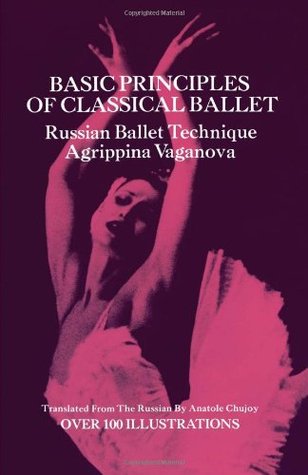
Basic Principles of Classical Ballet, Agrippina Vaganova
Although the stars of Russian ballet Anna Pavlova and Tamara Karsavina possessed a national manner of dancing, there was no truly Russian school of dancing until the 1930s. The development of this school was largely due to Mme. Vaganova (1879–1951), not only a great dancer but also the teacher of Galina Ulanova and many others and an unsurpassed theoretician.
The principles of Vaganova’s system are presented in this well-known book. Mme. Vaganova’s aim of creating a personal approach to the Russian dance was based on the critical assimilation of the experience of her contemporaries. Her ability to choose the best of what had been accomplished in the various ballet traditions (French, Italian, and Russian) and combine these into a unified teaching practice in itself amounted to a new school of dance. She firmly believed that the teaching process should be a planned exercise, ever changing with innovations in the dance. She sought from her pupils emotional expressiveness, strictness of form, a resolute, energetic manner of performance, and the understanding of the underlying coordination of movements.
Her book discusses all basic principles of ballet, grouping movements by fundamental types. Chapters cover battements, rotary movements of the legs, the arms, poses of the classical dance, connecting and auxiliary movements, jumps, beats, point work, and turns as well as material for a sample lesson. Diagrams show clearly the exact foot, leg, arm, and body positions for the proper execution of many steps and movements. The result is a fundamental theory of dance that offers dancers, teachers, and ballet lovers information often difficult to locate in other books.
This is another breakdown of teaching principles and technique, this one focuses on the Russian method. Agrippina Vaganova was a dancer in the Imperial Ballet in St. Petersburg, and studied under legendary choreographer and director Marius Petipa. (He created many of the ballets that we still see today, with much of his choreography still intact.) Many schools and companies will work in the Russian style, you can see its dramatic, sweeping style on many stages. You will also have to know the language of ballet to read this, but it can be quite helpful in decoding movements in classical Russian ballets.

Technical Manual and Dictionary of Classical Ballet, Gail Grant
Teacher recommended, Gail Grant’s Technical Manual has long been one of the most popular and effective ballet reference guides. Completely revised and updated, this third edition is virtually a new work and should be owned by every student, dance teacher, choreographer, and ballet enthusiast — even those who purchased the second edition. Extensive revision, expansion, and the inclusion of more than 300 new terms have added immeasurably to the value of this concise, definitive manual.
Moving from “abstract ballet” and “adage, adagio” to “working leg” and “wrapped position,” the book fully describes and defines over 1,100 ballet steps (saul de chat, jeté enveloppé, failli, entrechat six, etc.), movements and poses (arabesque, épaulement, attitude, en arrière, retiré, à terre, dégagé, etc.), and other expressions and concepts. For each, first a phonetic transcription is provided, then a literal translation, and finally an explanation of how the step is performed, the pose captured, or the movement executed, of how the concept fits in with actual ballet dancing, or of the purpose or function of the idea. A pronunciation guide, cross-references to alternate names for similar steps and positions that vary from the Russian to the French or Italian schools, and a bibliography are all invaluable aids.
But the most important supplement is the 15-page pictorial section, drawn by the author, who is both a successful ballet teacher and dancer. Keyed to the dictionary (and vice-versa), these diagrams show clearly the exact foot, leg, arm, and body positions for the proper execution of many of the more common ballet steps and movements. This essential and easy reference is a must for every teacher, aspiring dancer, and ballet class.
I wouldn’t recommend reading this book but cover to cover, but if you ever need to know the breakdown of a particular step, this is invaluable. The pictures are quite helpful, if you are struggling to understand the physical positions described.
♠
If you are interested in how ballet and fashion have intersected over the years, I would recommend reading the exhibition book, Ballerina: Fashion’s Modern Muse.

What books would you include in your list of history of ballet books?
Cheers,
The Historian
Facebook | Twitter | Instagram | Pinterest | Bloglovin’

I am so glad I found your blog! I love in Seattle, Washington, USA and began my dance journey two years ago at the Pacific Northwest Ballet, in the adult fundamentals classes and a couple months of private lessons. The love of dance has positively infected my soul. Recently, much to my delight, I got a new fraternity brother who was a professional ballerino for many years and so now we barter; I teach him martial arts (I am a Master instructor) and he is my new dance teacher.
Thank you for the book recommendations. I believe that to be truly expert in any sport necessitates a working knowledge of it’s history.
Thanks again!
Wesley Edminister
Oh, I am so glad to hear the list has helped, and that you are enjoying ballet! It is such an enveloping artwork, it is hard to not be drawn in. And what a great connection with your brother!
Hi! I am a ballet lover, and I am going to apply a PhD about ballet, these days I am looking for some professional books. I think your materials are really good and available for me as references.
Happy to see Gail Grant’s manual on your list! And I love how you started this post by mentioning how the history of ballet is incorporated into class time – learning and practicing ballet is more than “just” being taught steps and movement.
It is such a useful book!! I still use it constantly as a reference point, particularly for Cecchetti ☺️ And I’ve always been that annoying student who asks “where did X come from” or “where do we see Y on stage”, but we all learn so much in class that we don’t even realise!
Absolutely!!