The stars collided for my UK trip, as I was able to catch several different exhibitions. Between wildly different start and end dates, this was a MIRACLE. Diana: Her Fashion Story and Dior: Designer of Dreams are both fantastic, and you can expect to see more of them! However, the Royal Women exhibition at the Fashion Museum in Bath was quietly amazing, and I am incredibly thankful that I was able to see it before it closes in April. I have split this exhibition into two blog posts, to fully explore it. Today, I am looking at Queen Alexandra and Queen Mary’s pieces in the Royal Women exhibition, and what we can learn from them!

I absolutely loved my time at the Fashion Museum in Bath. The entire museum is a fashion historian’s dream, and the Royal Women collection is the pinnacle of it. I was able to speak with the museum’s curator, Rosemary Harden (more coming with my Fashion Museum proper posts), and I found out that the Royal Women exhibition will be the last major exhibition. The Fashion Museum is quite small, and they are switching to smaller display collections that are easier to manage, and will allow visitors to see see more of the collection. I completely appreciate this from a historian’s standpoint, but it means that I feel even luckier for seeing the exhibition before it closes!
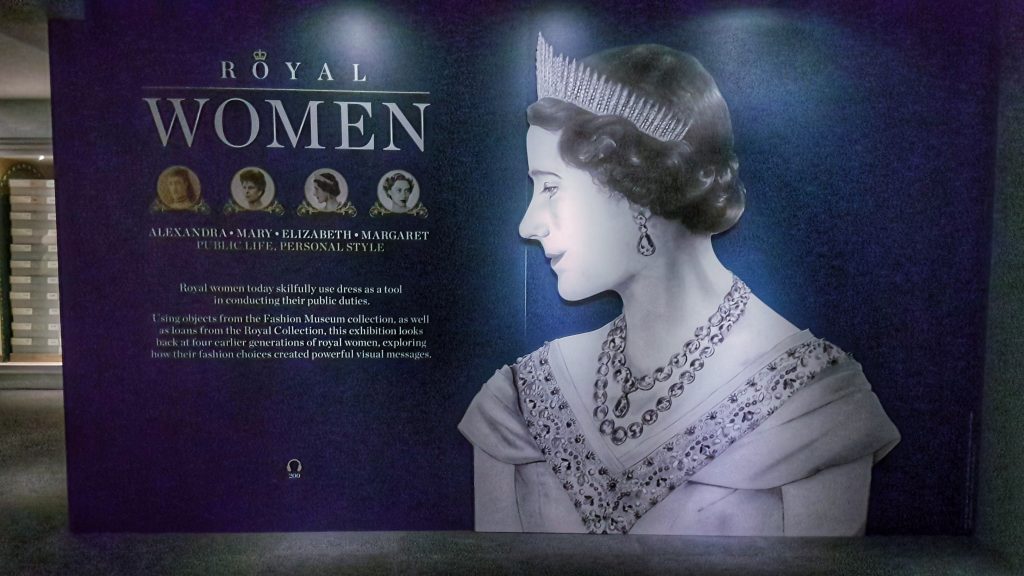
The Royal Women exhibition is open until 28 April 2019, so you have two months left to get to Bath and see it in person for yourself! Tickets to the Fashion Museum are less than £10, which is a fantastic price as you have entry to the Royal Women exhibition as well as the rest of the Fashion Museum. (Many museums will separate exhibitions out.)
You will notice that the four royals, Queen Alexandra, Queen Mary, Queen Elizabeth the Queen Mother, and Princess Margaret, “were not themselves reigning monarchs, but each one was close to the throne- a wife or sister of a monarch. Unlike private citizens, they could not dress solely to please themselves: well aware that clothes give messages, they had to consider the wider effects of their fashion choices. These figures had little voice in politics or current affairs; they were seen but not heard. By creating powerful visual messages through dress, these four women forged our modern idea of what it means to be a royal woman.” (Royal Women, Alexandra, Mary, Elizabeth, Margaret: public life, personal style, Fashion Museum Bath, p.1)

Queen Alexandra: A People’s Princess
Princess Alexandra was a Danish princess that was chosen to marry Queen Victoria’s oldest son, Bertie aka. Edward VII. They married in 1863, and Alexandra quickly became a fashion icon of her time. “Much loved by the public, Princess Alexandra’s very individual style- even down to a slight limp, caused by a serious illness in her youth- was widely imitated.” (Royal Women, FMB, p.2) Alexandra put up with Bertie’s serious wandering eye, and continued to carry herself with poise and grace throughout her life. Contrasted with the stuffy and perpetually mourning Queen Victoria, I can easily see how she because known for her style.

Queen Alexandra’s wedding dress opens the exhibition. Lent to the Fashion Museum by Her Majesty, this pale silk dress is beautiful and delicate. Interestingly, although she had been given a gift of Brussels lace, Queen Victoria insisted that she only wear British lace. The lace that she chose incorporated the rose, thistle, and shamrock (the flowers of England, Scotland, and Ireland). Alexandra and Edward were actually the first royals to be photographed on their wedding day, meaning that Alexandra’s dress would be scrutinised at an entirely different level than any previous royal bride. (I think it still stands up, a perfect emblem of it’s time!)
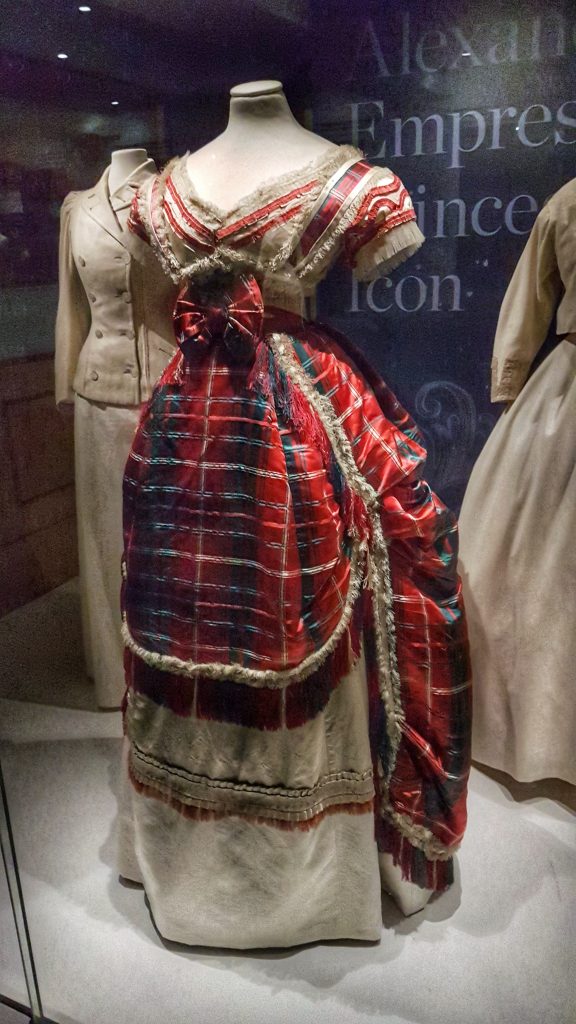
This tartan dress is absolutely, without a doubt, one of my favourite pieces in the museum. This is a red, green, and cream tartan silk satin evening dress, made by Madame Elise in c.1870. Madame Elise was one of Alexandra’s favourite dressmakers. Now, I am doing my best not to overload you with pure history, but I loved learning more about Madame Elise. “The name was actually a marketing strategy to suggest French design: the firm was owned and run by Mr. and Mrs. Isaacson. Despite a scandal in the 1860s involving the death of one of their seamstresses from poor working conditions, by 1870 Madame Elise was listed in the London Directory as dressmaker by Royal Appointment to Her Royal Highness the Princess of Wales.” (Royal Women, FMB, p.6) It is thought that this was worn to functions at Holyroodhouse, and shows a fashionable smaller bustle at the back.

This is a yachting jacket- yes, she had a wardrobe specifically for yachting. I’m going to guess that a queen wouldn’t be actively sailing herself and was rather a passenger, but it never fails to amaze me just how specific a wardrobe can be. Given the number of people who wear athleisure clothing for everything, this seems fairly remarkable now. Also, I know it was achieved with the use of a corset, but that waist is just insane.

Alexandra and Edward’s oldest son died suddenly in 1892, and Alexandra dressed in mourning for the rest of her life. However, she chose to go a different route than Queen Victoria, and dressed in half mourning. This allowed for lighter colours of lilac, grey, and pale yellow and pink, which you see for the rest of her life. This particular lilac gown dates to 1910. Once Edward ascended the throne in 1901, Alexandra’s evening wear became much more elaborate and richly decorated.The sumptuous beading on this gown from French designer Doeuillet illustrates this nicely! However, it may never have actually been worn. “[I]t may have been ordered prior to King Edward’s death in 1910 and then put aside when Queen Alexandra went into deep mourning.” (Royal Women, FMB, p.12) Luckily for us, it has meant it was preserved perfectly!

Another lucky find for us royal fashion watchers? This black evening gown was possibly purchased at the same time as the previous purple gown. However, it was packed away in protective tissue and forgotten for decades after being shown at the Fashion Museum when it first opened in 1955. It was passed on to Francesca Counsell Risius, who re-discovered it after reading about the Royal Women exhibition, and has now been donated to the Museum. It is absolutely gorgeous in person, and between the beading and texture of alternating fabrics, it is a breath-taking gown. Although historians will often complain that discoveries can be rare, when they do happen like this, it is truly a miracle!
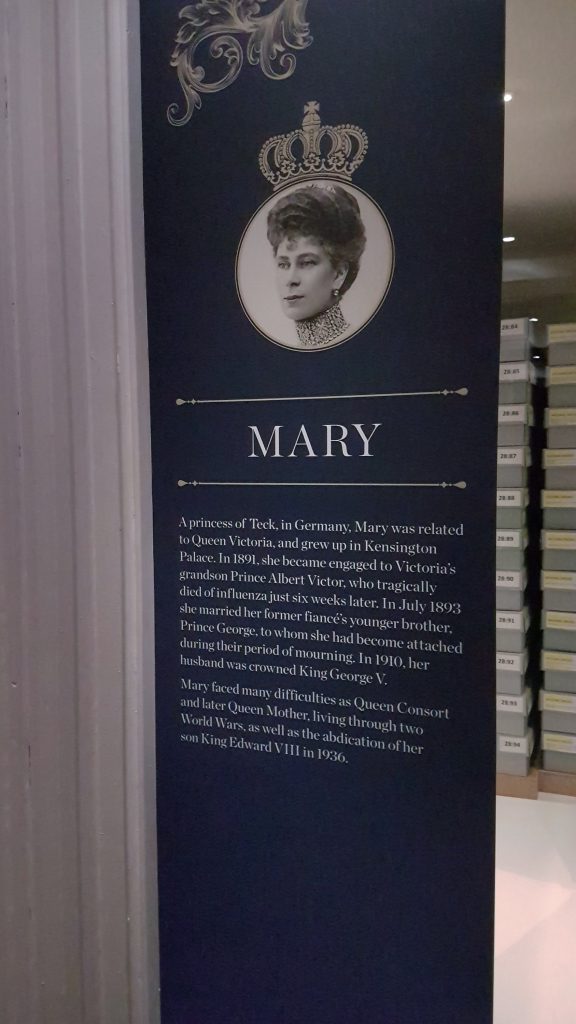
Queen Mary: Grace Under Pressure
I could be wrong, but I think that Queen Mary is slightly more well-known than Queen Alexandra. Many of our grandparents and great-grandparents would remember seeing Queen Mary with George VI, and even with Queen Elizabeth II. However, she does tend to be one of the quieter consorts in history, despite being incredibly hard-working and entirely dedicated to the monarchy. “She faced many difficult events as Queen Consort and later Queen Mother, living through two World Wars, as well as one of the biggest crises in the history of the royal family, in the abdication of her son King Edward VIII in December 1936. At the onset of the First World War, the British Royal Family adopted the name of Windsor to avoid the German associations of their dynastic name, Saxe-Coburg and Gotha. Queen Mary reinforced this message in her fashion choices; in contrast to Queen Alexandra, who often looked to French design, Queen Mary bought exclusively British fashions”. (Royal Women, FMB, p.14)
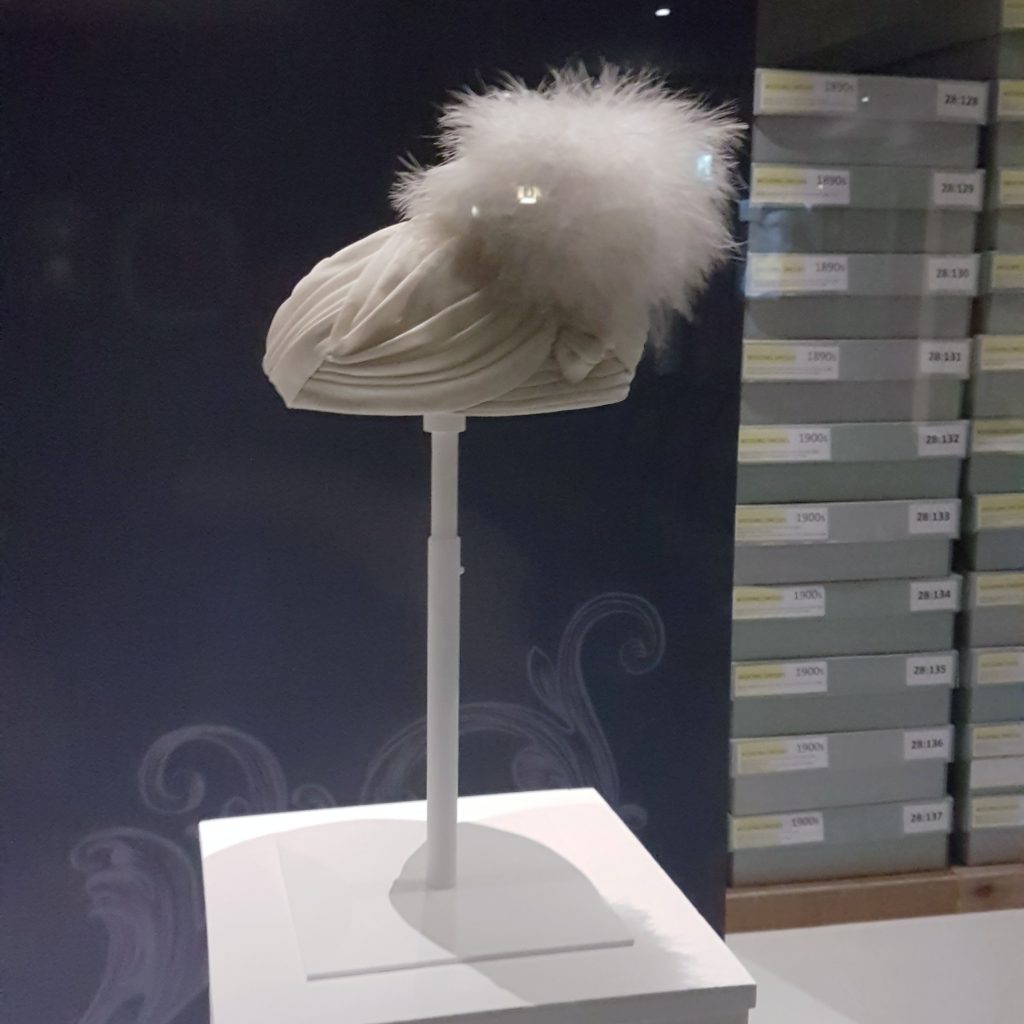
This pale blue silk and white feather hat is beautiful in person, and was worn on the Jubilee Drive in May 1935, to celebrate her husband’s 25 years on the throne. Queen Mary was not a short woman, but she was not afraid to add to her height with hats or shoes. (Given my love of millinery, I am happy to see a hat included in this exhibition!)

Both of these pairs of shoes are made by Rayne shoes, a London shoemaker founded in 1885. Originally making theatrical footwear, Rayne shoes has received a royal warrant from Queen Mary, Queen Elizabeth the Queen Mother, and Queen Elizabeth II! Given that fashion during her husband’s reign would have seen hemlines raised slightly, her shoes would have actually been visible at all times. I am interested in the fact that both shoes have a mid-vamp- they aren’t particularly low or high. (It isn’t a profile that I like on myself, which is frustrating given that it seems to be everywhere right now.) I would be curious to know if it matches general shoe profiles of the time, or if it was particularly to Mary.

Quite opposite to her mother-in-law, Queen Alexandra, Mary was not known for being particularly fashionable. Her style m.o. tended to be a regal bearing and consistency. “[S]he understood public expectation and successfully projected a royal image; with her imposing figure, and stately bearing, she was the embodiment of queenliness. For day wear, she favoured tailored suits and three-quarter length coats, her evening wear consisted of heavily beaded gowns.” (Royal Women, FMB, p.16) This black and purple beaded gown and coat as no exception to that rule. I think what stands out to me the most with Mary’s pieces is the sheer weight of them. Her clothing has the same gravitas (or perhaps played a part in hers?), and you can tell simply from looking at it that there is considerable gravity there.

The first Hartnell piece in the exhibition!! Queen Mary wore this gold lamé Norman Hartnell gown to Princess Elizabeth and Prince Phillip’s wedding in 1947. Hartnell designed a suite of gowns for the entire royal family, including the bride and her wedding party. (If there is ever a Norman Hartnell exhibition happening, I am going to do my utmost to get there- one of Britain’s most talented designers ever!) Originally it had a higher neckline and longer sleeves, but was re-purposed with a lower neckline and a small cape feature. Although it is something that most of us common people have forgotten, royal women (to this day) re-purposed and redesign pieces to get the most use out of it.
See the second half of the Royal Women exhibition here, for Queen Elizabeth the Queen Mother, Princess Margaret, and Sophie, Countess of Wessex.
Are you going to see the Royal Women exhibition before it closes? What strikes you most about these pieces?
Cheers,
The Historian
Facebook | Twitter | Instagram | Pinterest | Bloglovin’

You said that “I’m going to guess that a queen wouldn’t be sailing.” Well, there are many photos of Alexandra on a boat, so she most definitely would have worn that dress on a boat, not just to other places because she liked it. People back then didn’t just go around, like some do today, wearing clothes at the “wrong” time of day or occasion. Clothes, like a riding habit, were worn for specific activities or times of day. Alexandra was photographed on boats many times wearing outfits like the dress pictured.
Hi Suzanne, thank you for stopping by! I absolutely should have been more precise in my language- I have not seen any photographs of Alexandra actively sailing but rather solely as a passenger across many yachts and royal vessels. If you know of any, please send the link my way!
Another tidbit regarding Alexandra’s wedding gown-
Queen Victoria and then Princess Alexandra often disagreed about just about everything. Victoria was extremely overbearing and involved with every day details of those at court, ESPECIALLY her family. Alexandra very subtely defied Victoria and was actually pretty clever about it; bending the protocol of exactly what was “appropriate” for her posistion as Princess of Wales (much like Diana pushed the establishment’s “rules” and was a fashion rebel). When it came down to her wedding gown, Victoria basically made all of the decisions for her (insert sterotypical mother-in-law) and insisted that only English lace be used. Still wanting to use the gift of Belgian lace, which was hugely sentimental to her, and not openly defying the Queen- She had the Belgian lace sewn into all of the undergarments that were worn under the wedding gown. This made the lace even more personal, wearing it in such an intimate way… and stodgy Queen Victoria was never the wiser.
I had read that anecdote about Alexandra, but I couldn’t find it substantiated anywhere- she certainly did take her own quiet path throughout her life. Victoria was such a difficult person to deal with (really, one of my least favourite monarchs) and Alexandra handled it with such poise and grace. She really made her own statements, in the quietest way possible. Such a fascinating consort who should absolutely have more attention!!
I would actually be surprised if Alexandra wasn’t out on the yacht in that outfit. I’ve seen pictures of her on boats with family members. She seemed to have a good sense of humor, played with her children, was a loving grandmother, and known for her photography. I have no doubt she was out on the boat many times. I’ve seen the pictures myself. Also, I’m guessing your comment about Mary not being known for fashion had a lot to do with her husband. He was very much against her shortening her skirts as the 20th century went by. I remember seeing a photograph from the day of Alexandra’s funeral. Mary’s dress is pretty much to the ground, while her sister in law Maude’s skirt was close to knee length. Mary wanted to dress in the newer styles, but George was very much against it.
I’ve seen two pictures that I think she is actually wearing it on yacht- she absolutely was a family women, and her entire family loved being out on the water! (I mean, she may have had more than one piece, but I think it was this particular piece.)
In regards to Mary, I think part of it was George’s influence, but I think a large part of it was her own personality. She very much was a “get-down-to-business” type adult, and I think that that is reflected in her wardrobe. She could have updated her wardrobe in several ways, not just skirt lengths, but she specifically chose not to- I think that when you consider the Great Way and the abdication crisis, it really paid off in the long run (offering a visual identity of continuity). As much as I love style and fashion, there are many people who don’t, and I think Mary was one of those people!
These are gorgeous!! I love the yachting outfit- I feel like your could wear that today, or maybe 40yrs ago since most people, as you mentioned, have relaxed their fashion choices.
Do you know if it’s travelling (to Canada specifically)?
I love that the yachting piece is so simple- although she obviously loved elaborate evening wear, her day wear tended to be much simpler, and it is just as beautiful.
I don’t believe it is travelling- the museum is quite small, and I don’t know that they have the resources to support a travelling exhibition. It is also a smaller exhibition, so I’m not sure that another museum would put all of the legwork in for a smaller exhibition. I could be wrong, though!