In case you have been completely avoiding me on all social media, you will have seen a lot of Dior photos lately on my feed. On my trip, I was able to see the Dior: Designer of Dreams exhibition at the Victoria and Albert, and when you see that much Christian Dior, you have to share it. I took close to 1,000 pictures, and I’ve been mulling over the exhibition catalogue since I’ve been home. So, I have decided to break the exhibition down into three separate posts so that I can properly focus on each section of the exhibition! Part I of Dior: Designer of Dreams today will look at the first three sections, so you can begin your deep dive, too!

Dior: Designer of Dreams is the largest Dior exhibition ever staged in Britain, and features over 500 Dior pieces. The V&A is the perfect host for the exhibition, which builds on the 2017/18 exhibition at the Musée des Arts Décoratifs in Paris. Adding in a section on Dior in Britain (which you will read about today), it covers over 70 years of style and fashion history. The exhibition runs until 14 July 2019, but is sadly sold out. A few extra tickets are being released on the 15th of each month, but those aren’t a guarantee. So, you can enjoy my three part series on the exhibition in the meantime! (And stay tuned to my Instagram Stories, as I will be sharing more there on Fridays.)

The New Look
“Christian Dior unveiled his first haute couture collection on 12 February 1947, amid excited anticipation within fashion circles… Offering a radical alternative to the boxy, masculine style of women’s fashion after the Second World War, Dior’s designs caused a sensation… The New Look was adopted as the name for the collection and its two stand-out silhouettes, Corolle and En 8. The Corolle shape featured full skirts echoing the petals, or corolla, of flowers. En 8 was characterized by hip-hugging pencil skirts. Both featured ample busts, nipped-in waists, soft shoulders, and shaped hips.” (Christian Dior, Oriole Cullen and Connie Karol Banks, p. 26)

I love that so many of the sections of the exhibition featured Dior’s sketches, from his own hand and his designers. Fashion sketches are their own form of art, and he captures movements brilliantly in these simple sketches. The New Look was such a radical change from war-time fashion rationing, and the simple ink drawing emphasises that beautifully nipped waist. I would actually love to see a book entirely made of his sketches, if you know of one! (Or are in the business of publishing and could produce one…)

I admit that I am particularly drawn to Dior because his sense of design suits my figure well. I know that people fawn over Coco Chanel, but Chanel is difficult to wear if you are anything but androgynous. Dior embraced the natural curves of women, his designs worked for nearly all body types. I don’t think that anyone will be shocked, but nearly every person that I have shown pictures of the exhibition to have remarked that Dior designed for the average woman’s figure, rather than a size 0. While I do believe that it partially has to do with societal expectations after the war (being “skinny” would have been the result of rationing, not a trendy diet), I think it speaks to his understanding of the female shape and mind.
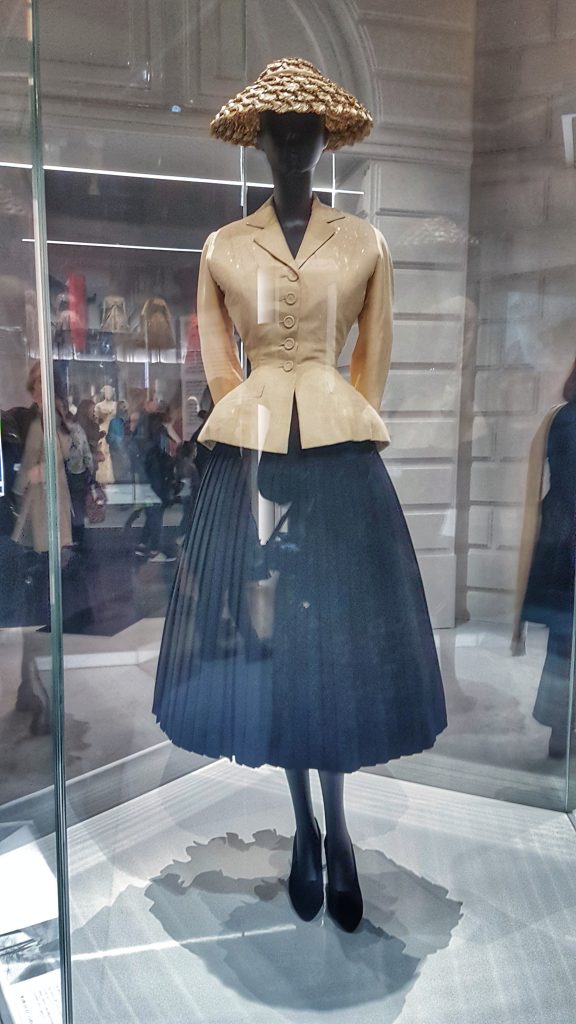
The Bar Suit (above) is a stunning example of the New Look, and emphasises a fuller figure. I think that I also just adore his use of pleats. I know that pleats tend not to be used these days due to more material being needed, but it is such a gorgeous look.
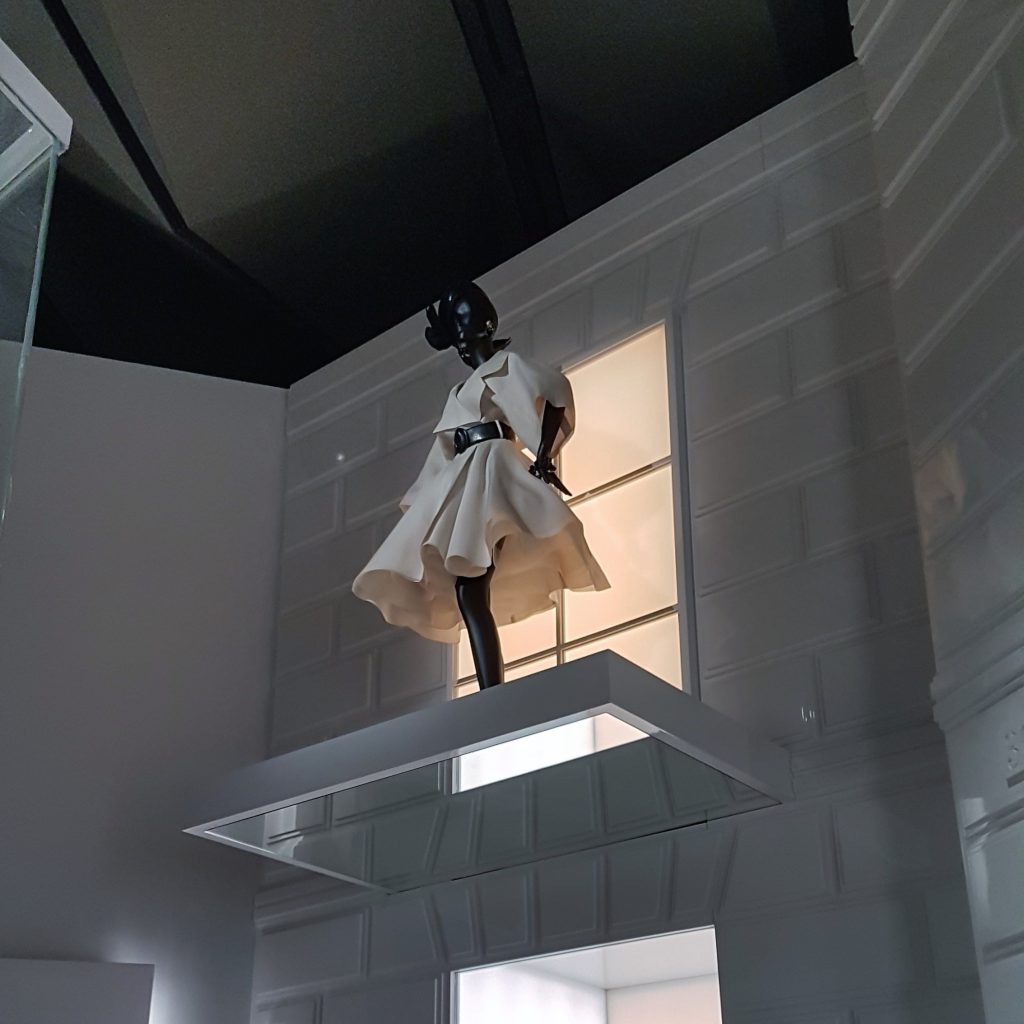
Every Dior creative head has attempted their own version of the New Look, to embrace the history of the house but keep it contemporary. Gianfranco Ferré’s Forcément dress is a stunning take on the New Look. I love that although it was produced in 1991, you could absolutely wear it now. (My only regret with this exhibition is that some pieces are far above your eyeline, but what can you do?) Also, the millinery in this exhibition is just stunning. That is all.

Maria Grazia Chiuri is currently the artistic director of Dior, and she is doing a wonderful job. She evokes a simple elegance paired with a strongly modern simplicity, and I think that she is doing wonderful things for the brand. Although I do think that Raf Simons (the previous artistic director) stuck closer to vintage Dior shapes, I think that Chiuri’s lines are gorgeous, and she is nothing but timely. (We Should All Be Feminists, anyone?)
The Dior Line
“Anchored by the curves of the female figure, Christian Dior’s designs played with structure and proportion to create clothes that powerfully expressed an attitude. He considered carefully the effect of movement, acknowledging that even the most ethereal garment relied on meticulous construction and elaborate workmanship.” (Christian Dior, Cullen and Banks, p. 36)

The early Dior collections have really reminded me that I hate how casual our society is. These dresses are absolutely gorgeous, and it is a sad fact that most of us have nowhere to wear them. I thought that The Dior Line section of the exhibition was brilliantly staged- the black and neon setting allowed the pieces to shine on their own. Also, why aren’t bows used like this anymore? Bows tend to be used in a costume-y, fake prep way- these are simple and elegant. #bringbackthebow

The Profilée coat is quite possibly my favourite piece in the entire exhibition. Given a choice in colour, I will always choose red, and the shape and drape of this wool coat could not be more brilliant. As someone who lives in a place that routinely reaches -45°C for weeks on end, I don’t know that I would get a whole lot of wear out of it. I would make that sacrifice, though… I have added a wool coat to my “to-find” list for the coming year. (Also, why is no one willing to stand out in a piece like this any more??)

And the Écarlate dress. I could not love this dress more. The colour, the shape, the bow. Remind me again why we aren’t dressing like this? Anyone? Anyone at all? From 1955, this silk dress comes from the “Y line”, so named for the shape of the neckline. I think that this dress is a perfect example of why we should return to tailoring…
Dior in Britain
“Christian Dior was a confirmed Anglophile… As a couturier, he was delighted to dress English debutantes and the young Princess Margaret. Following his first British fashion show at London’s Savoy Hotel in 1950, Dior began showing his collections in grand country houses such as Blenheim Palace… In 1952 Dior established C.D. Models. The London business provided ready-to-wear versions of his haute couture garments through exclusive department stores such as Harrods and Kendal Milne…” (Christian Dior, Cullen and Banks, p. 56)

Dior left a lasting impression in Britain, more so than any other French designer. The royal seal of approval will do wonders for a designer (see: Norman Hartnell), and especially so when that royal is the impeccably fashionable Princess Margaret. I think that he launched his designs in Britain at the perfect moment in time, and post-war Britain went absolutely nuts for it. And after seeing his designs in person, I can see why!
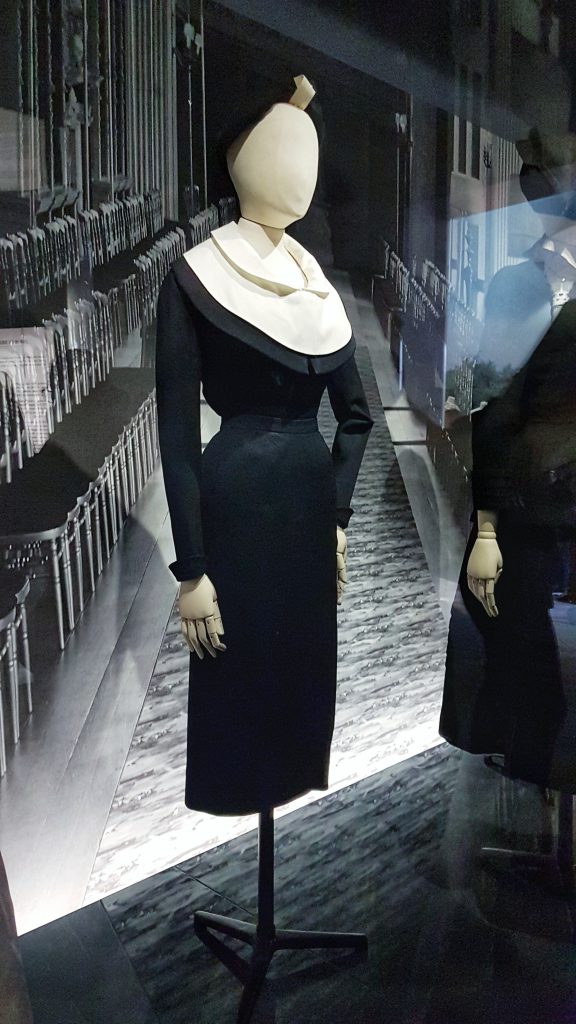
This wool Nonette suit is absolutely gorgeous, and it makes me wish people wore suiting again. “Jean Dawney, later Princess Galitzine, was a house model at Dior in 1950. Chosen by Dior for her “essential Englishness”, she modelled this ensemble from the Verticale line spring collections at…Dior’s first London show held at the Savoy Hotel in April 1950″. (Christian Dior, Cullen and Banks, p.66) Dior knew to market directly to his English clientele, and did it well. Given that PR and marketing is nothing of what it is today, I think it shows his strength and brilliance.

I think that if you were going to the Dior exhibition for one dress, and one dress alone, it is this dress. Princess Margaret’s 21st birthday dress. That infamous dress immortalised by Cecil Beaton’s timeless portrait. And this dress does not disappoint. Stunning in person, it actually seems smaller than the portrait would lead you to believe but no less no perfect. Interestingly this dress uses straw in the embroidery, along with mother-of-pearl and sequins.

I think it was used brilliantly to dazzling effect! In the portrait it appears to be much softer, but in person, it is radiant. This dress highlights the success of the New Look, and how it catered to small waisted women. Although that might not seem too special now, it was an incredible departure at the time. My only hope is that I can see the dress on someone someday to see it’s grace and movement in action!
What is your favourite look from the first three sections of Dior: Designer of Dreams?
Cheers,
The Historian
Facebook | Twitter | Instagram | Pinterest | Bloglovin’

I have been loving all your fashion posts on insta. These clothes really are gorgeous I can totally see why you love them.
Especially that Profilée coat! I would LOVE that. I used to have a coat that colour and found I was often the only bright colour when crossing London bridge on my commute. Everyone around me would be in grey or black coats…
Aww that is so kind of you to say, Josy!! After wandering around the city and spending a fair amount of time on public transportation over the years, I think that any bit of colour is rare haha. I mean, my own coat was grey, but I carried a bright red bag and I always noticed people staring at it. London, you need more colour!!