I am quite excited to finally be delving into more style history on the blog! It occupies an odd place in history still; some historians acknowledge that style, fashion, and clothing plays an enormous role in social, economic, and cultural history, while others dismiss it as trivial. (I am the former, not the latter…) It is an interesting lens to view any period through, if you want to get to know an era. There are so many things to look at in style history. A particular garment, a technique, a designer. Today’s post is focused on a modern style guru, and what his impact has been: this is Christian Dior’s history!

This post is slightly self-serving, as I am preparing for my trip to the UK- specifically a visit to the Victoria and Albert Museum for the “Dior: Designer of Dreams” exhibition. Although Dior himself had a fairly short life, he has left a lasting mark on style and fashion and his house is still one of the prominent houses in fashion today. (Impressive given that it was founded in 1946.) While I will be taking everything possible when I am wandering through the collection, I wanted to inform myself before going on the trip. Various fashion houses from the twentieth century have fallen, but Dior (now owned by LVMH) is still arguably one of the most recognisable brands in fashion and style.
Christian Dior’s History: Early Life
Dior was born in 1905 in a small town in France, but moved to Paris with his family in 1910. His family had hoped that he would go into diplomacy but it was not meant to be! He sold his own fashion sketches for 10c each- if anyone has one of these, I would love to see it! After leaving school, he actually ran a gallery with a friend that sold Picasso pieces. (No big deal, right?) Art would remain a large part of his life, but shifted into focusing on fashion.
Christian Dior’s History: Working For Other Designers
His fashion and style career started with designer Robert Piguet in 1937, who allowed him to design three different collections. He even went on to be the house designer for Piguet! Piguet was a Swiss born, French designer who not only trained Dior but also Hubert de Givenchy, another talented French designer. And because apparently Paris was the place to be for fashion designers in the mid-twentieth century, Dior worked with Pierre Balm at Lucien Lelong, as well. Although his career was going well, he had to leave when he was called up to serve in the French army.

Christian Dior’s History: The House of Dior
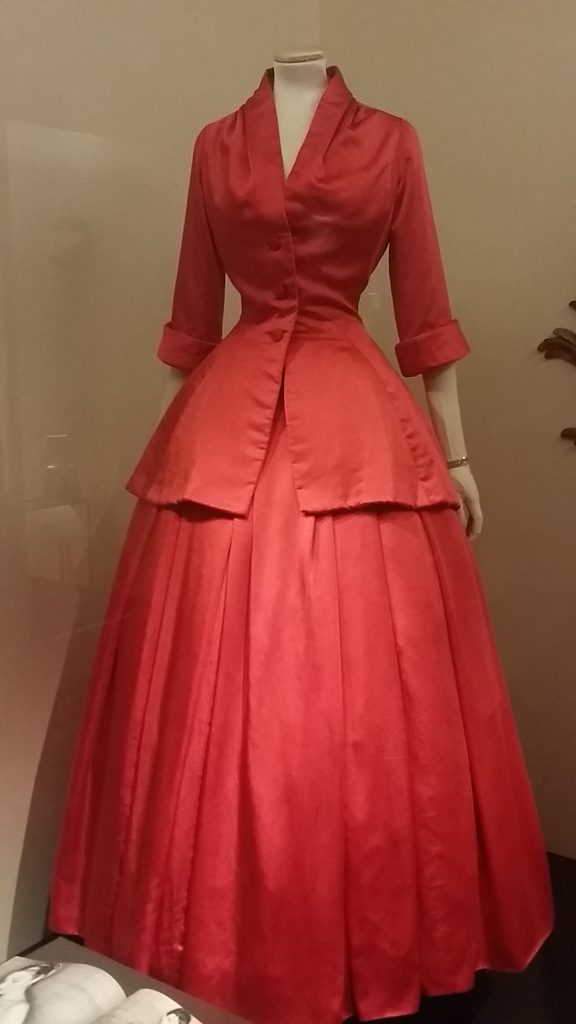
Now, the good stuff. At the end of 1946, Dior finally founded his own fashion house! Within three months, he was debuting two new lines. Nowadays, you will see fashion designers move lines to production fairly quickly, but this seems incredibly fast to me for 1940s. Dior had a very specific style- he liked to retain some of the masculine elements that had crept into fashion in the war years, but overall, he designed a very feminine silhouette. In 1949, a Dior shop opened in New York City, and by 1953, locations had opened in Canada, Cuba, and Mexico. In 1954, a location finally opened in London (in honour of Princess Margaret), and was marked by a fashion show at Blenheim Palace. (That fashion in that palace? That is the dream, folks.)
Dior died at the young age of 52 in 1957, and the house had to decide whether to stay open or close. Well, thankfully for all of us, they did stay open, promoting a young designer that no one knew at the time, a certain Yves St. Laurent. (Add another to the list!) In an odd twist of fate, St. Laurent also had to leave Dior when called into the French army. There have been several creative directors at Dior since, with Raf Simons being notable in the twenty first century. If you are interested in modern Dior, I would watch Dior and I, a wonderful documentary about one of his collections!
Dior’s New Look
I don’t often talk about it, but I cannot stand Chanel for the life of me. I think the markup and price increases that the brand currently employs is insane (especially given that there are continual questions of quality), and Coco Chanel was a fairly abhorrent human being. Why does this matter when I’m talking about Dior? Well, the backdrop of Chanel plays a big role in why Dior became so popular. Coco Chanel preferred a quite androgynous look, which suits some people well but looks terrible on a lot of people who have curves or any sort of shape. Enter: The New Look. The New Look is defined by its small waist and a full skirt that hit at the mid-calf. You can see the callback to nineteenth century corsets and dress shapes (without the actual corsets). It is a clear departure from the slim and shapeless fashions of the earlier decades, and emphasised the post-war end of rationing fabric. (Rationing was still in place in 1947, but you get the point…) I love this look, and for me, it truly is a timely look that wouldn’t be out of place today. Princess Margaret was a big fan of Dior’s New Look, and wore Dior designs throughout her life, as well as other known socialites and figures.

What do you think of Christian Dior’s life and history? Does it change the way you look at him as a designer, or the house and designs now?
Cheers,
The Historian
Facebook | Twitter | Instagram | Pinterest | Bloglovin’

I didn’t see the exhibition, but I’m very glad you wrote about it, I read all the parts. 🙂 I also saw a little behind the exhibition in the documentary Secrets of the Museum (V&A) and also the documentary from Dior youtube page.
Hmm, I like Maria Grazia’s creations, not all of them, but I think she moves away from what was Dior in the past. What I don’t like about creative directors in the present is that they don’t get involved anymore. They don’t draw anymore, they don’t sew anymore … there are others who make for them.
I loved the Secrets of the Museum series, I thought it was so well done!! And the Dior documentary/video on the Paris exhibition was lovely (I might have watched it several times).
I do agree that her Dior looks are quite different. Although Galliano was quite “out there”, I think he did continue the Dior look and aesthetic in his own way. However, MGC’s looks are for a taller, slimmer, more androgynous silhouette. It isn’t inherently a bad thing, but I completely agree with you- it is a big departure. And yes, as I study more fashion history and specific designers, I am coming to lament the loss of those skills. I know that designers often have several different projects/companies on the go at any time, but it has really changed the process 🙁
Well that was certainly a who’s who of the french fashion industry! I had no idea he worked with so many other great designers. I imagine you’ll have the most wonderful time at the V and A museum!
I am *so* excited to finally go to the V&A!! And once you start researching any of the big names in twentieth century fashion, it’s like 2 degrees of separation- you will always find another one!!