Consort of the Month is a monthly series (…duh…) where I turn the spotlight on a different royal consort, a position that has largely been ignored by historians everywhere despite often playing a major role in their husband’s reign. For Women’s History Month this year, I wanted to focus on one of my favourites from all of history- one who made an impact on the arts, on learning, on politics, on court life. When you say consort, she is the first person I think of. Let’s get into our March Consort of the Month: Caroline of Ansbach!
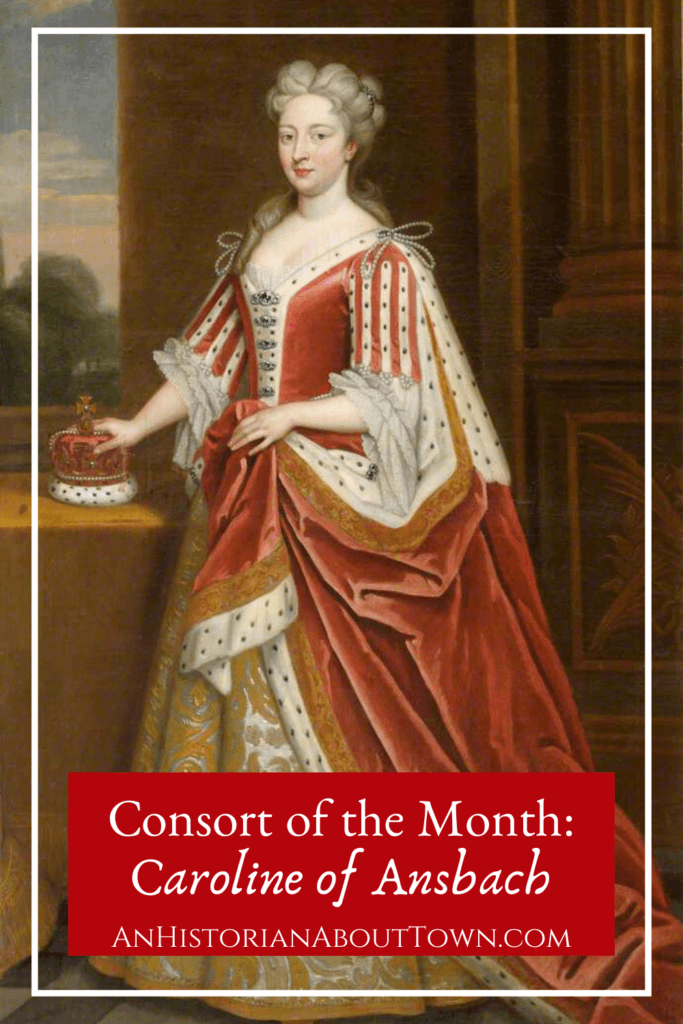
Consort of the Month: Caroline of Ansbach
Birth Date: 1 March 1683
Death Date: 20 November 17737
Tenure: 11 June 1727 – 20 November 1737
Birth Name: Wilhelmina Charlotte Caroline of Brandenburg-Ansbach
Spouse: King George II of Great Britain and Ireland
House: Hohenzollern
Father: John Frederick, Margrave of Brandenburg-Ansbach
Mother: Princess Eleonore Erdmuthe of Saxe-Eisenach
Why Do We Know Queen Caroline of Ansbach?
Caroline of Ansbach is in an interesting place- I think within royal history and those interested, she isn’t unknown but she also isn’t one of the most popular historical figures (which is unfortunate). However, if you have visited Kensington Palace in the last decade, you will probably be familiar with her- she is fairly celebrated at KP (her former home).

Caroline of Ansbach’s early life
Caroline was born in Ansbach in 1683 but her early life was fairly chaotic, as her father died when she was only three years old. Her mother then died when Caroline was thirteen and she eventually found herself under the guardianship of Frederick, Elector of Brandenburg and Sophia Charlotte in 1696.
In 1701, the couple became King and Queen of Prussia and played host to one of the most erudite courts in Europe. And Caroline took full advantage- she became well-acquainted with the leading philosophers, theologians, and scholars of the period.

A promising marriage
In August 1705, Caroline married Prince George Augustus of Hanover. The son of the Elector of Hanover, George sought a love match rather than an arranged marriage. (His parents’ arranged marriage was famously horrendous, with his mother- Sophia Dorothea of Celle- imprisoned in a castle for decades.) The couple immediately hit it off.
Prince Frederick was born to the couple in January 1707; Frederick was followed by Anne, Amelia, and Caroline. Although George kept mistresses, the couple had a strong marriage and were reportedly incredibly happy together.
A new Princess of Wales
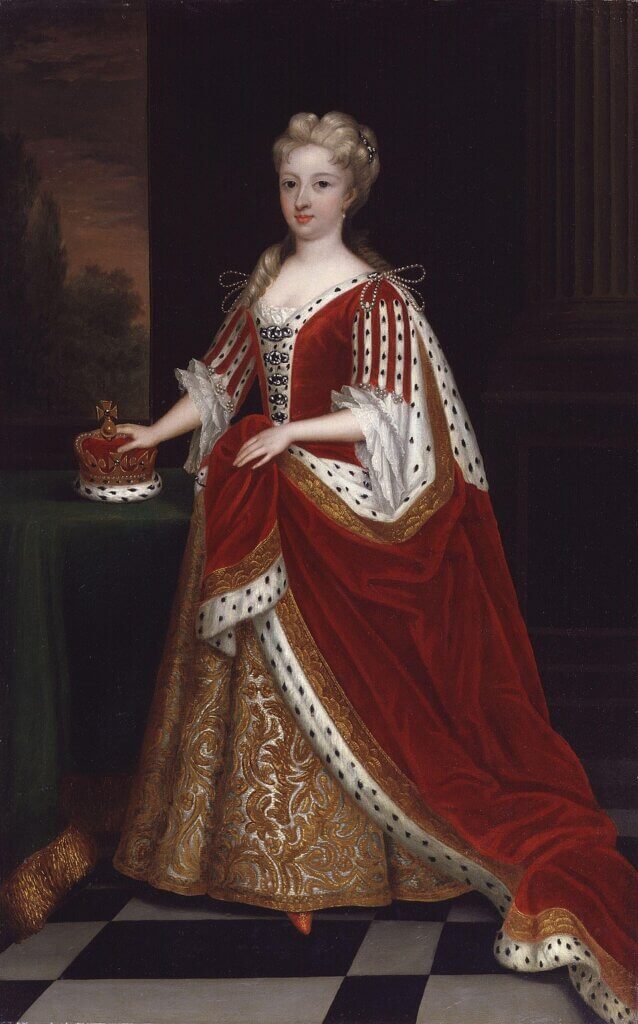
Queen Anne of Great Britain died in August 1704, and as her father-in-law was now King George I of Great Britain, Caroline followed her husband (as heir to the throne) to Britain. Anne was the first Princess of Wales since Catherine of Aragon became the PoW in 1501 when she married Prince Arthur. Because King George I left his wife in a castle in Germany, Caroline was the leading lady of the Hanoverian court in Britain.
The new Princess of Wales was intelligent and understood that becoming more English was key to the couple’s success. She encouraged her family to learn English, in addition to immersing themselves in English culture and politics. As would become a trend for the Hanoverians, Caroline and George did not get along with his father who remained very German, and they quickly established a rival, more Anglicised court. In 1717, the couple fell out with the King over the baptism of their newborn son, and they were banished from court, including being separated from their children.

The talented queen
Caroline was a Renaissance queen if one ever existed. She cultivated a massive library at their home in St. James’s Palace, as well as a major art collection. The Princess was also a strong advocate for scientific advancement, including supporting scholars working in physics and promoting variolation (the precursor to what we know as immunisation). French philosopher Voltaire spoke highly of Caroline, writing, “I must say that despite all her titles and crowns, this princess was born to encourage the arts and the well-being of mankind”.
Caroline also had a great amount of political influence, both as Princess of Wales and then Queen. She worked closely with Prime Minister Robert Walpole (despite her husband’s dislike of him) and was able to influence several policies. The Queen also served as Regent when George would return to Hanover (where he was also ruler) and in 1729 played a major role as Regent in the negotiation of the Treaty of Seville.

Death as an escape
Caroline suffered from serious health issues in the last decade of her life, notably an umbilical hernia from her last child birth in 1724. In 1737, she fell gravely ill when her small intestine finally pushed through the hole, and without anaesthesia, doctors cut the piece of the small intestine off. (Obviously, doctors understand now that this is not how to treat a hernia.) On 20 November, she died when her bowels burst, in possibly one of the most painful and gruesome royal deaths.
Caroline had told George to remarry when she was gone, but George refused. (He did however keep two mistresses, continuing on the trend from their marriage.) He had her buried in Westminster Abbey with a coffin with a removable side- he was buried beside her after his death in 1760.
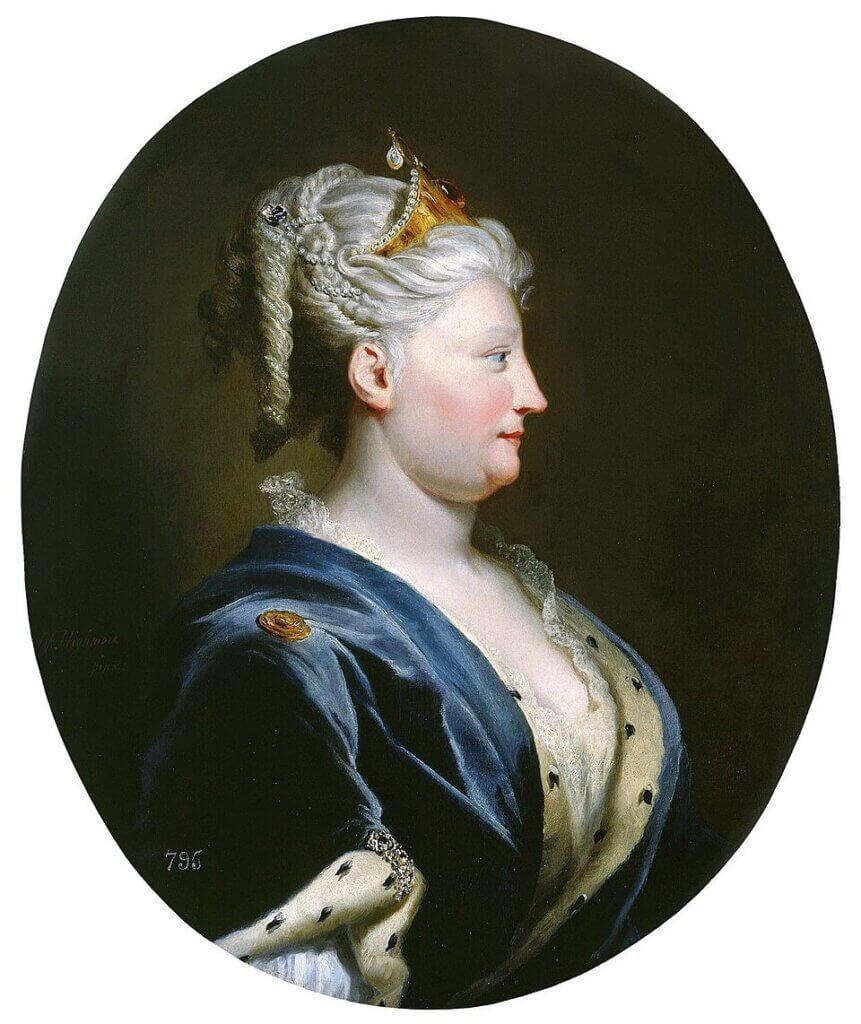
Caroline of Ansbach: Interesting Facts
– Handel composed a funeral anthem for Caroline (“Funeral Anthem for Queen Caroline).
– Just like her husband and father-in-law, Caroline and George did not get along with their son in any way.
– Caroline originally consulted Queen Anne’s former friend, Sarah, Duchess of Marlborough, but quickly grew to dislike the duchess.
– Queen Caroline discovered hidden Hans Holbein sketches in a drawer at Kensington Palace, forgotten for nearly half a century.
Interested in more book previews, period dramas, royal news, and more? You can subscribe to my biweekly substack newsletter here: https://anhistorianabouttown.substack.com/!
Further Readings/Listenings on Queen Caroline of Ansbach
Dennison, Matthew. The first iron lady: A life of caroline of ansbach. London: William Collins, an imprint of HarperCollins Publishers, 2018.
Rex Factor Podcast. “S3.58 Caroline of Ansbach” Episode.
Looking for my earlier Consort of the Month posts? Read about:
Queen Charlotte of Mecklenburg-Strelitz
Queen Marie Antoinette
Catherine de Medici
Queen Adelaide
Catherine de Valois
Marie de Guise
Queen Alexandra of Denmark
Empress Josephine of France
Queen Elizabeth of York
Queen Elisabeth de Valois
Queen Catherine of Braganza
Queen Caroline of Brunswick
Queen Josephine of Leuchtenberg
Elizabeth Stuart
Queen Elisabeth of the Belgians
Saint Margaret of Scotland
Queen Maud of Wales
Empress Sisi of Austria
Queen Marie of Romania
Queen Astrid of Belgium
Queen Maria Eleanora of Brandenburg
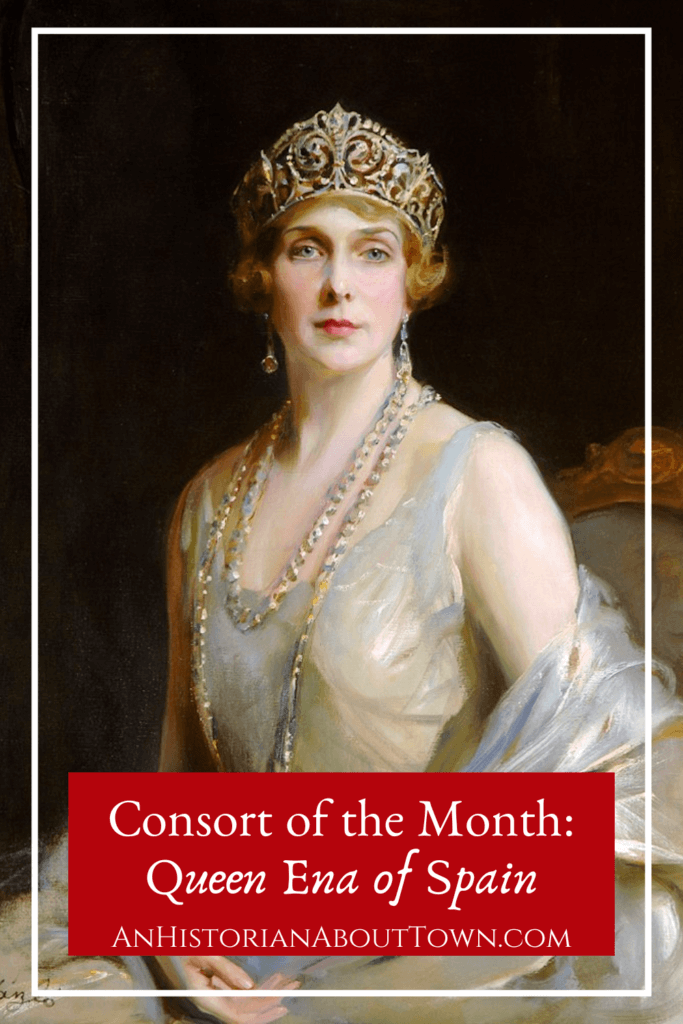
Queen Ena of Spain
Queen Mary of Modena
Sophia Dorothea of Celle
Queen Anne of Austria
Queen Louise of Hesse-Kassel
Empress Maria Feodorovna
Empress Marie Louise
Anne, Princess of Orange
♠
I hope you have enjoyed Consort of the Month: Caroline of Ansbach!
Cheers,
The Historian
Facebook | Threads | Instagram | TikTok