With the release of the first season of The Crown in 2015, the House of Windsor has been an exponentially more popular topic, and they were not unpopular prior to that. However, one of the most interesting members of the modern royal family has been left largely in the past. Queen Alexandra was only Queen for a decade, but built a massive legacy while Princess of Wales for nearly four decades before that. Let’s explore our December Consort of the Month: Alexandra of Denmark.
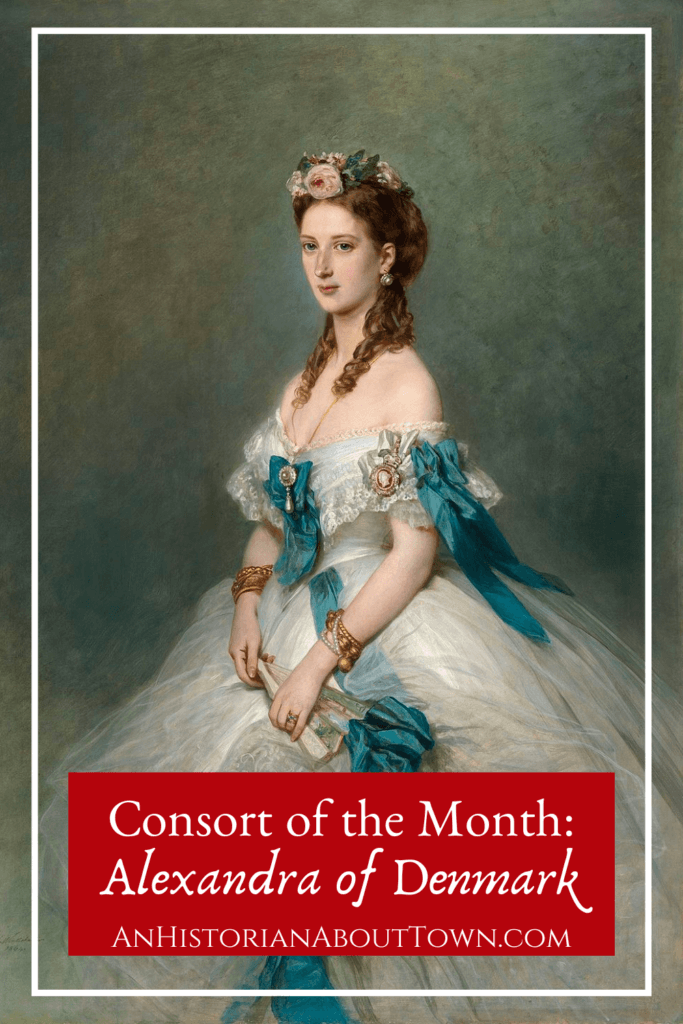
Consort of the Month: Alexandra of Denmark Fast Facts
Birth Date: 1 December 1844
Death Date: 20 November 1925
Tenure (Queen Consort): 22 January 1901 to 6 May 1910
Birth Name: Alexandra Caroline Marie Charlotte Louise Julia
Spouse: King Edward VII of Great Britain
House: Glücksburg
Father: Christian IX of Denmark
Mother: Louise of Hesse-Kassel
Why Do We Know Queen Alexandra of Denmark
If you live in Britain, you may know of Queen Alexandra through Alexandra Rose Day. To celebrate the fiftieth anniversary of her arrival in Britain, she proposed the idea of a day where roses would be sold to earn funds for specific charities. Also, if you are interested in nineteenth century fashion history, there is also a good chance you’ve heard of her (more on that below).

Alexandra of Denmark’s Early Life
Alexandra was born when her father was still Prince Christian of Schleswig-Holstein-Sonderburg-Glücksburg on 1 December 1844. She was born at the Yellow Palace in Copenhagen, the second of six children. The family lived a modest life by royal standards as they had to make do with Prince Christian’s military pension.
However, that did not mean that Alix (as her family called her) did without. The author Hans Christian Anderson would come and read his stories to Alix and her siblings, and they would receive a thorough education that included exercise, making their own clothing, and learning multiple languages.
Notably, Alix was incredibly close with her younger sister, Dagmar. There were only three years between the girls, and they did everything together.

The Perfect Bride
Queen Victoria and Prince Albert had long been mulling over the choice of a bride for their eldest son, the Prince of Wales. The Prince, known as Bertie, was rather a wild child, and the couple were keen to see him settled and to start producing heirs. They unlisted their eldest daughter and Bertie’s sister, Princess Victoria, for the task.
Princess Victoria had married into the Prussian Royal Family and was not a fan of Alix as Denmark and Prussia were at odds over several political issues at the time. However, Prince Albert decided that she was the only suitable candidate.
Bertie and Alix met in September 1861 but Bertie did not actually propose until September 1862. Notably, his father died in 1861 which would have further effects. On 10 March 1863, Bertie and Alix married in St. George’s Chapel at Windsor. Because the wedding was relatively close to Albert’s death, the court was still in half-mourning meaning that the wedding was small and everyone was required to dress in appropriately sombre clothing.

A Fashion Trendsetter
Alexandra was a fashion trendsetter from her arrival in Britain. Her mother-in-law had strong feelings about most things, including fashion though, and made specific demands for Alexandra’s wedding dress. Victoria required that the gown be made of British lace, despite Alexandra receiving a gift of Brussels lace from her uncle, the King of Belgium. (Many historians believe that Alexandra had a piece of Brussels lace sewn inside the gown.
The Royal Collection Trust describes her wedding gown as:
cream silk bodice with low drawstring neck with Honiton lace and net trim, short puff sleeves with orange blossom sprigs; the skirt with flat front and six panels, gathered into train at the back, with a wide needle-lace trim, all lined with brown silk and stiff muslin.
I’ve seen the gown in person- I was lucky enough to see it at the Royal Women exhibition in Bath, and it is incredibly well-preserved.
Young women across Britain immediately began to emulate the new Princess of Wales’ sense of style, making Alexandra a fashion icon almost immediately. Designer Charles Frederick Worth named the Princess silhouette in her honour, and when she acquired a limp from an unknown illness, women began walking with a walking stick in imitation of her.

Sisters in Crowns
Alexandra remained close with her sister, Dagmar, throughout her life. Geographically, they would be almost as far as possible for royals- Alexandra would be in Britain and Dagmar would be in Russia. Dagmar, known to her family as Minnie, was first engaged to the Tsarevitch, Nicholas, but after he died, she then married his younger brother, Alexander. (Interestingly, this exact situation would play out for Alexandra’s sons in the 1890s.)
The sisters would regularly take vacations together, cruising together on the Imperial yacht. (In the nineteenth century, most European royal families were related and spent time visiting with other royal families at multiple points throughout the year.) In Alexandra’s charity fundraiser, Queen Alexandra’s Christmas Gift Book, there are several photographs of the sisters on various vacations. (Alexandra was a dedicated and talented photographer- Catherine is not the first Princess of Wales to look through the lens!)

Life as Queen and then Queen Mother
Alexandra would not become Queen until her husband ascended the throne in 1901. While their coronation had to be postponed for a few months due to Bertie’s illness, their coronation took place in 1902.
The Queen had been dedicated to her family and charitable works as Princess of Wales, and this continued as Queen. Bertie had a wandering eye, to say the least, and had several well-known mistresses. Alexandra chose to look the other way and instead focused on their children. In 1892, their oldest son, Albert Victor, died from influenza, and she remained in half-mourning for the rest of her life.
When her son, George, took the throne in 1910, she remained active in her role as Dowager Queen. She remained staunchly anti-Prussian for all of her life, which became particularly prominent during the Great War. Alexandra died in 1925, with the last few years of life marred by illness and physical limitations.

Queen Alexandra of Denmark: Interesting Facts
– Alexandra had two kings and one empress among her five siblings.
– The Queen Alexandra Birdwing butterfly is named in honour of Alexandra. (If you play Animal Crossing: New Horizons, you will have caught this butterfly!)
-Alexandra was the longest serving Princess of Wales.
– She was passionate about woodworking, and was quite accomplished at it- her work was exhibited in galleries and exhibitions.
– The Princess of Wales was the first royal bride to be photographed in her wedding dress.
–Franz Xaver Winterhalter painted one of the best known portraits of Alexandra.
Interested in more book previews, period dramas, royal news, and more? You can subscribe to my biweekly substack newsletter here: https://substack.com/profile/34734695-anhistorian-abouttown!
Further Readings on Queen Alexandra of Denmark
Dimond, Frances. Queen Alexandra. History and Heritage Publishing, 2022.
Strasdin, Kate. Inside the Royal Wardrobe: A Dress History of Queen Alexandra. London: Bloomsbury Visual Arts, 2020.
Looking for my earlier Consort of the Month posts? Read about:
Queen Charlotte of Mecklenburg-Strelitz
Queen Marie Antoinette
Catherine de Medici
Queen Adelaide
Catherine de Valois
Marie de Guise
I hope you have enjoyed Consort of the Month: Queen Alexandra of Denmark!
Cheers,
The Historian
Facebook | Twitter | Instagram | Pinterest