Catherine de Medici, much like Marie Antoinette, remains one of those perpetually misunderstood figures. Most legends and stories of Catherine focus on her treachery and manipulation. However, she was much more complex than these stories will lead you to believe. Now that she is receiving more attention again, both in academia and in popular media, there is no better time to explore her life. Onto Consort of the Month: Catherine de Medici!

Consort of the Month: Catherine de Medici Fast Facts
Birth Date: 13 April 1519
Death Date: 5 January 1589
Tenure (Queen): 31 March 1547 – 10 July 1559
Birth Name: Caterina Maria Romula di Lorenzo de Medici
Spouse: King Henry II of France
House: Medici (birth); Valois-Angoulême (marriage)
Father: Lorenzo di Piero de’ Medici
Mother: Madeleine de La Tour d’Auvergne
Why Do We Know Queen Catherine de Medici?
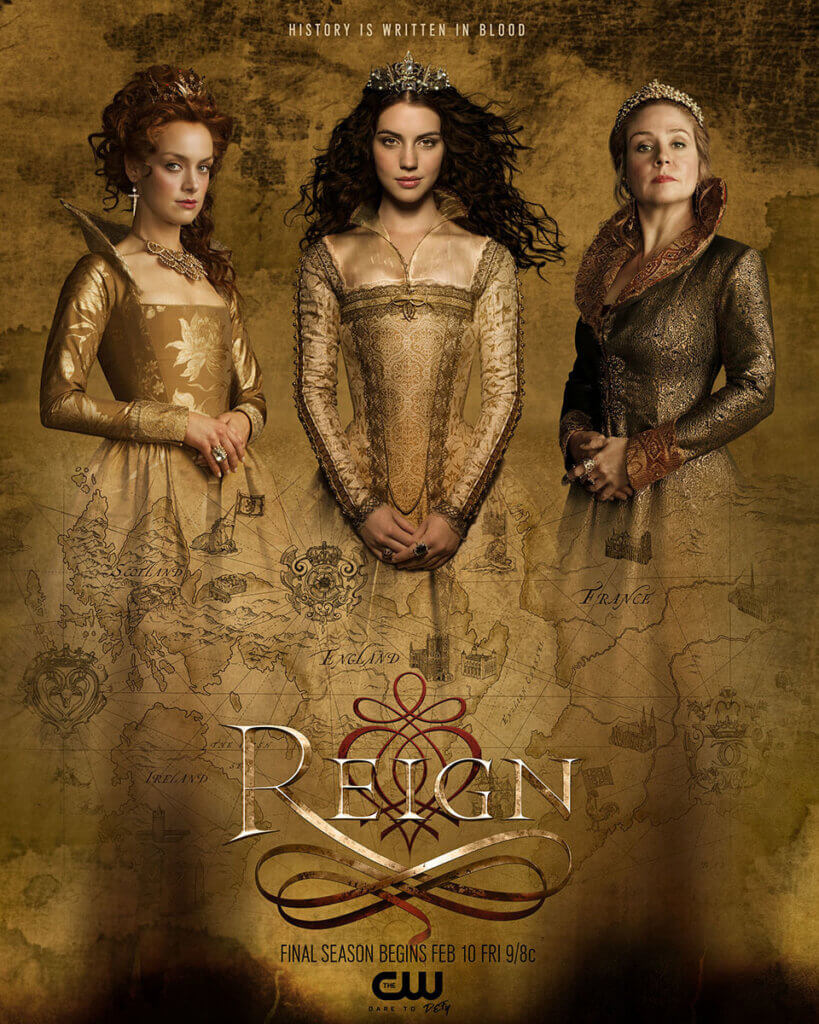
This is an interesting question about Catherine. If you aren’t into early modern history, I will guess that if you do know of Catherine de Medici, it is because of one of two TV shows. Firstly, the wonderfully melodramatic Reign where Catherine is played by the ever-talented Megan Follows. (Yes, the actor who was Anne Shirley in the amazing CBC 1980s Anne of Green Gables films.) Or if you are watching more recently, Starz just released The Serpent Queen in the autumn of 2022. (Thinking on it, neither is accurate.)
Catherine is not quite as well-known as her daughter-in-law, Mary, Queen of Scots. However, if you watch or read anything of sixteenth-century France, you will absolutely have come across her.
Queen Catherine de Medici’s Early Life
Catherine de Medici was born into the powerful Medici family in Florence in April 1519, as her name would imply. She was born to the Duke of Urbino and the Countess of Boulogne. While that theoretically should have set her up for a stable childhood, both of her parents died within a month of her birth. Her mother died of a post-partum infection two weeks after giving birth, sadly common for mothers. Her father died on 4 May; historians largely believe that it was due to syphilis.
Her grandmother first cared for the infant, but she died in 1520. The young Catherine was then raised by her aunt. Another member of the Medici family was elected pope in 1523; he was known as Pope Clement VII. She then went to live at the Vatican.
A Traumatic Childhood
I think that in 2023, “trauma” and “traumatic” get thrown around a lot when it may perhaps be a tad of an exaggeration. However, I think that “traumatic” is an accurate description of Catherine’s childhood.
In 1527, when Catherine was only eight years old, the Medici family were challenged by another faction who did not accept their rule. The young girl was taken hostage, and would go on to spend time at three different convents. Although she did have fond memories of the third and final convent she spent time at, she went through things that no child (or person) should experience.
By late 1529, the Holy Roman Emperor has marched on Florence. His troops were brutal, and they say Catherine as a target. Some suggested she be forced to serve the troops sexually, while others suggested that she be hung from the city walls on chains while naked. (Yes, this was at the age of ten/ eleven.) After the city surrendered, she was able to rejoin her family at the Vatican.

Promised to France
After Catherine’s experiences, Pope Clement understood that she needed to be married. He quickly accepted King Francis I’s proposal for his second son. The couple married in 1533, with a wildly extravagant wedding. Clement promised a massive dowry as befitting a Medici, and both sides benefited. France was happy to receive Catherine’s dowry, and Catherine was elevated from a commoner to a Princess in France.
However, Clement died in 1534 and Catherine’s dowry payments stopped shortly afterwards. Although the women of the French court had initially loved Catherine, the French King realised that she was not as helpful as he once thought she would be without her money.
A Difficult Marriage
Prince Henry and Catherine did consumate their marriage on their wedding night as was expected of couples. However, they would not conceive any children for a decade.
Henry took many mistresses throughout his adult life. (This is one thing that Reign got right!) Diane de Poitiers became his mistress in 1539, and she would exercise much of the control and authority that Catherine should have had as Henry’s wife.
Catherine gave birth to their first child in 1544, the future Francis II. She then gave birth again in 1545, 1547, 1549, 1550, 1551, 1553, 1555, and 1556.
Henry became the Dauphin in 1536 after his older brother died, and in 1547, he became King of France upon his father’s death. As explained above, Catherine had little political influence during her husband’s reign.

Queen Mother and Regent
Catherine’s real moment came as Queen Mother rather than Queen Consort. When her teenage son, Francis II, took the throne in 1559, she became Queen Mother and exercised more power during her son’s reign. Mary Stuart’s French relatives, the Guise family, largely seized power for themselves and controlled much of the government. Catherine was forced to work with them, but Francis did look to his mother for guidance.
Francis died in 1560, less than two years into his reign. Her next son became King Charles IX at only nine years old, meaning he needed a regent. Catherine was held much control of the government and was able to make most decisions. She was balancing a fraught France that was divided regionally and religiously. While she was able to keep her son on the throne, she did struggle to understand French politics. Charles was never particularly interested in ruling, so Catherine continued to exercise these powers even after Charles came of age.
Charles died at the age of 23 in 1574, and Catherine’s next son became King Henry III of France and Poland. Henry was Catherine’s favourite in the family, and when he came to throne, he was 22. Catherine did not need to act as Regent for Henry as he was an adult and needed far less assistance, but like his elder brother, he had no interest in politics and left most state business to his mother until her death in 1589.
Religious Turmoil
Catherine’s tenure as Queen Mother and Regent was marked by religious turmoil in France. Huguenots were a Protestant group in France who followed Calvinist teachings, and throughout the sixteenth century they pushed for more rights and standing. (If you are interested, I would recommend reading on the French Wars of Religion- I’m not an expert, so I don’t want to share incorrect information, but it is a fascinating period in France.)
The St. Bartholomew’s Day Massacre in 1572 was a key moment in Catherine’s time as
Queen Mother. Huguenots across France had been persecuted for decades, but this massacre was concentrated. In addition to a targeted group of assasinations, Catholics mobs hunted Huguenots, and 5,000-30,000 people were killed. (Historians are not certain on numbers. For centuries, Catherine (and her advisors) have been held responsible for the massacre. However, in recent decades, historians have challenged her role.

Catherine de Medici: Interesting Facts
-Catherine played a significant role in ballet’s development- she brought the Italian balletti to France, a courtly dance that would evolve into ballet.
-She was not a fan of Mary Stuart- while the young Scottish queen enchanted many at the French court, Catherine was not one of them.
-Pope Leo X was her father’s uncle, meaning that Catherine was not only connected to Italian and continental royalty but also the papacy. (She also was related to Pope Clement VII.)
-Catherine employed Nostradamus at court, another item that Reign got right!
Interested in more book previews, period dramas, royal news, and more? You can subscribe to my biweekly substack newsletter here: https://substack.com/profile/34734695-anhistorian-abouttown!
Further Readings on Catherine de Medici
Frieda, Leonie. Catherine de Medici: Renaissance queen of France. New York: Harper Perennial, 2006.
Goldstone, Nancy. The rival queens: Catherine de’ Medici, her daughter Marguerite de Valois, and the betrayal that ignited a Kingdom. Back Bay Books, 2016.
Paranque, Estelle. Blood, fire & gold: The story of elizabet I & catherine de medici. New York: Hachette Books, 2022.
♠
Looking for my earlier Consort of the Month posts? Read about:
Queen Charlotte of Mecklenburg-Strelitz
I hope you have enjoyed our Consort of the Month: Catherine de Medici!
Cheers,
The Historian
Facebook | Twitter | Instagram | Pinterest



Enjoyed the article. Just one thing, the caption for the first image is incorrect. Elizabeth is in the middle, not on the left: Reign — Image Number: RE_S4_KeyArt.jpg — Pictured (L-R): Rachel Skarsten as Queen Elizabeth, Adelaide Kane as Mary, Queen of Scots and Megan Follows as Catherine de Medici — Photo: The CW — é 2017 The CW Network, LLC. All rights reserved.
Hi Sydney, thanks for stopping by! In Reign, the actress that plays Elizabeth I is actually on the right there 🙂 Left to right is: Elizabeth I, Mary, Queen of Scots, Catherine de Medici (The photo credit is also from the CW, so it would stay as is!) Happy history-ing!