This is a new series for An Historian About Town, and I’m pretty excited about it. This is first Monarch of the Month post, where each post will feature a different English monarch. Two of my best friends gave me a fantastic set of Royal Flash Cards that feature all 59 monarchs of England. (They just get me.) I decided to feature one monarch a month, randomly drawing them. I’m going to give all of the pertinent information on the monarch and the highlights. (Not a full biography, as some of them would warrant an entire blog dedicated to them.) You will find some interesting facts, some things you probably didn’t know, and what their legacy is. And we start with our first Monarch of the Month: Mary I!
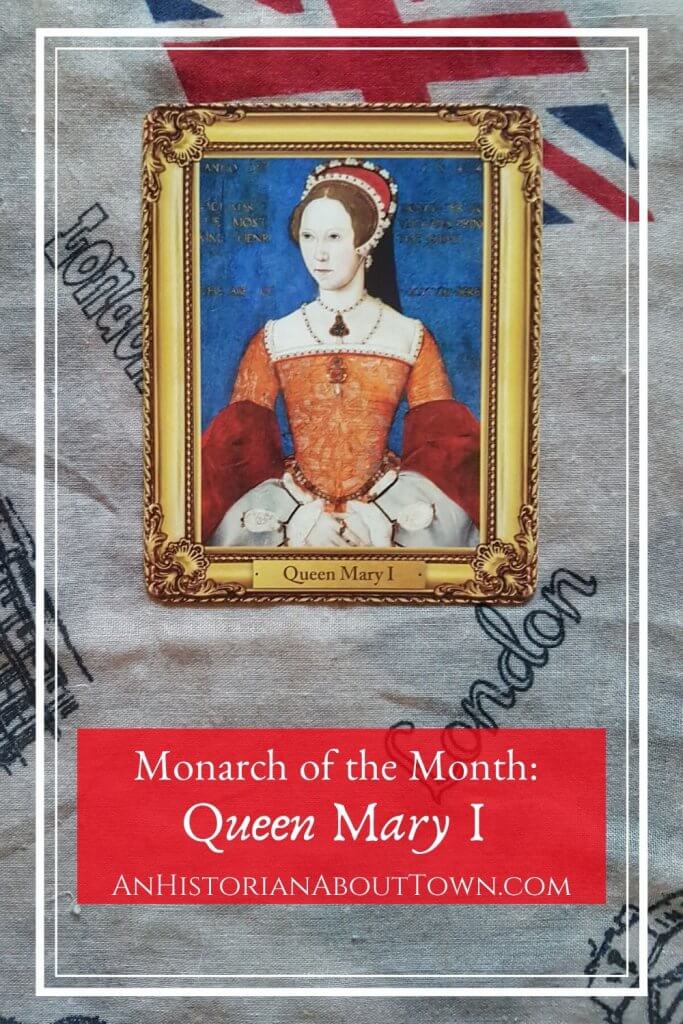
My goal with this series is to give an introduction and an update to the kings and queens that you may or may not about. Some of them are quite well known to us, while others aren’t at all. So, while I am sure that you have at least heard of Mary I, there is still undoubtedly some you don’t know! I’ve always been a fan of Mary. I can certainly understand why people love Elizabeth as much as they do, but I think that Mary is unfairly left behind and mocked for her sister. She achieved much in her own right, and set the stage for Elizabeth to be Queen herself. Had Elizabeth been the first Queen Regnant, I don’t know if her reign would have been the same. So, without any further delay, on to our Monarch of the Month: Mary I…
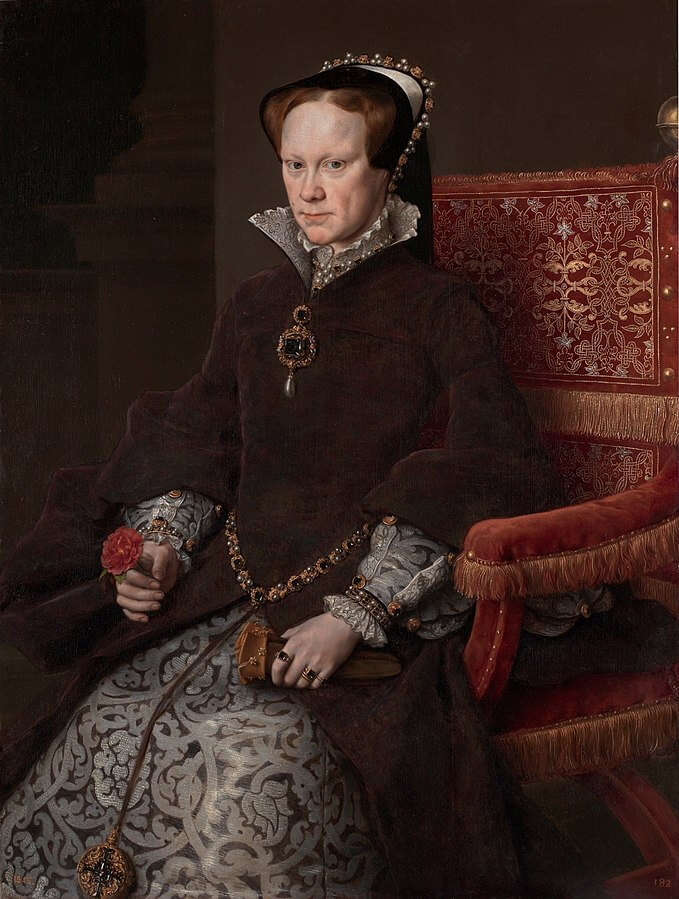
Monarch of the Month: Mary I Fast Facts
Birth Date: 18 February 1516
Death Date: 17 November 1558
Reign: 19 July 1553- 17 November 1558
Coronation Date: 1 October 1553
Predecessor: Lady Jane Grey
Successor: Elizabeth I
House: Tudor
Father: Henry VIII
Mother: Catherine of Aragon
Spouse(s): Phillip II of Spain (Co-Monarch)

Why Do We Know Mary I?
Mary I was the daughter of Henry VIII and Catherine of Aragon, his first wife. Meaning that she was the older sister of Elizabeth I, the Queen that everyone remembers. And so Mary is remembered in relation to her sister. Oh, Bloody Mary, the myth that children are fed… so they don’t say the name into mirrors? (Not sure what the point is.)
Yes, Mary executed over 300 people as religious heretics for not adhering to the Catholic faith. However, Elizabeth also executed hundreds of people in her reign, instead as traitors rather than heretics. (Henry VIII executed more than either one of them.) And given that Elizabeth reigned for over 40 years, and England is still technically Protestant, the idea of the barbaric Catholic queen murdering everyone stuck.

Mary I’s Early Life
Mary was Catherine and Henry’s fifth pregnancy, and the first child to live beyond a few days. (None of the children conceived after would survive.) She was a precocious and intelligent child, and would impress members of the court and visiting dignitaries with her musical talents and dancing from a young age. Mary was educated to be a future queen, be it of England or another nation (if Henry got that longed for son…), and understood English, French, Spanish, Latin, and potentially Greek. She spent three years in Wales from 9-12 as a de facto Princess of Wales (though did not receive the title). She joined Henry’s court after that. Once Henry had decided to give up Catherine for Anne Boleyn, life cahnged drastically for Mary.
Mary refused to acknowledge her father as the head of the Church of England, and Anne Boleyn as queen. Given that he had cast her mother aside, Mary only had the status of a bastard. She was sent away quickly, and would serve her sister Elizabeth as a Lady in Waiting. Henry did not allow Mary to visit Catherine when she was dying, and she refused to speak with him for three years. Jane Seymour, his third wife, encouraged the two to make up, and they did.

Mary I’s Adulthood
Still firmly Catholic, Mary spent most of her brother, Edward VI’s reign on her own estates. After an attempt to reconcile with Edward and Elizabeth ended with Edward embarrassing Mary for not observing the Protestant faith, she mostly kept to herself. She didn’t have that long to wait, though, as Edward died in 1553. He wanted Lady Jane Grey to succeed him on the throne, but Princess Mary had quite a strong base of support in the North. On 3 August 1553, Queen Mary processed through London to see the huge crowds cheer her on.
Unfortunately, Lady Jane Grey and her husband would need to go, and both were beheaded at the Tower. Mary had decided on Phillip of Spain for her husband, and Sir Thomas Wyatt led 200 rebels to London to protest the foreign, Spanish, Catholic marriage. Well, 46 of those rebels also had to go. And the very unfortunate part? The marriage was a disaster. Mary was in love with Phillip, but he couldn’t stand her. She was aged beyond her years due to never-ending stress, and fairly highly strung. She thought she had conceived right after the wedding, and showed what seemed to be a pregnancy. However, it was either a phantom pregnancy or a tumour. She would die from this tumour in November 1558.

Mary I: Interesting Facts
– James I had Elizabeth’s coffin placed on top of Mary’s in Westminster Abbey, with the monument dedicated to Elizabeth and only a mention of Mary.
-Mary was the first English Queen Regnant in her own right, and her Act for Regal Power in 1554 gave queens the same rights as kings.
-Although she was a staunch Catholic, she loved dancing, singing, fashion, and gambling!

Jane Austen’s Take on Mary I
The History of England by a partial, prejudiced & ignorant Historian by Jane Austen is one of my favourite writings of all time. In her youth, Austen wrote this quirky and entirely prejudiced history of English monarchs. She covers Henry IV through the death of Charles I, so I will include her take on them if she has one. It’s quite humorous, as she does not hide her feelings for any of them.
This Woman had the good luck of being advanced to the throne of England, inspite of the superior pretensions, Merit, & Beauty of her Cousins Mary Queen of Scotland & Jane Grey. Nor can I pity the Kingdom for the misfortunes they experienced during her Reign, since they fully deserved them for having allowed her to succeed her Brother- what was a double peice of folly, since they might have foreseen that, as she died without children, she would be succeeded by that disgrace to humanity, that pest of Society, Elizabeth. many were the people who fell Martyrs to the Protestant Religion during her reign; I suppose not fewer than a dozen. She married Philip King of Spain who in her Sister’s reign was famous for building Armadas. She died without issue & then the dreadful Moment came in which the destroyer of all comfort, the deceitful Betrayer of trust reposed in her, & the Murderess of her Cousin succeeded to the throne.
(I have used the Quince Tree Press version, there are no page numbers. If you would like to find it, the ISBN is 9780900847882.)
Further Readings
Whitelock, Anna. Mary Tudor: England’s First Queen. Bloomsbury, 2010.
Edwards, John. Mary I: The Daughter of Time. Penguin Books, 2018.
Weir, Alison. The Children of Henry VIII. Balantine Books, 2008.
Lewis, Brenda. Dark History of the Kings and Queens of England: 1066 to the Present Day. Amber Books, 2008.
Rex Factor Podcast, Mary I episode.
There is our first Monarch of the Month, Mary I; what do you think of Mary I?
Cheers,
The Historian
Facebook | Twitter | Instagram | Pinterest | Bloglovin’

Really interesting! As a lover of history, I absolutely love reading about Tudor history. Mary I is a queen I know little about with regards to her adult years and reign. This was very interesting, thank you 🙂
I’m so happy that you enjoyed it!! The Tudors are so popular, but we only seem to see the same few things over and over!
I’m glad you started with someone other than Elizabeth I (that it’s Mary I is just better). Elizabeth I is so obvious so it’s nice that you chose a) another female monarch and b) her sister.
Haha, I used a random generator so I can’t take credit for the choice! But I do think that Mary gets left behind for Elizabeth far too often, so I was happy when luck gave me Mary 🙂