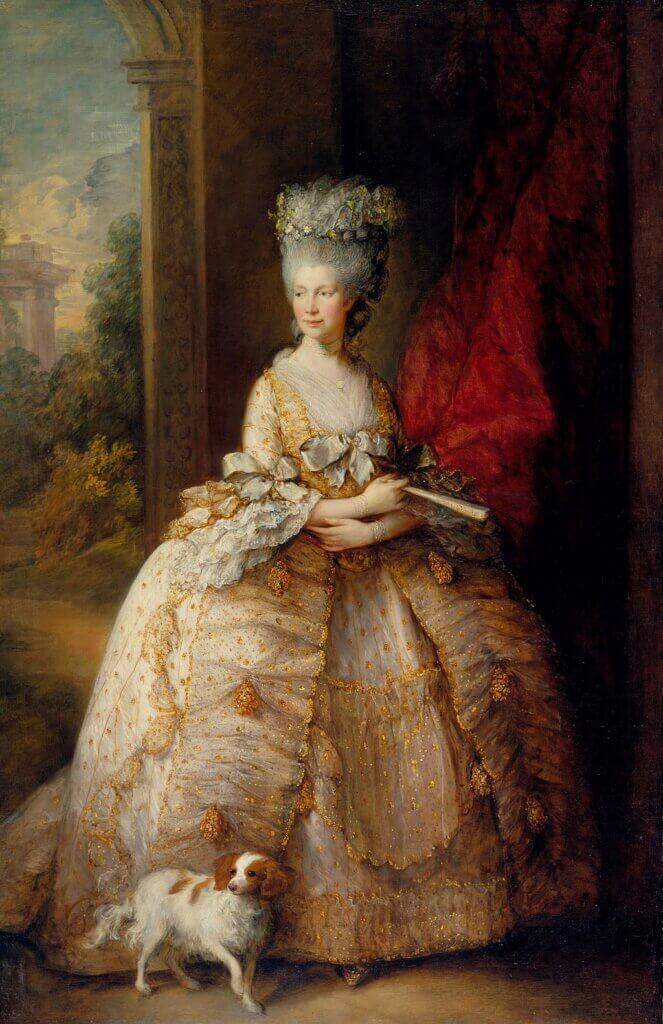
With the upcoming Queen Charlotte Netflix series (The Bridgerton prequel series), Queen Charlotte has never been more popular. The wife of George III and the mother of George IV and William IV (and ten other surviving children), Charlotte’s legacy is still felt within the Royal Family now. She is often forgotten for her husband’s madness and her son’s Regency, though. Onto our Consort of the Month: Queen Charlotte of Mecklenburg-Strelitz and give her her time in the spotlight before Queen Charlotte premieres!

Consort of the Month: Charlotte of Mecklenburg-Strelitz Fast Facts
Birth Date: 19 May 1744
Death Date: 17 November 1818
Tenure: 8 September 1761- 17 November 1818
Birth Name: Charlotte Sophia of Mecklenburg-Strelitz
Spouse: King George III of Great Britain and Ireland
House: Hanover (by marriage)
Father: Duke Charles Louis Frederick of Mecklenburg-Strelitz
Mother: Duchess Elisabeth Albertine of Saxe-Hildburghausen
Why Do We Know Queen Charlotte of Mecklenburg-Strelitz?
Firstly, Netflix’s Bridgerton has brought her into wider public attention with the gossiping royal matriarch catching everyone’s eye. Golda Rosheuvel has made her one of the most beloved characters of the series despite relatively little screen time, and we are all lucky for her.
Secondly, her ancestry has been a question within the historical world for the last decade and a half. A Spanish historian in the late 2000s suggested that Charlotte was descended from Black members of the Portuguese royal family and that portraits of her show typically Black physical characteristics.* The theory has gained traction online with shows like Bridgerton adopting it; many historians question the reality of it, and it continues to spark debate.
*I personally do not work in genealogical studies nor genetics and do not have a comment on this either way. (I leave that to the experts.)

Queen Charlotte’s Early Life
Charlotte Sophia was born to the Duke of Mecklenburg-Strelitz and Princess Elisabeth Albertine of Saxe-Hildburghausen in 1744 at Untere Schloss in Mirow. We do not have an excess of information about her childhood, but it was remarked that Charlotte’s education was not particularly in-depth. (It would have been similar to that of the daughter of a lower English aristocrat.) She learned some botany, some natural history, languages, and religious studies.
Moving Quickly
King George III ascended the throne at age 22 when his grandfather (George II) died in October of 1760. Understandably, George needed a consort and his advisors looked to the royal houses of Europe to find a match.
The young Princess Charlotte Sophia of Mecklenburg-Strelitz appealed to George for a number of reasons, with the main one being her social position. Given that she was essentially from the European backwaters (my words), there was little chance that she would meddle politically in George’s court or government.
Charlotte landed on English soil on 7 September 1761, met George in the morning on 8 September, and the couple was married by 9:00pm on the 8th.

Studio of Joshua Reynolds, Public domain, via Wikimedia Commons
A Rocky Start to a Reign
Charlotte and George had a joint coronation on 22 September 1761, a mere two weeks after they were married. When Charlotte had arrived in England, she did not speak any English. While she did learn it rather quickly, it was not by their coronation. And the issues did not end with a lack of a common language among all participants.
There were no chairs for George and Charlotte when they arrived at the Abbey, nor was there the Sword of State. They also left St. James’ Palace at 9:00 am and didn’t arrive at the Abbey until 1:30 pm. And although there were massive crowds ready to see the young King and Queen, many onlookers were unable to see anything due to the number of soldiers lining the route. (I know that in 2023 we expect coronations to be meticulously planned events, but that was not the reality for much of history.)

A Full Family Needs a Home
Only eleven months after the couple married, Charlotte gave birth to their first child. The future King George IV was born in August of 1762. She would give birth again in 1763, 1765, 1766, 1767, 1768, 1770, 1771, 1773, 1774, 1776, 1777, 1779, 1780, and 1780. Yes, Charlotte gave birth to fifteen children. And miraculously for the period, thirteen of them survived to adulthood. Two of her sons sat on the throne, George IV (born in 1762) and William IV (born in 1765).
In anticipation of a large family, George bought the-then Buckingham House as a family home. It originally belonged to the Duke of Buckingham, but he bought the country estate to allow for more space. In the 1760s, Buckingham House was actually surrounded by acres of parks and somewhat of a retreat compared to St. James’s Palace. (Much of the work to create the Buckingham Palace that we now know was done in later reigns.)

Mozart and More
Charlotte was a dedicated patroness of the arts, particularly music. Unsurprisingly, she favoured German composers and was a dedicated fan of Georg Frideric Handel. (Yes, Handel would go on to compose “Zadok the Priest”, one of the most well-known pieces of music related to the British Royal Family.) Johann Christian Bach, son of the famed composer Bach, served as Charlotte’s music master. She also saw an exceptionally talented eight-year-old Mozart play when he was touring in England.

An Unstable King
George III is largely known for his madness. Historians have posited several different diseases and afflictions that may have affected him, but he went through several periods of mental instability throughout his reign. While he had a brief bout in 1765, his first episode bega in 1788 and lasted a year, and again in 1801. However, in 1810, he permanently descended into instability and would not return to his former self.
Understandably, this has a massive effect on Charlotte’s life. He would become quite frightening during his episodes, speaking frantically and oftentimes hugging his wife and children and refusing to let them go. While it was suggested that Charlotte stay at Buckingham Palace or the Queen’s House with her daughters, she insisted that they live at Kew Palace with George while he received his treatment.
As time wore on, Charlotte began to change under the pressure and stress of her husband’s illness. The Prince of Wales acted as Regent for his father (henceforth the Regency period), with Charlotte watching over the family. She had been a lively woman fond of music and entertainment but in her later years suffered from depression. Many of George and Charlotte’s children were strong personalities with their own plans and Charlotte’s relationships with several of them deteriorated.
She died in 1818 as the longest-serving female consort in British history and the second-longest-serving consort (after Prince Philip).

Charlotte of Mecklenburg-Strelitz: Interesting Facts
-Charlotte, North Carolina was named after Queen Charlotte.
-While she supported many composers, she actually was a musician herself and played the harpsichord.
-Charlotte actually had a close relationship with French Queen Marie-Antoinette, and the two had a lengthy correspondence.
-The first debutante ball was held in 1780 to celebrate Queen Charlotte’s birthday, and happened annually for nearly 200 years. (It has been revived again in the twenty-first century.)
Interested in more book previews, period dramas, royal news, and more? You can subscribe to my biweekly substack newsletter here: https://substack.com/profile/34734695-anhistorian-abouttown!

Further Readings on Queen Charlotte of Mecklenburg-Strelitz
Curzon, Catherine. The Real Queen Charlotte: Inside the Real Bridgerton Court. Yorkshire: White Owl, an imprint of Pen & Sword Books Ltd., 2022.
Hadlow, Janice. A Royal Experiment the Private Life of King George III. New York, NY: Henry Holt and Company, 2014.
Norrie, Aidan, Carolyn Harris, J. L. Laynesmith, Danna R. Messer, and Elena Woodacre. “Charlotte of Mecklenburg-Strelitz: The Enlightened Nurturer.” Essay. In Hanoverian to Windsor Consorts: Power, Influence, and Dynasty. Cham, Switzerland: Palgrave Macmillan, 2023.
♠
Looking for my earlier Consort of the Month posts? Read about:
Empress Eugenie of France
I hope you have enjoyed our April Consort of the Month: Queen Charlotte of Mecklenburg-Strelitz!
Cheers,
The Historian
Facebook | witter | Instagram | Pinterest