This week many of us have cracked open our Advent calendars! Advent calendars have made a big resurgence in the last decade. If there is an item, there is an Advent calendar around it. Beer advent calendar? Yup. 24 pairs of socks? You got it. Short stories? The readers are covered! However, Advent calendars haven’t always been the often expensive and flashy tradition that they are today. So, today we are looking at the history of Advent calendars and how they ended up where they are now!

The Different “Days” of the Season
Given that many of us celebrate a secular Christmas rather than a religious one, the “days” of the season tend to get a bit muddled or lost in translation now. I’ve seen many snarky Tweets and Facebook posts swiftly and condescendingly correcting people, but do not feel bad about mixing things up. (The world will not end if you put the 12 days of Christmas on the wrong dates…)

Advent
This is the period or season of preparation for celebrating Jesus’ birth. Historically, Advent hasn’t had a set time length. At very points, it was as short as a few weeks to as long as six weeks starting with St. Martin’s Day (11 November). “By the 13th century, Advanet had become a four-week fast with activities such as marriage, games, feasting, and sex forbidden, but these restrictions were abolished in the 20th century, and the season is now one of reflection and spiritual preparation.” (Encyclopedia, 3) In a secular context now, Advent is the 24 days preceding Christmas Day- 1 December to 24 December.
The 12 Days of Christmas
The 12 days of Christmas is the period between Christmas and Epiphany (6 January). Depending on where you are, it is calculated differently- some places will use Christmas Day as the first day, while others use 26 December. There are many “mini” 12 day Advent calendars available now, which makes it a little difficult to follow! (Just remember, they got all of those birds and people in-between Christmas and Epiphany, when we normally have parties and gather.)
Now that we have clarified, onto the history of Advent calendars!

What is an Advent calendar?
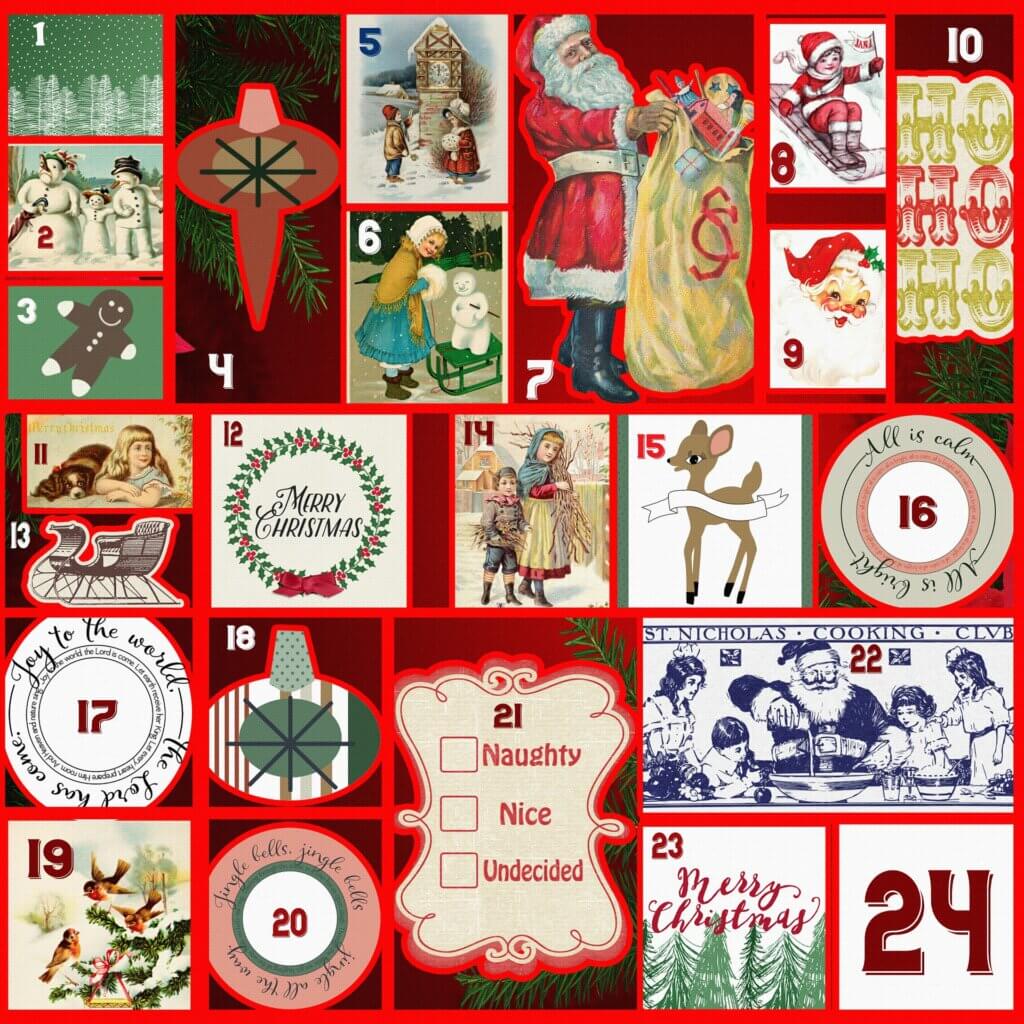
Simply put, an Advent calendar is a calendar that marks the days remaining until Christmas. It can be a regular physical calendar, one with doors or drawers, or even boxes.
The Early History of Advent Calendars
According to The World Encyclopedia of Christmas,
The notion of graphically depicting the time until the arrival of Christmas seems to have begun in 19th-century German homes. Some families marked chalk or paint lines on the floor as Christmas approached, others hung a different devotional picture on the wall or lit a new candle every day beginning December 1. Homemade Advent calendars appeared about 1850, with each day from December 1 to 24 marked by a Bible verse, a sweet, or a drawing. (Encyclopedia, 3)
As with many of our modern Christmas traditions, it begins in Germany! Closer to the people who use a regular calendar to note Advent nowadays, for the most part, this would have been fairly economical. While lighting a new candle each day could be costly, hanging pictures or marking chalk would be very economical.

The First Commercial Advent Calendar
We don’t see the first commercially produced Advent calendar until 1903. Gerhard Lang created the Münchener Weihnachtskalender (the Munich Christmas Calendar), after being inspired by his mother’s homemade calendar of sweets hung on cardboard. Other German publishers quickly followed. “By 1914 Germany was exporting ornate Advent calendars in numerous designs involving winter landscapes, Christmas trees, town scenes, or castles”. (Encyclopedia, 3.) Surviving calendars from the early twentieth century are now rare collectors’ items.
Many people now will claim that Advent calendars with pictures inside are the “right” kind of calendar. While there isn’t a “right” or “wrong” Advent calendar, these are the traditional Advent calendars.

Modern Advent Calendars
With the arrival of more modern Advent calendars, we start to seeing more inside of the doors. I’ve seen 1951 and 1958 cited as the first appearance of an Advent calendar with chocolate inside, though no one provided concrete proof. (Let’s just say they appeared for sale in the 1950s!) Other calendars will include fudge or candy canes, or even small toys. “Advent calendars are particularly popular in Scandinavia, where various tie-ins with television programs both entertain and raise money for charitable causes.” (Encyclopedia, 3)

Luxury Advent Calendars
In the twenty-first century, luxury Advent calendars are all the rage. They are particularly prevalent in the UK, but in Western society, you can find luxury advent calendars that range from $50-$300, promising however many hundreds of dollars of products inside. Beauty Advent calendars with skincare and makeup, Lego calendars with different figures and items, even Funko pop Advent calendars with 24 characters. In North America, we don’t tend to see many Advent calendars that exceed the $50 range. However, in the UK, it is entirely normal an Advent calendar for £250 that sells out in pre-order.
As an historian, these luxury Advent calendars elude me- I can’t place when they exactly started, but I’m going to go with firmly in the twenty-first century. I am going to continue researching this, and will update with more information when I’ve found it. (If you know when these luxury Advent calendars started appearing widely, please let me know!)
I admit, I bought one of these for myself this year. I splurged and bought myself the Whittard’s Tea Advent calendar, and I’m thrilled to pieces with it. You get four teabags for each day, save for one day, a lovely ceramic teabag holder, and a gorgeous Art-Deco calendar which I will be keeping. (You can see which tea I have each day on my IG stories.)

Advent calendars are only one of countless holiday traditions that you can enjoy at home no matter what is happening in the world, and I’ve got many more in my holiday guide. I have all the historical inspiration you will need for your holiday season, including decorating ideas, book recommendations, and traditions to start. This year can be an incredible and special holiday season for you, no matter where you are or who you are with! You can purchase it here!

The history of Advent calendars is quite interesting to me, and I think it is fascinating to look at how many of our Christmas traditions began in Germany. Do you have an Advent calendar?
Cheers,
The Historian
Facebook | Twitter | Instagram | Pinterest | Bloglovin’

Yes, I have a homemade Advent Candle with felt pieces that come out of the pocket for each day and are placed into the manger above. What a delightful post. I hope you don’t mind if I share it in a weekly e-news that I send out.
Hi Jeff! Your Advent Calendar sound wonderful 🙂 And yes, feel free to share it!!