We return with more women’s history! It is becoming more and more obvious that women’s history needs our attention and support, and that includes in royal history. Unsurprisingly, Queen Victoria’s children and granddaughters made up a large number of consorts in the second half of the nineteenth century and the first half of the twentieth, and today’s consort is no exception. Let’s get into one of the most well-connected consorts of the twentieth century: our April Consort of the Month: Queen Ena of Spain!
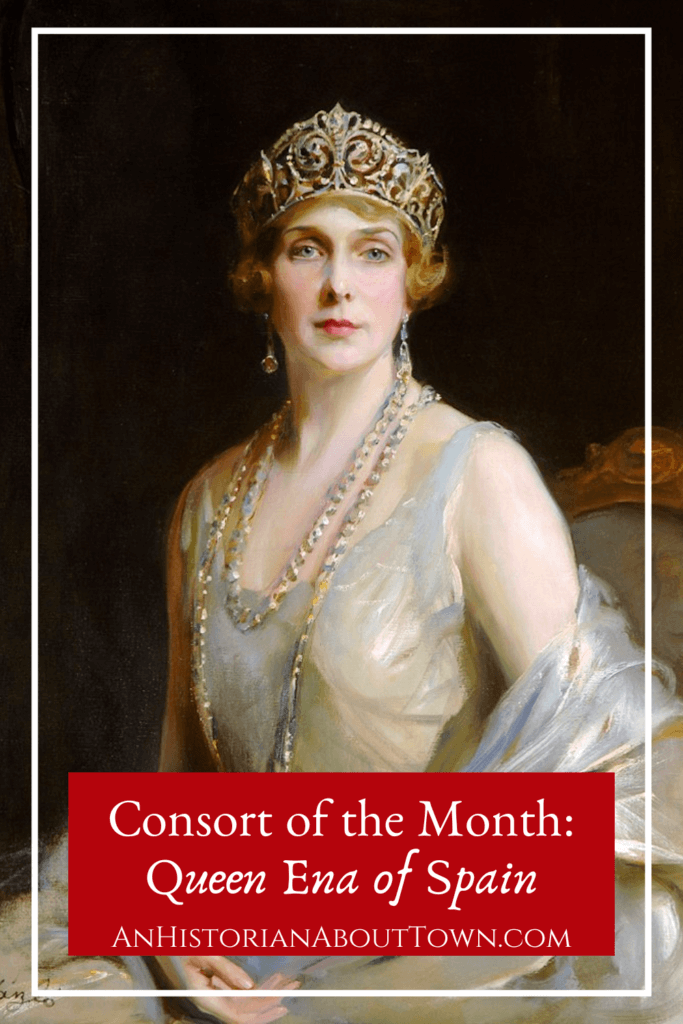
Consort of the Month: Queen Ena of Spain
Birth Date: 24 October 1887
Death Date: 15 April 1969
Tenure: 31 May 1906 – 14 April 1931
Birth Name: Victoria Eugenie Julia Ena
Spouse: Alfonso XIII of Spain
House: Battenberg
Father: Prince Henry of Battenberg
Mother: Princess Beatrice of the United Kingdom
Why Do We Know Queen Ena of Spain?
Queen Victoria Eugenie, more commonly known as Queen Ena, is not particularly well known outside of Spain. However, in Spain, she is more well-known. Her grand-son, Juan Carlos, became King Juan Carlos I when the Spanish monarchy was restored. There are also several geographical landmarks named for her, in addition to several bridges and buildings.
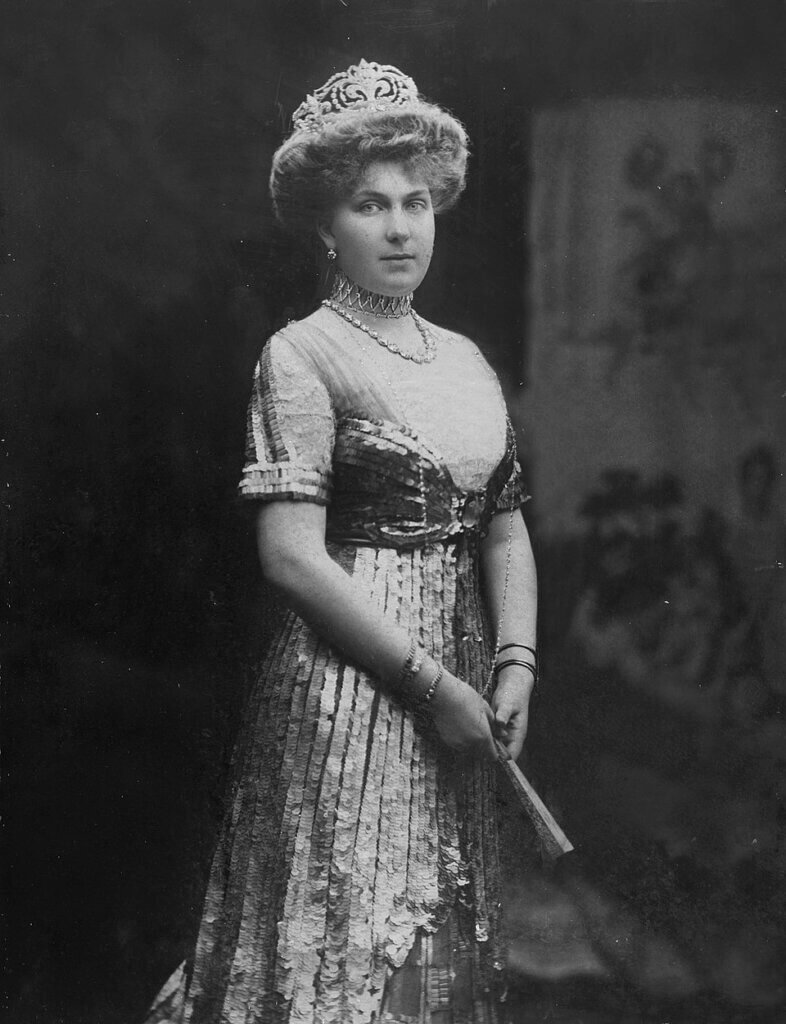
Queen Victoria Eugenie of Spain’s early Life
Victoria Eugenie- known as Ena- was born to Prince Henry of Battenberg and Princess Beatrice of the United Kingdom, Queen Victoria’s youngest daughter. Her godparents included Empress Eugenie, the future Empress of Germany, and the Duke of Edinburgh.
Beatrice was only allowed to marry if she remained at Victoria’s side, meaning that the young princess and her siblings grew up in Victoria’s household. Although Ena should have been styled as a “Serene Highness” due to her father being from a morganatic royal branch, Queen Victoria issued a Royal Warrant granting her the “Royal Highness” style (as well as her siblings). Because she spent her childhood living with her grandmother, she was very close with many of her cousins and her aunts and uncles. In 1893, she was a bridesmaid at the wedding of the future King George V and Queen Mary.

The Blonde Princess
Ena was considered to be a great beauty, especially with her light blonde hair. When King Alfonso of Spain was in London during a State Visit, Ena was invited to the State Dinner. Although he wasn’t actually seated beside her, he was immediately infatuated with the 17 year old Princess and began to pursue her.
This was not the smoothest start to a royal courtship. Alfonso was the Catholic monarch of a very Catholic nation, and Victoria Eugenie was a Protestant princess, the grand-daughter of the head of the Church of England. It also had become somewhat obvious that haemophilia ran in Queen Victoria’s family and it was very possible that the teenage princess was a carrier. However, Alfonso and Ena ignored both of these issues and the engagement was settled in the spring of 1906.

A Bloody start to marriage
After converting to Catholicism, the wedding date was set for 31 May 1906. The couple wed at the Church of Saint Jerome the Royal in Madrid. The ceremony was well-attended, with her mother, siblings, and some of her cousins in attendance (including George and Mary). However, the day took a terrifying turn.
While the couple was processing back to the Royal Palace in their carriage following the ceremony, an anarchist threw a bomb at them. Ena was luckily saved as she had turned to look out the other window, but the guard beside their carriage was not as lucky. Twenty four people died and over one hundred were wounded. The couple were able to change carriages and carry on but when they appeared on the balcony to greet the crowds, Ena was still covered in blood spatter.
A Family Spectre Appears
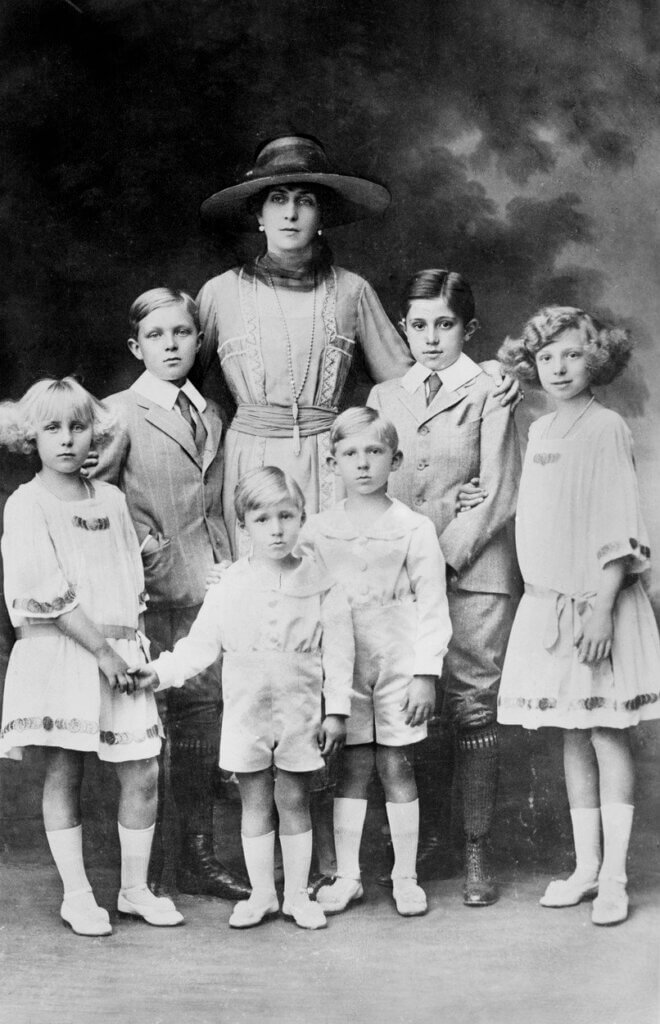
While Alfonso chose to marry Ena because it was not guaranteed that she would be a carrier of the haemophilia gene, she unfortunately did end up being a carrier. Their much hoped-for heir, Alfonso, was born on 10 May 1907 and suffered from haemophilia. He and one of his brothers were forced to wear padded clothing to help protect them from injuries that might cause internal bleeding. King Alfonso did not accept the diagnosis, though, and although the couple had six children together, he never forgave Ena for being a carrier.
Alfonso had several extramarital relationships and had at least five illegitimate children, possibly more. Ena had not been popular after marrying him, and she retreated further with their rapidly deteriorating relationship.

Life in Exile
The Spanish King and Queen voluntarily took their family into exile in 1931 when a new Republican government came to power. The family first lived in France and then in Italy, but they would eventually scatter. Alfonso and Ena separated, with Alfonso living mostly in Italy and Ena splitting her time between the United Kingdom and Switzerland. He died in 1941 from a heart attack.
In 1968, Ena returned to Spain for her great-grandson’s christening- he would go on to become King Felipe V of Spain in 2014 upon his father’s abdication. Ena died on 15 April 1969.

The Joyas de Pasar
One of Queen Ena’s greatest legacies is the joyas de pasar. It is a collection of jewels that originally belonged to Ena and now belong to the Spanish Royal Family privately, rather than as a part of the state-owned Regalia. These pieces can only be worn by the Queen of Spain and include a fleurs-des-lis tiara, a diamond collet necklace, a long-strand pearl necklace, and a large diamond brooch. (You will often see Queen Letizia wearing pieces for state events.)

Queen Ena of Spain: Interesting Facts
– Ena was Queen Victoria’s youngest grand-daughter.
– Her Catholic education was largely carried out at Versailles.
– In 2012, one’s of Ena’s Cartier bracelets sold at Sotheby’s for $3.4 million USD.
Interested in more book previews, period dramas, royal news, and more? You can subscribe to my biweekly substack newsletter here: https://anhistorianabouttown.substack.com/!
Further Readings/Listenings on Queen Ena of Spain
Sagrera, Ana de, Dorward Stewart, John Van der Kiste, Sue Woolmans, and Ricardo Mateos Sáinz de Medrano. Ena and Bee: Queen Victoria’s Spanish granddaughters. Oxford, UK: Fonthill Media, 2022.
The Other Half of History podcast. “Ena of Battenberg (2) Oh what a life for the Queen of Spain!”
Looking for my earlier Consort of the Month posts? Read about:
Queen Charlotte of Mecklenburg-Strelitz
Queen Marie Antoinette
Catherine de Medici
Queen Adelaide
Catherine de Valois
Marie de Guise
Queen Alexandra of Denmark
Empress Josephine of France
Queen Elizabeth of York
Queen Elisabeth de Valois
Queen Catherine of Braganza
Queen Caroline of Brunswick
Queen Josephine of Leuchtenberg
Elizabeth Stuart
Queen Elisabeth of the Belgians
Saint Margaret of Scotland
Queen Maud of Wales
Empress Sisi of Austria
Queen Marie of Romania
Queen Astrid of Belgium
Queen Maria Eleanora of Brandenburg
I hope you have enjoyed Consort of the Month: Queen Ena of Spain!
Cheers,
The Historian
Facebook | Threads | Instagram | Pinterest