We return again for our theatre history series! Which reminds me: if you know of anyone interested in the theatre, the ballet, or the opera, please send this along! We are really becoming a niche community unfortunately, and I would love for this to reach anyone who might be interested. (And while I’m at it- check out your local theatre and dance performances!) Anyways, back to historic theatres! Is it a European theatre if it wasn’t opened by a royal? Probably not, and today’s theatre is no different. We go to the heart of the Austro-Hungarian Empire, to Franz Joseph and Sisi’s opera house. We are exploring the history of the Vienna State Opera!

The birth of the Vienna Court Opera
You will notice that the name of the opera house is different from what we know it as now. In the late 1850s, the city of Vienna was rapidly expanding and a new opera house was needed. There was a “Vienna Court Opera” inside the Hofburg Palace originally built in 1636, with this new theatre replacing it.
Emperor Franz Joseph chose the site, on the new Ringstrasse (large boulevard); Viennese architects August Sicard von Sicardsburg and Eduard van der Nüll won the architectural competition and designed the Neo-Renaissance building. Building commenced in 1861 with the Emperor footing the bill and finished in 1869. The opera house officially opened on 25 May 1869 with Emperor Franz Joseph and Empress Elisabeth “Sisi” in attendance. (It was Mozart’s Don Giovanni, if you are curious.)
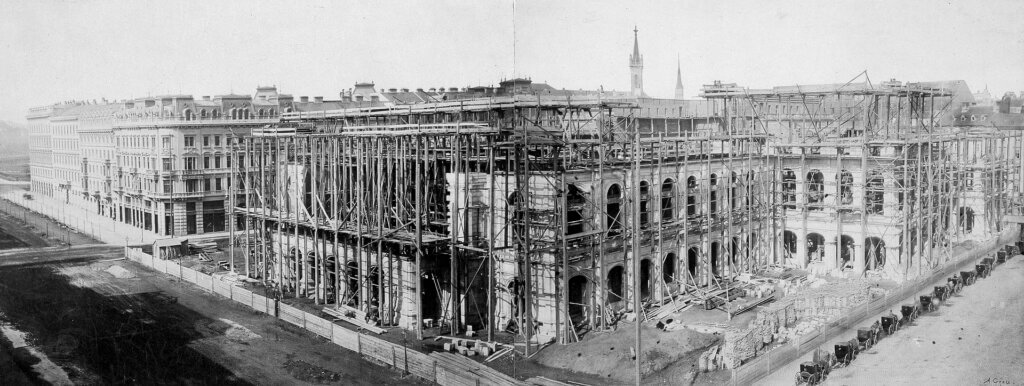
Not quite it…
The new opera house was not overly loved by the public. It sat slightly lower than the Ringstrasse, leading to it being referred to as a “sunken box”. The mixed style of ornamentation was also publicly mocked, with someone even making up a rhyme,
Sicardsburg and van der Nüll
They don’t have the right style
Whether Gothic or Renaissance
It’s all up to the Lord
The architects were so heavily criticised that one took their own life and the other died shortly after the building was completed. While that seems extreme to us now, opera was a major element of society- it was where you went to see and be seen.
The Fall of an Empire
With the fall of the Austro-Hungarian Empire in 1918, there was no court, therefore there could not be a court opera. Its second name was the “Operntheater” but was eventually renamed the “Wiener Staatsoper” or the Vienna State Opera (the current name).

The Opera under the National Socialist regime
The Nazi government annexed Austria in March 1938 and life changed immediately in Vienna, including at the opera house. Most Jewish employees or artists, as well as many other groups that were considered “undesirable” under the National Socialist regime were forced out and often faced persecution. And while that was happening, those artists who aligned themselves with the party found their stars rising quickly at the Vienna State Opera.
Along with that, the actual pieces performed and created under the regime changed greatly, with personnel. The Nazi party utilised culture in the propaganda campaigns, and that included opera.
From the Opera’s site,
One of the more bizarre episodes in the history of the Staatsoper during this period was the premiere of Richard Strauss’ Friedenstag on 10 June 1939. This opera, which deals with peace, was performed in the presence of Adolf Hitler, symbolizing the perverse intertwining of art and ideology at the time. Interestingly, a singer at this performance criticised the situation in a private act and wrote the word “war” on one of his piano scores, which is a subtle form of resistance.
Note: I would recommend visiting the Vienna State Opera’s own site for more info on their history. A lot of sites, including Wikipedia, omit the period under the Nazi party and it is a fairly glaring omission.

Damage During the War
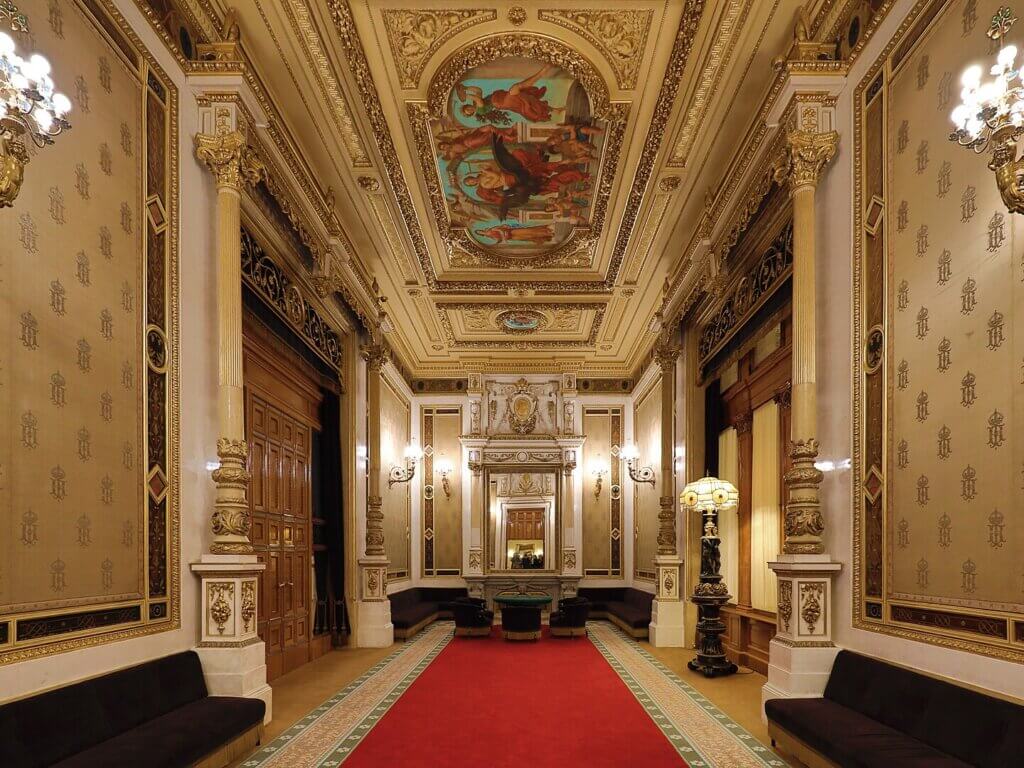
Notably, the opera house stayed open for performances through almost the entirety of the war and it was not until March 1945 that it faced significant bombing. On 12 March 1945, Allied forces bombarded Vienna and the Vienna State Opera was largely destroyed. The auditorium and stage burnt down, as did well over 150,000 costumes as well as thousands of props and set pieces. The main foyer, staircases, and tea room were saved, though.
The first performance in a liberated Austria took place on 1 May 1945; the company performed out of the Theatre an der Wien. Rebuilding commenced quickly with a goal of resuming performances by 1949. Unfortunately, monetary and construction issues caused delays but the Vienna State Opera officially reopened in 1955.

The Vienna State Opera now
The Vienna State Opera is one of the busiest opera houses in the world. There are 50-60 different operas performed each year and 10-12 ballets, in addition to the symphony. The opera continues to draw visitors to Vienna, with over 600,000 people coming to the city for the opera.
The opera is known for its “standing room only” tickets- roughly 80 minutes before curtain time, €10 standing room tickets are available and they continue to be popular. (I wouldn’t count on being able to get one if you visit- you might need to get a standard ticket.)

Want more theatre history?
The History of the Teatro alla Scala (Milan)
The History of the Palais Garnier
Were you familiar with the history of the Vienna State Opera in Austria?
Cheers,
The Historian
Facebook | Threads | Instagram | Pinterest