I originally started this series to highlight the royal consorts who have largely been forgotten from our collective memory- they are in the records, but beyond that, they are rarely ever mentioned. This also applies to royal daughters and sisters. The consort for this month was the first Princess Royal in nearly a century before she became a consort, and the first Hanoverian Princess Royal. Onto our February Consort of the Month: Anne, Princess of Orange!

Consort of the Month: Anne, Princess of Orange
Birth Date: 2 November 1709
Death Date: 12 January 1759
Tenure: 25 March 1734 – 22 October 1751
Birth Name: Anne of Hanover
Spouse: William IV, Prince of Orange
House: Hanover
Father: King George II of Great Britain
Mother: Queen Caroline of Ansbach
Why Do We Know Anne, Princess of Orange?
Few people seem to know of Anne, Princess of Orange, at least in the English speaking world. (Dutch friends, is she better known in the Netherlands?) Her full title is Anne, Princess Royal and Princess of Orange but after her marriage, she did not go by the Princess Royal title. You will see both referenced when people are discussing her!

Anne, Princess of Orange’s early life
Anne was born in 1709 to Prince George of Hanover and Princess Caroline of Ansbach. In 1714, Anne’s grandfather would become King George I upon Queen Anne’s death, but at the point of her birth, her parents and grandparents lived in Hanover. She spent her early years in Hanover and learned German, French, and English from a young age. She also was tutored in music by Georg Friedrich Händel- she would remain a fan of Händel’s works for the rest of her life. (Fittingly, he would compose “Zadok the Priest” for her father’s coronation.)
Scarily, at the age of eleven, she contracted smallpox. Thankfully for her parents, she did survive, but it was noted that she did have permanent facial scarring. (I would argue that scarring is better than death…)

A move to Britain and a new title
In August 1714, the two Georges (King George I, Anne’s grandfather, and the future King George II, Anne’s father) went to Britain following Queen Anne’s death. Princess Caroline took Anne and her sisters to London in October 1714 to begin their new life. Life at the Hanoverian court in England was dramatic, as King George I and his son, the Prince of Wales, did not get along in any way shape or form. (This would be a trend throughout the Hanoverian dynasty.)
In 1727, following his accession to the throne, King George II granted Anne the title of Princess Royal. (The last King to grant the title was King Charles I in 1642.)

An escape to marriage
Despite her new title, Anne did not particularly get along with either her father, King George, or her brother, the Prince of Wales, and knew that getting married would be her way out. She was considered as a potential bride for several continental royals, including King Louis XV of France, but as a Protestant princess, she refused to convert to Catholicism.
In March 1734, Anne married William, Prince of Orange in London. Although he did suffer from a spinal deformity, he was the only available Protestant heir or ruler in Europe at the time, so she accepted he was the only choice. The couple honeymooned at Kew and then set sail for Holland.
The couple did come to have a close and loving marriage, though it was not immediate. However, Anne was never popular with the public. She remained fairly pro-Britain for most of her life, and she never went out of her way to truly embrace her new Dutch life.

The Regent
Despite her lack of popularity, when William died in 1751, Anne was named as Regent for their three-year-old son, William. She was an involved Regent and her policy choices often led to greater discontent. However, her rule as Regent did have some positive outcomes for the Netherlands, including a stronger, more consolidated position for the Stadtholder (the prince of Orange’s title).
Sadly, in 1759, Anne died of dropsy, leaving her son without a Regent. Her mother-in-law then took up the role of Regent for William until her death in 1765, and Anne’s daughter, Carolina, was the final Regent until William came of age in 1766.
♠
Anne, Princess of Orange: Interesting Facts
– Anne was a talented painter, and left several paintings behind, including a self-portrait.
– She is buried in the Nieuwe Kerk in Amsterdam, close to the Royal Palace.
– Anne was named in honour of Queen Anne (her grandfather’s second cousin).
Interested in more book previews, period dramas, royal news, and more? You can subscribe to my biweekly substack newsletter here: https://anhistorianabouttown.substack.com/!
Further Readings/Listenings on Anne, Princess of Orange
I have not found any English language books on Anne- please let me know if you know of any!
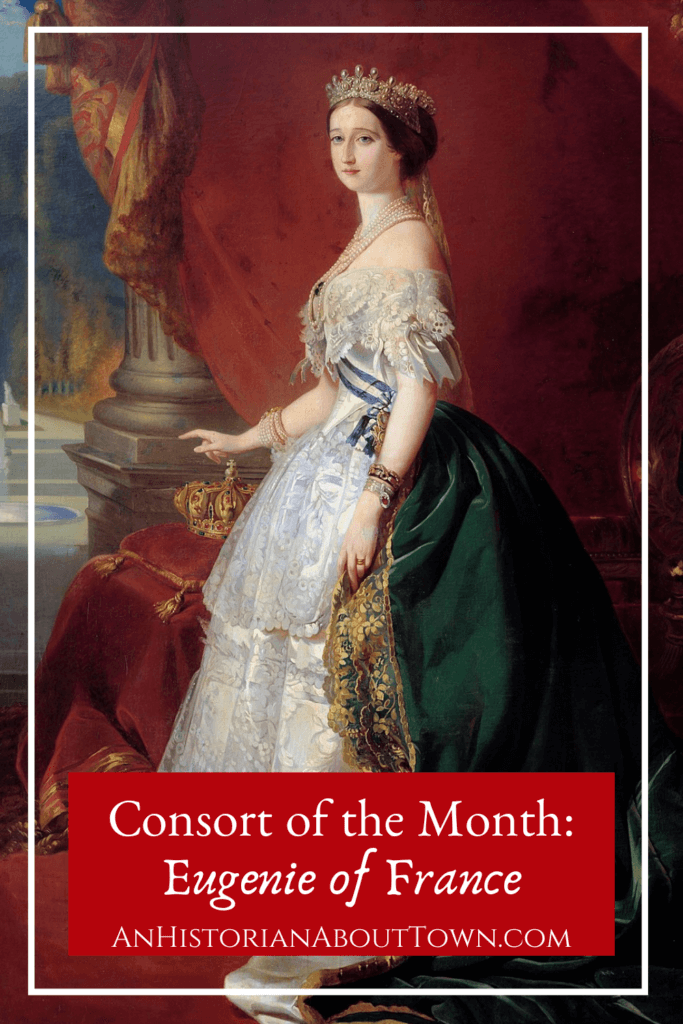
Looking for my earlier Consort of the Month posts? Read about:
Queen Charlotte of Mecklenburg-Strelitz
Queen Marie Antoinette
Catherine de Medici
Queen Adelaide
Catherine de Valois
Marie de Guise
Queen Alexandra of Denmark
Empress Josephine of France
Queen Elizabeth of York
Queen Elisabeth de Valois
Queen Catherine of Braganza
Queen Caroline of Brunswick
Queen Josephine of Leuchtenberg
Elizabeth Stuart
Queen Elisabeth of the Belgians
Saint Margaret of Scotland
Queen Maud of Wales
Empress Sisi of Austria
Queen Marie of Romania
Queen Astrid of Belgium
Queen Maria Eleanora of Brandenburg
Queen Ena of Spain
Queen Mary of Modena
Sophia Dorothea of Celle
Queen Anne of Austria
Queen Louise of Hesse-Kassel
Empress Maria Feodorovna
Empress Marie Louise
I hope you have enjoyed Consort of the Month: Anne, Princess of Orange!
Cheers,
The Historian
Facebook | Threads | Instagram | TikTok