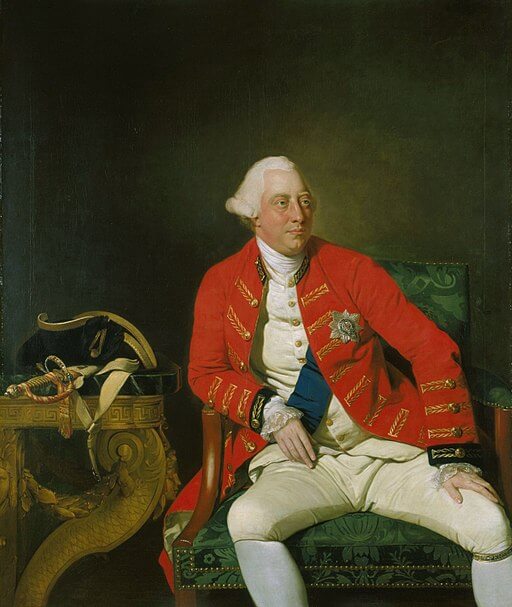
Monarch of the Month is back again! I have to say, this is one of my favourite series to research and write. I know a decent amount about each sovereign, but I’ve learned so much more. King George III looms large in British royal history. However, he seems to be ignored for everything other than the American Revolutionary War and his mental health episodes. So, while those points will be mentioned, I’m going to be focusing on everything else that the Monarch of the Month King George III accomplished in his life and reign!

Monarch of the Month: George III Fast Facts
Birth Date: 4 June 1738
Death Date: 29 January 1820
Reign: 25 October 1760 – 29 January 1820
Coronation Date: 22 September 1761
Predecessor: George II
Successor: George IV
House: Hanover
Father: Frederick, Prince of Wales
Mother: Augusta of Saxe-Gotha
Spouse(s): Charlotte of Mecklenburg-Strelitz
Why Do We Know George III?
George III is known for quite a few reasons. If you are of the Hamilton persuasion, you know him as the English king who lost the American colonies. If you are more of a Bridgerton fan, it was his incapacity to rule that led to the Regency period (with the Prince Regent giving his name to the period). Or you may know him for having serious physical and mental health issues. (Porphyria is largely cited but there has been much dissension on that.) And if all of those aren’t enough, you might know him as the father of several dissolute sons whose philandering ways forced him to create the Royal Marriages Act. There is a lot to go on for George III…

King George III’s Early Life
George William Frederick was born to Frederick, the Prince of Wales, and Augusta of Saxe-Gotha, the Princess of Wales on 4 June, approximately two months premature. Interestingly, he was the first British monarch to systematically study science- he was tutored in chemistry, biology, and physics. He also learned both English, French, and German, along with political philosophy, commercial law, music, and history.
George’s grandfather, King George II, knew little of him as a child. The king and his son, the Prince of Wales, hated each other, and a result, the king barely saw his grandchildren. However, Frederick died in 1751, and the King took a much greater interest in his grandson. Though the King offered George a lavish and large apartment at St. James Palace, George declined it in favour of remaining with his mother, the Dowager Princess. Her strict code of morals would stay with George for the entirety of his life.

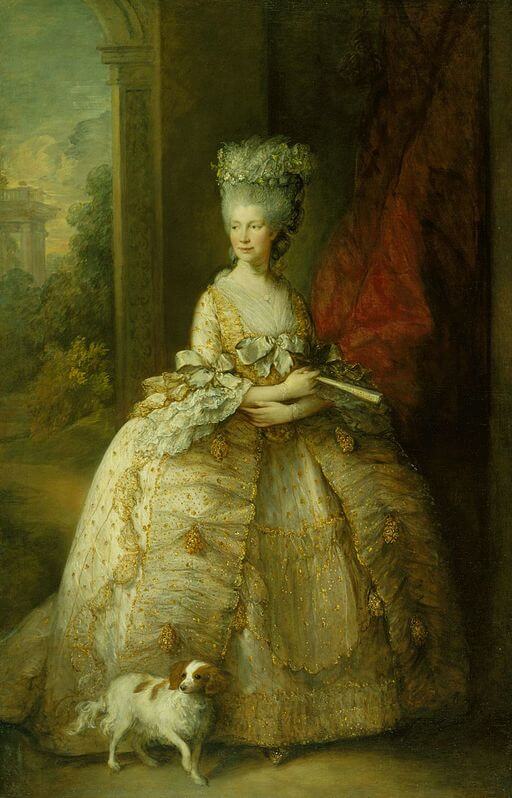
Charlotte of Mecklenburg-Strelitz
Queen Charlotte has come to prominence with the popular Netflix series, Bridgerton. She is a fascinating historical figure, so it is well-deserved attention. Charlotte and George met for the first time only six hours prior to their wedding on 8 September 1761. George had come to the throne in October of 1760 with the death of his 77-year old grandfather, and hadn’t yet had a coronation. The two had a joint coronation just two weeks later on the 22nd of September.
Although they only met briefly before saying “I do”, the pair is famously a royal love match. They had fifteen children in total- nine sons and six daughters, with thirteen surviving to adulthood.
The Royal Academy of Arts and the King’s Library
One of the most lasting accomplishments of George III’s reign is the Royal Academy of Arts. Several artists from the Society for the Encouragement of Arts, Manufactures and Commerce attempted to set up their own academy of arts in 1755, though it failed. One of the leading architects for the government, Sir William Chambers, used his government connections to gain George’s patronage and support. George signed the instrument of foundation on 10 December 1768, officially establishing the Royal Academy of Arts. The first 34 members included painters Joshua Reynolds and Thomas Gainsborough.
The King’s Library is one of the lasting cultural accomplishments of George’s reign. George hadn’t inherited any sort of library from either his father or his grandfather, and set out to build his own. In 1762/63, George purchased Joseph Smith’s library. As the British consul in Venice, he was able to collect several notable books and manuscripts. He continued to add more to the collection throughout his adult life, and when he was mentally unable to make decisions, trustees continued on in his stead. After his death, George IV donated it to the British Museum. It was unclear on whether it legally belonged to the Crown or to George as heir personally, so the donation nicely sidestepped the issue.
Constitutional Struggles…
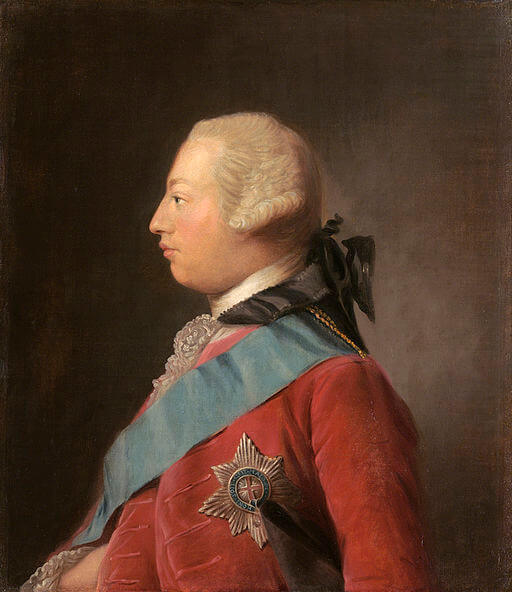
While the American Revolutionary War was a major international issue (or it would be international by the end of it), the later quarter of the eighteenth century was domestically difficult for George. In the 1780s, George was forced to appoint ministers that he did not like, something he struggled with immensely. Charles James Fox in particular proved difficult for George, as greatly disliked Fox for both his influence over the Prince of Wales and for his Whig politics. When George meddled in politics (by influencing the House of Lords, Parliament actually voted to condemn any monarch who meddles in politics, he was forced to take a step back.
George was not abolitionist by any stretch- he was firmly pro-slavery. Prime Minister William Pitt’s cabinet was divided on slavery, and Pitt, an abolitionist, was forced to work towards abolition as an individual person rather than as a political figure/party.

The Regency
Ahhh, the Regency. The time of Jane Austen and Bridgerton and a scandalous society. George suffered seriously, both physically and mentally. His first serious episode occurred in 1788. He suffered from acute mania, where he would talk incessantly for hours, to the point where his mouth would foam and he would lose his voice. He would mistake people, and once even mistook a tree for the King of Prussia. During this episode, Parliament debated on who to make the Regent (the Prince of Wales was a bit of a wild card…) but George recovered before the bill passed.
The true Regency period dates from 1810 to 1820, when George was incapitated. Contemporary sources thought the episode was brought on by the death of his daughter, Princess Amelia, but in any case, he never recovered. He was completely blind, almost completely deaf, and now suffered from dementia. Sadly, he didn’t understand that his beloved Charlotte had died in 1818. During the Regency, the Prince of Wales became the Prince Regent, henceforth, the Regency!

A Legacy
Most people tend to think of George as a failed king, at least in regards to the American colonies. (Especially with Hamilton…) And scholars agreed with this interpretation until the mid-twentieth century when they began to re-evaluate his life.
Aside from his more scholarly and artistic pursuits (the Royal Academy and the King’s Library), George focused on agriculture and the natural world. While it gets overshadowed by the US war and the Regency, “Farmer George” oversaw the bulk of the British Agricultural Revolution. That is in no way to say that there aren’t failures in his reign- I’m going to say that being pro-slavery is a failure- but there also were advancements.

George III: Interesting Facts
– George was very London-centric; he never travelled further than 100 miles from London.
– He was a passionate supporter of the arts, and was a bit of a fanboy for Handel (who wasn’t, am I right?). And he wasn’t just a fan, George also played the flute and harpsichord himself.
– George commissioned the Gold State Coach in 1760; it is still used by the British Royal Family for special events to this day.
– He was the first English and British monarch since the Hundred Years War to not claim the title of “King of France” (or Queen).
-George and Charlotte bought Buckingham House, which would
Further Readings on George III
Foreman, Amanda. George III (Penguin Monarchs): Madness and Majesty. Penguin Books, Limited, 2020.
Hadlow, Janice. A Royal Experiment: the Private Life of King George III. New York: Henry Holt and Company, 2014.
Hibbert, Christopher. George III: a Personal History. New York: Basic Books, 1999.
Rex Factor Podcast. George III Biography episode and Review episode.

Looking for my earlier Monarch of the Month posts? Read about:
Mary I
Anne
Edward the Confessor
William IV
Edward IV
James I
George V
Mary, Queen of Scots
George IV
Henry VII
Mary II
James II
Edward VII
Did you know anything about King George III before Hamilton?
Cheers,
The Historian
Facebook | Twitter | Instagram | Pinterest