With May being Queen Victoria’s birth month, I have focused on her throughout the month. However, I wanted to include a monarch connected to her rather than Victoria herself for this Monarch of the Month. William IV was Victoria’s uncle, and she ascended the throne after his death- he played a significant role in her early life. But many of us only know him in relation to Victoria. Today we are going to look at King William IV, the Sailor King, and his active and fascinating life!

William tends to get lost in the shuffle a bit when it comes to British monarchs, which is a shame. He is preceded by four Georges, who all had rather fraught and complicated relationships with one another. And then followed by Victoria, who reigned over an empire for nearly 64 years. However, he led an interesting life himself, and his seven-year reign was during a time of great change in Britain.

Monarch of the Month: William IV Fast Facts
Birth Date: 21 August 1765
Death Date: 20 June 1837
Reign: 26 June, 1830- 20 June 1837
Coronation Date: 8 September, 1831
Predecessor: George IV
Successor: Victoria
House: Hanover
Father: George III
Mother: Charlotte of Mecklenburg-Strelitz
Spouse(s): Adelaide of Saxe-Meinigen
Why Do We Know William IV?
Most people who do know William IV will most likely know him for being the uncle that hung on long enough for VIctoria to take the throne without a Regent. (Jim Broadbent’s outburst at the Duchess of Kent in The Young Victoria is one of my favourite scenes committed to film.) Had he not lived past her 18th birthday, she would have had a regent, most likely her mother (controlled by SIr John Conroy).
You might also know William IV from his impressive statue as you enter the grounds at Greenwich. The statue originally stood on King William Street in the CIty of London, but it was moved here to Greenwich in 1936. (It is a fitting spot for William, as he served in the Royal Navy himself, was appointed Admiral of the Fleet, and would be known as the Sailor King.)

William’s Early Life
William was born on 21 August 1765 at Buckingham House, the third child of King George III and Queen Charlotte. Like the rest of George III’s children, he spent much of his childhood at Richmond and Kew Palace. He was educated with his brother Prince Edward (the future Duke of Kent and father to Queen Victoria). However, William left Kew at the age of 13 to join the Royal Navy as a midshipman. He was not an average midshipman, as his tutor accompanied him, but it was the beginning of a successful career in the Navy.

William and the Navy
He actually served in the Navy in New York, during the American War for Independence. (Washington approved a plot to kidnap him, but it did not come to fruition.) He went on to become a Lieutenant in 1785, and then Captain in 1876 of the HMS Pegasus. In 1788 he took command of the HMS Andromeda, and finally became a rear-admiral taking command of the HMS Valiant in 1789. He retired in 1790 but it was not permanent.
When Britain declared war on France in 1793, William had expected to be given a post right away. However, he was not appointed an admiralty until 1798, and even then, it was nominal. He asked several times, but was never given a working position in the Napoleonic Wars. He was given the honorary title of Admiral of the Fleet in 1811, and in 1813 he was visiting troops in Antwerp where he was nearly shot.

William, Duke of Clarence
William’s oldest brother, George, the Prince of Wales, was also the Duke of Cornwall, and his second oldest brother, Frederick, was Duke of York. William sought to be given a dukedom like his brothers, and the parliamentary grant that came with it. George III was hesitant, as William had had several affairs in the military and was known for fighting and brawling in his youth. (He was essentially the opposite of his father.)
However, William threatened to stand for a seat in the House of Commons in a Devon riding. William and his brothers tended to side with the Whigs (though not on all issues) because they opposed his father, and George wanted to avoid putting the issue to voters at all cost. He was created Duke of Clarence and St Andrews on 16 May 1789.

Mrs. Jordan, Princess Adelaide, and His Family
William took a mistress, Irish actress Dorothea Bland, better known as Mrs. Jordan. The couple were together for two decades, until 1811, and lived a rather quiet life together. They had ten children together, five boys and five girls, and they were given the surname of FitzClarence (indicating their illegitimacy). Although George III was a particularly straightlaced person, he did not take any issues with the relationship. In 1797, he made William Ranger of Bushy Park, so that they could use Bushy House.
The relationship ended because of William’s debts- he needed to marry a wealthy woman to help with his debts. Princess Charlotte of Wales’ death in 1817 also put a rush on William finding a bride. With Charlotte and her son’s death, two generations of heirs were gone in a day, and they needed another. In July of 1818, William married Princess Adelaide of Saxe-Meiningen at Kew in a joint ceremony with the Duke of Kent and his new bride. Although the couple had two daughters, one died within a few hours and the other only a few months. Despite their lack of children, the marriage was a happy one lasting nearly 20 years until his death.
King William IV
George III died in 1820, with George IV taking the throne. Given that George’s heirs had died, and that their brother Frederick, Duke of York died in 1827, William became first in line for the throne. When George IV died on 26 June 1830, William IV ascended the throne. William had rather reformed himself since marriage; he walked for hours each day, drank only barley water with lemon, and ate simple food. He was dedicated to his tasks, and Wellington was shocked at the amount of work William put in compared to his brother. He also worked hard to endear himself to the people- he replaced French and German staff members with English ones, donated many of George’s pieces of art to the nation, and even tried to give away Buckingham Palace (George had started costly renovations). Although not everything was successful, he was generally liked by his subjects.

Reforms
Although his reign was only seven years long, he notably oversaw reforms in several areas. The Reform Act of 1832 was an incredibly important act. It abolished many tiny electoral seats, often controlled by wealthy families, gave cities representation in the Commons, gave the vote to smaller landowners, shopkeepers, tenant farmers, and to householders who paid £10 a year or more in rents. (Men, of course- women in the United Kingdom wouldn’t have the right to vote until 1928.)
Before he was king, William also made reforms to the Navy as well as Lord High Admiral when he was appointed in 1827. He abolished the cat-o-nine-tails as a punishment, a multi-tailed whip used in the Navy, for nearly all offences but mutiny. He also required that regular reports on the state of each ship be made.
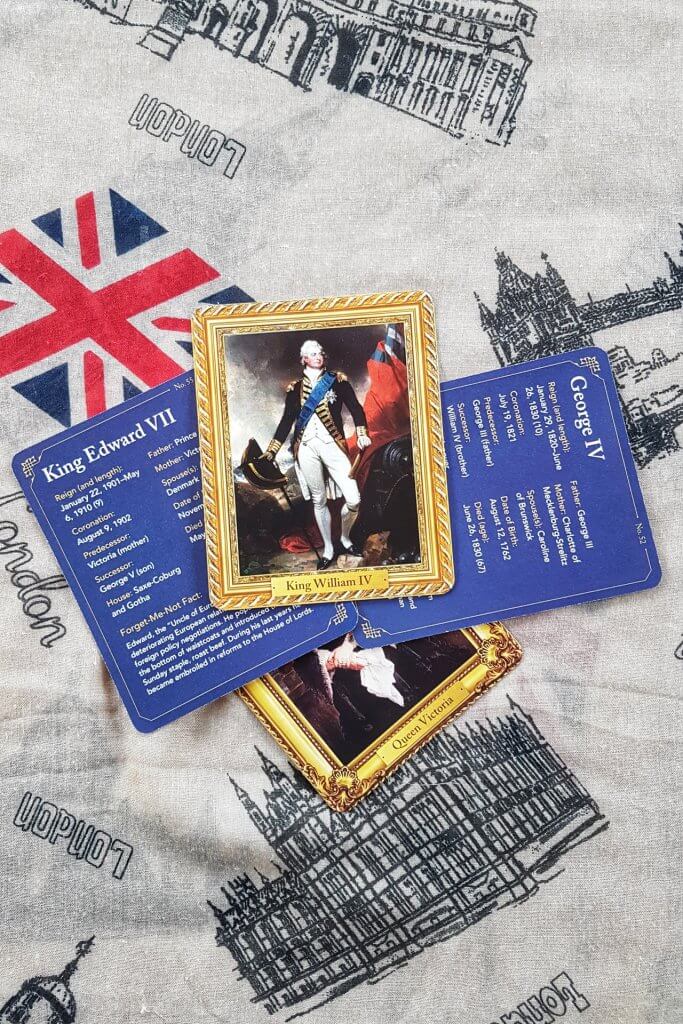
William IV: Interesting Facts
– Nine of his ten children with Mrs. Jordan were named after his siblings.
– He was also King of Hanover, but never visited Hanover while king.
– William and Adelaide enjoyed spending time with their niece, the future Queen Victoria, and Adelaide would remain close with her after William’s death.
-One of his first nicknames was Silly Billy, but it was luckily replaced by the Sailor King.

Further Readings on William IV
Knight, R.J.B. William IV: A King at Sea. Allen Lane, 2015.
Somerset, Anne. The Life and Times of William IV. Weidenfeld Nicolson Illustrated, 1993.
Pocock, Tom. Sailor King: The Life of William IV. Sinclair-Stevenson, 1991.
Luscombe, Stephen. “William IV.” The British Empire. Accessed May 10, 2020. https://www.britishempire.co.uk/biography/williamiv.htm.
Rex Factor Podcast. William IV episode.
♠
Looking for my earlier Monarch of the Month posts? Read about Mary I here! And read About Anne here! Edward the Confessor more your speed?
Cheers,
The Historian
Facebook | Twitter | Instagram | Pinterest | Bloglovin’

Thank you Historian for your work and research on the British monarchy. I’ve always admired William IV for his compassion for his British sailors in the Royal Navy. He put a stop to the flogging of British sailors and William IV truly cared about the downtrodden of Great Britain. Thank you again and I’ll be getting your emails from now on.
I am so glad to know you enjoy them! And yes, William did a lot for Britain in many different areas, but unfortunately gets overshadowed by his father, brother, and niece. He deserves far more attention!