Monarch of the Month is back, to look at another English monarch! Although most of us have only known Queen Elizabeth II as our monarch, her grandfather’s lasting influence has shaped much of her reign. From Windsor to different holiday traditions, George is everywhere. So, let’s dive into this Monarch of the Month: King George V, and what you may not know about him!

Monarch of the Month: King George V Fast Facts
Birth Date: 3 June 1865
Death Date: 20 January 1936
Reign: Scotland: 6 May 1910- 20 January 1936
Coronation Date: 22 June 1911
Predecessor: Edward VII
Successor: Edward VIII
House: Saxe-Coburg and Gothe; Windsor
Father: Edward VII
Mother: Alexandra of Denmark
Spouse(s): Mary of Teck

Why Do We Know George V?
Depending on how “into” modern royal history you are, you may know him as the king who abandoned his Romanov cousins to their deaths. (HOWEVER, it’s not quite as simple as that, and it shouldn’t be reduced to that sentiment.) You most likely know him as the king who changed the British royal family’s name from Saxe-Coburg and Gothe to Windsor during the First World War to avoid more anti-German sentiment.

George V’s Early Life- Regular Royal Life
George Frederick Ernest Albert Windsor was born at Marlborough House in 1865, the second son and child of the Prince and Princess of Wales (the future King Edward VII and Queen Alexandra). Although he was seventeen months younger than his older brother, Prince Albert Victor, they were educated together and generally spent most of their time together. Neither were particularly curious, intellectually. So, their father decided that the navy would be a good fit for the boys, and they joined the service in 1879. When they returned in 3 years, Queen Victoria was dismayed that neither of her grandsons could speak French or German, and they were sent to Lausanne for six months to learn another language. It was unsuccessful, though, and George returned to the Navy afterwards.

Taking Over for Albert Victor
George originally fell for his cousin, Princess Marie of Edinburgh. While his father, uncle, and grandmother were all for it, both of their mothers were opposed. Marie followed her mother’s instruction and refused the proposal. In late 1891, Albert Victor became engaged to Princess May of Teck. All was well, until it wasn’t- Albert Victor caught pneumonia in mid January and died. Thus George became his father’s heir, something he had never been prepared for. And he also stepped in for his brother’s fiance. George and May bonded over Albert Victor’s death and a year after he had passed, George proposed and May accepted. A bit of an unusual royal engagement, but given that they were faithfully married for 43 years, it seems to have worked out.

Life as the Duke of York and Prince of Wales
Upon their marriage, George and May were made the Duke and Duchess of York. They lived at York House, which is a small cottage on the Sandringham estate. It was a rather secluded home for the royal couple, but it suited George well. He preferred a quiet, middle class life- he did not inherit his father’s love of society and parties. They attended what they needed to, and carried out engagements and tours, but returned to York House again. Impressively, they lived at York Cottage until Queen Alexandra’s death in 1925.
Upon Queen Victoria’s death in 1901, George became the Prince of Wales. His father had resented not being allowed to have any practical role in the monarchy as Prince of Wales, and did not want the same to happen to George. He was given access to state documents, and was able to learn in practicality what ruling meant. In 1901, the Waleses carried out a tour of the British Empire spanning the globe. The tour was useful, as he was able to get a feeling for how subjects in the colonies were feeling. (Many were not impressed, including White cape Afrikaners in South Africa.)

A Tense and Difficult Reign
Politically George’s reign was a minefield. The Liberal government’s budget was passed in the House of Commons but failed in the Conservative House of Lords. Indian and Irish nationalism only continued to grow, with Irish nationalism coming to a head in the 1920s. And then there is the First World War. Though they referred to it as the Great War, George’s extended family would be shaken to the core in the First World War. Countless monarchies and principalities fell, including the Romanovs who were brutally executed in 1918. George was incredibly close with Tsar Nicholas II, as they were first cousins and close friends. (You may mistake them for twins, it’s a common mistake.)
Anti-German sentiment was high in the UK, and the very Germanic House of Saxe-Coburg and Gothe had to make a choice. George chose to rename the House to Windsor, in honour of the fortress that has been at the heart of the English monarchy for centuries. (It wasn’t as easy as “Windsor sounds great!”, though. He also had to make the difficult choice in regards to Nicholas and his family. Historians argue over whether not the King or the government decided to leave the Romanovs behind, but they did not escape their tragic fates. Republican sentiment was also high, and George chose his own family over his cousins. In any case, it wasn’t an easy decision for any parties.
Later Life and Death
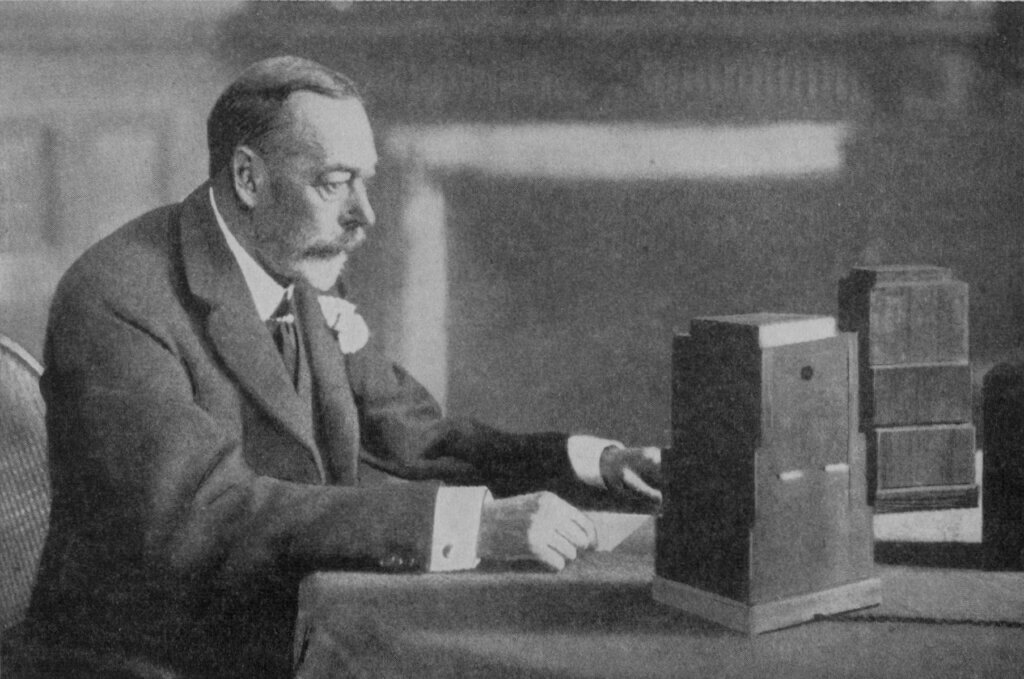
One of the lasting legacies of George V’s reign is the Christmas broadcast. The head of the BBC first approached George about a Christmas broadcast in 1922, but the king didn’t agree until 1932. He wasn’t a fan of the newfangled technology, but it became an annual tradition. George VI and Elizabeth II have both continued the tradition, and in 1957, the first televised Christmas speech aired on Christmas Day.
George was not in the best of health in his later years. His horse fell on him and broke his pelvis while he was inspecting the troops in the First World War. He also suffered from chronic bronchitis, and a serious bout with septicemia. His favourite sister died in December of 1935, pulling him into a deep depression, and in January, his health failed him. On 20 January 1936, George was barely hanging onto life. Lord Dawson of Penn, leading the team of the king’s physicians, administered two lethal injections of cocaine and morphine shortly before midnight. (Meaning that it met the deadline to be published in the morning newspapers…) Neither the Queen nor the Prince of Wales were asked, but no one knows if they would have said no or allowed it.

George V: Interesting Facts
– George was a dedicated philatelist- he collected stamps! By the time of his death in 1936, he had collected over a quarter of a million stamps.
– The tattooed king- following in his father’s footsteps, George acquired at least one tattoo on his travels. On an 1882 trip to Japan, he had a tattoo done. (It is debated on whether or not it is a dragon, or crosses to mimic his father’s.)
– George brought back the tradition of wearing St. Edward’s Crown for his coronation. Recreated for Charles II, it fell out of use after William III’s coronation until George decided to wear it.
– A century ago, on 11 November 1920, George laid the Unknown Soldier to rest in Westminster Abbey. A wreath is still laid on his coffin on 11 November each year.

Further Readings on George V
Rose, Kenneth, and George. King George V. New York: A.A. Knopf, 1984.
Cannadine, David. George V: the Unexpected King. London, England: Allen Lane, 2014.
Carter, Miranda. George, Nicholas, and Wilhelm: Three Cousins, Three Empires, and the Road to World War I. New York: Alfred A. Knopf, 2010.
Rex Factor Podcast. George V episode.
Looking for my earlier Monarch of the Month posts? Read about Mary I here! And read About Anne here! Edward the Confessor more your speed? Or William IV? Edward IV? Maybe James I?
Cheers,
The Historian
Facebook | Twitter | Instagram | Pinterest | Bloglovin’