Back again with another Monarch of the Month! I know that we all have our favourite monarchs and read everything possible about them, but that usually leaves many behind. And hopefully these monthly posts change that! I shamefully must add, all of the fifteenth century is a haze of the War of the Roses for me, so I was excited to draw Edward IV and start digging a little deeper. So, let’s get to this Monarch of the Month, King Edward IV!

Monarch of the Month: Edward IV Fast Facts
Birth Date: 28 April 1442
Death Date: 9 April 1483
Reign: 4 March 1461- 3 October 1470, 11 April 1471- April 9 1483
Coronation Date: 28 June 1461
Predecessor: Henry VI
Successor: Henry VI, Edward V
House: York
Father: Richard Plantagenet, Duke of York
Mother: Cecily Neville, Duchess of York
Spouse(s): Elizabeth Woodville

Why Do We Know Edward IV?
If you think that King Edward IV sounds vaguely familiar, it is very likely because of The White Queen. (You might be a Tudor historian, and you otherwise knew, but I fully admit that I didn’t know much about Edward prior to seeing it.) Granted that is a fairly recent television show, and people obviously knew of him before STARZ put him on the big screen. He is well-known as one of the main claimants during the War of the Roses, and a military leader.

Edward IV’s Early Life
Edward was born in 1442 in Normandy, to Richard, 3rd Duke of York and Cecily Neville while his father was governor of English lands there. He was known as the Earl of March until his father’s death. Both of his parents were direct descendents of Edward III, giving him a strong claim to the English throne. His claim was further strengthened after becoming Henry VI’s year following Humphrey, Duke of Gloucester’s death. The Yorks spent much of his childhood in France, and also Ireland, but returned to London when the Duke attended the Great Council in 1454.

The War of the Roses
If nothing else, the War of the Roses dominated the second half of the fifteenth century, and Edward’s life. Although he was young, Edward quickly became a strong and respected military leader. By the 1450s, the Lancastrian and the York factions were in conflict over the throne, and Edward led York troops in many of the battles. He was separated from his father and brothers, but all were named on documents criticising the king’s evil counselors. Edward worked closely with the Earl of Warwick (also known as the Kingmaker). After several hard fought battles, Edward was crowned in England in March of 1461. Henry VI escaped while his wife and son fled to Scotland- Henry was caught in 1462 and imprisoned in the Tower of London.
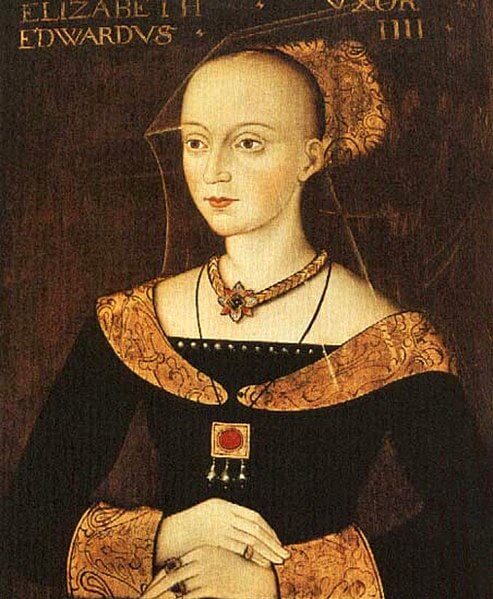
Elizabeth Woodville: A Love Match?
Edward’s early reign was politically unstable, as many of the nobles had supported Henry VI or stayed neutral rather than support Edward. He relied heavily on his mother’s family, the Nevilles, but also needed support from other kingdoms. Several different foreign royal brides were suggested to secure treaties, but on 1 May 1464, Edward secretly married Elizabeth Woodville. Woodville was a low ranking aristocrat, and a widow with two sons from her previous marriage- Edward’s counselors were furious. Historians still debate the match. It may have simply been a love match, or it may have been a calculated move due to the Woodvilles lower status. (Because they were relatively low-ranking, there was a greater chance of loyalty.)
Although Edward was in love with his wife, he had several notable mistresses, including Jane Shore.
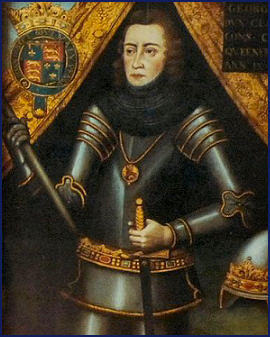
The Duke of Clarence….
Edward’s younger brother, George, Duke of Clarence, was a difficult person for Edward. When Edward stopped taking counsel from the Earl of Warwick, Warwick turned his eye to the Duke of Clarence. Warwick arranged a marriage between his eldest daughter Isabel and Clarence, but Edward refused the match. And of course, they married anyways. Warwick and Clarence then went further and supported an arming rising against the King in 1470, and then fled to France. The brothers were reconciled in 1471, but Clarence continued to scheme and Edward was fed up with his disloyalty. After he publicly slandered the king, a bill of attainder was passed, and he was sentenced to death. He was executed on 18 February 1478 at the Tower of London, apparently drowned in a butt of wine. (This is debated, but either way, he ended up dead.)

The Uprising and Exile
The aforementioned uprising had a great deal of popular support, and Lancastrian forces overtook Edward’s Yorkist troops. Edward fled to Bruges, and the Lancastrian Henry VI took the throne again. He was mentally unstable and the kingdom was plagued by the same issues that Edward faced, his reign lasted less than a year.

King Edward IV’s Encore and Death
With support from Flemish merchants, Edward landed at Hull and slowly won over groups of supporters, one by one. By the time he reached London, he was unopposed and took Henry prisoner immediately. Henry died at the Tower of London, though the cause is unknown. (Was it Edward?) There were small rebellions here and there that Edward was forced to put down, but overall, there was more stability. He died in 1483 at the age of 41- he drank excessively and overate, which probably contributed to his death. Some historians think that he may have been poisoned, but there is no hard evidence that supports that.
Edward was often “lost” in general War of the Roses discussion. For centuries, he blended into years of battle and the struggle for power. However, in the last few decades, historians have recognised that he was stable and peaceful ruler in the latter part of his reign, and generally deserves credit for that.
His two sons, Edward and Richard- aka the Princes in the Tower- were taken to the Tower of London upon their father’s death. The two boys would not be seen again, and the question of who murdered the Princes in the Tower still dominates discussion today. (I personally don’t lean one way or the other- their are pro and cons to everyone!)
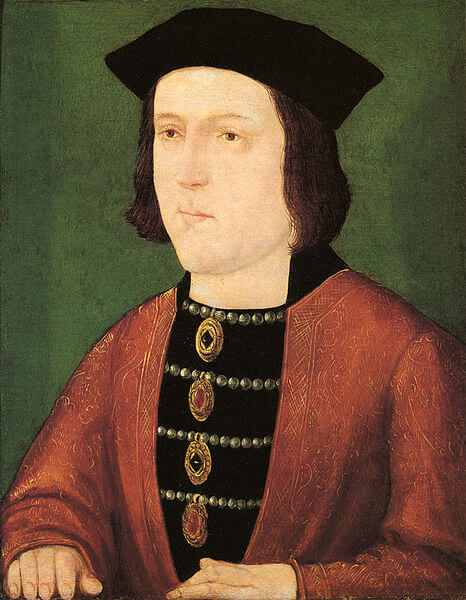
Edward IV: Interesting Facts
– Edward was the tallest of all British monarchs, standing tall at 1.93m or 6’4”.
– Much of the monarch’s personal wealth comes from the Duchy of Lancaster- Edward made the Duchy a Crown property, which is it remains to this day.
– His daughter, Elizabeth of York, would marry the first Tudor king, Henry VII, and was mother to Henry VIII.
– Edward rebuilt St George’s Chapel at Windsor, which is now the resting place for many monarchs and royals.

Further Readings on Edward IV
Licence, Amy. Edward IV & Elizabeth Woodville: a True Romance. Stroud, Gloucestershire: Amberley Publishing, 2016.
Ross, Charles. Edward IV. New Haven: Yale University Press, 1997.
Pollard, Anthony James. Edward IV: the Summer King. London: Allen Lane, 2016.
Rex Factor Podcast. Edward IV episode.
Looking for my earlier Monarch of the Month posts? Read about Mary I here! And read About Anne here! Edward the Confessor more your speed? Or William IV?
Cheers,
The Historian
Facebook | Twitter | Instagram | Pinterest | Bloglovin’