With it being LM Montgomery Month on the blog, and wanting to feature a monarch she was connected to, I had a few options. I decided to go with the monarch on the throne when she wrote Anne of Green Gables, Edward VII. (After all, it is what most people know her for.) More so than most monarchs, he was defined by his predecessor. So for this Monarch of the Month: King Edward VII, we are going to get to know Edward and not his mother!
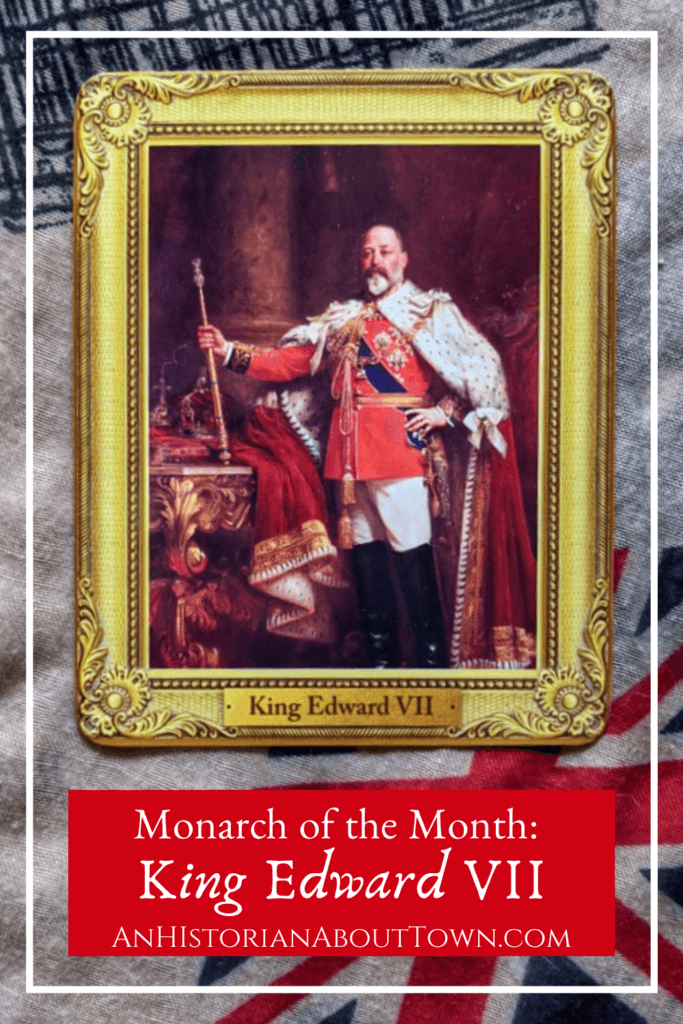
Monarch of the Month: Edward VII Fast Facts
Birth Date: 9 November 1841
Death Date: 6 May 1910
Reign: 22 January 1901 – 6 May 1910
Coronation Date: 9 August 1902
Predecessor: Victoria
Successor: George V
House: Saxe-Coburg and Gotha
Father: Prince Albert
Mother: Queen Victoria
Spouse(s): Alexandra of Denmark
Why Do We Know Edward VII?
Amongst British monarchs, he is somewhat well-known. Much like Prince Charles, Edward (aka Bertie) had decades and decades of waiting as the Prince of Wales before he ascended the throne. And although short, the Edwardian period is well-remembered. (Possibly in the twenty-first century because of Downton Abbey and the like…) His reputation as a lothario has also lasted long after his death. His final mistress, Alice Keppel, is the great-grandmother of Camilla Parker-Bowles, now the Duchess of Cornwall.

King Edward VII’s Early Life
Albert Edward was born to Queen Victoria and Prince Albert on 9 November 1841, following his elder sister Victoria (born in November 1840). Known as Bertie to the family, his parents started his rigorous education at the age of seven in order to prepare him for his future role. Unfortunately for everyone, he wasn’t a particularly studious person and this was evident from a young age. He tried to please his parents – particularly his father – but his skills were his charm and personality, rather than intellect.
In 1859, he travelled abroad to Rome for three months, and then studied at the University of Edinburgh. After spending the summer in Edinburgh, he became a student at Christ Church College, Oxford. He started to flourish when able to escape his parents’ strict regime, and his academic performance improved significantly. In 1861, he moved on to Cmabridge, and became a student at Trinity College. While there he studied history, and thoroughly enjoyed his course.
Prince of Wales on Tour
Bertie’s good nature and charm were an asset as he began to take on duties as the Prince of Wales. He took the first tour of North America by a Prince of Wales in 1860, and it was a rousing success. Over four months, he opened various bridges, attended ceremonies, and even visited Niagara Falls. When in the United States, Bertie was exceedingly popular and crowds gathered for him wherever he went.
Bertie wanted to have an active military career, but unfortunately, his mother wouldn’t allow it. He went to Germany to observe maneuvers in 1861, a compromise of sorts, but was also sent to meet Princess Alexandra of Denmark. He then went to Ireland to observe maneuvers there. It was at this camp that he met actress Nellie Clifden. The officers he was staying with snuck her into the camp to give Bertie experience, and he spent three nights with her.

Bertie: A Cause of Death?
As one might expect, Prince Albert had expected a chaste and focused life of all of his children, but especially Bertie as future monarch. When he found out that Bertie had spent time with Clifden, he was enraged and disappointed. Albert went to see him at Cambridge to reprimand his son and remind of his duties- the pair spent hours walking in the rain. Within two weeks of the visit, Albert was dead. Although it was most likely stomach cancer that caused his death, Victoria would forever blame Bertie for her beloved Albert’s death.
Bertie hadn’t set out to specifically disrespect his parents wishes, but rather was a very different person. It is thought that during their talk at Cambridge, father and son had come to an understanding and peace. However, because of Bertie’s behaviour and Albert’s death, Victoria did not allow him any access to state papers, government officials, or the day-to-day functions of the monarch.
Bertie did follow his parents’ wishes; on 10 March 1863, he married Alexandra of Denmark at St. George’s Chapel, Windsor. Their main residences were Marlborough House and Sandringham House.
Not So Discrete…
Although Alexandra was a famous beauty who set fashion trends across the Empire and further, Bertie quickly returned to Clifden and his extra-marital affairs. Clifden did not last for long, but he rarely went without an affair partner. Alexandra knew of his affairs, but ignored them (or at least publicly).
Bertie had three long-term mistresses. Actress Lillie Langtry was his mistress from 1877 to 1880. Their physical relations probably ended when she was pregnant (most likely by another man) in 1880. In 1879, she had begun an affair with the Earl of Shrewsbury and when they planned to run away together, her husband had planned to sue for divorce and name Bertie as a co-respondent. He had his solicitor bury the charges, but it wouldn’t be the last time his name was dragged through the mud.
Daisy Greville, Countess of Warwick was the Prince’s mistress from 1889 to 1898. Known at the time for being a flighty woman, she carried on affairs with several different men. She was in several difficult situations because of her affairs, and pulled Bertie into several of them. After becoming pregnant with Joseph Laycock’s child, he ended the affair.
Alice Keppel, 25 years younger than Bertie, met him in 1898 and quickly became his mistress. She was different from previous mistresses, as Alexandra appreciated her calmer demeanor and relative lack of public scandal. Keppel remained his mistress to the end of his life, and was with him on his deathbed.
Marlborough House Set
Bertie and Alexandra’s social group was known as the Marlborough House Set. Given that his mother barred him from most official activities, Bertie spent much of his time carousing. Endless house parties with several course meals, days and days of shooting, frequent trips to the theatre, and extravagant fashion kept the Set very busy. Interestingly, this set was not only made up of royals and aristocrats, but also featured bankers, gamblers, actors, and other “questionable” people (at least to Victoria).
A Short But Definitive Reign
King Edward VII ascended the throne on his mother’s death in January of 1901. He was a popular monarch during his reign, and the people loved him. His coronation had to be rescheduled from 26 June to 9 August in 1902, as on the 24th of June, he was taken ill with appendicitis. (He actually had a new and radical surgery that saved his life.)
Known as the Uncle of Europe, he was related to nearly every other European monarch. He was fluent in both German and French, and frequently travelled. Much of his travel and soft diplomacy saved the British from several possible international episodes.
Edward died on 6 May 1910, and was succeeded by his son, George V. In the last decade of his life, he had several bouts of respiratory illness, and a cancerous ulcer (all caused by decades of heavy smoking). In the months leading up to his death, he collapsed and suffered several heart attacks. HIs funeral in London was one of the last large gatherings of European monarchs ever, as the outbreak of World War I in 1914 would see the end of several monarchies.

Edward VII: Interesting Facts
– Until Prince Charles passed him in 2017, Edward had been the longest serving Prince of Wales (just shy of 60 years).
– In his later years, his friends called him “Tum Tum” behind his back, because of his ever expanding waistline.
– Edward was responsible for Monte Carlo becoming the wealthy vacation spot it is today.
– Historians think that he may be connected with over 50 different women, leaving him with another nickname, the Playboy Prince.
Further Readings on Edward VII
Aronson, Theo. The King in Love: Edward VII’s Mistresses. London: John Murray, 1988.
Hibbert, Christopher. Edward VII: the Last Victorian King. New York: Palgrave Macmillan, 2007.
Ridley, Jane. The Heir Apparent: a Life of Edward VII, the Playboy Prince. New York: Random House, 2013.
Rex Factor Podcast. Edward VII episode
Looking for my earlier Monarch of the Month posts? Read about:
Mary I
Anne
Edward the Confessor
William IV
Edward IV
James I
George V
Mary, Queen of Scots
George IV
Henry VII
Mary II
James II
I hope you’ve enjoyed this Monarch of the Month, King Edward VII!
Cheers,
The Historian
Facebook | Twitter | Instagram | Pinterest