King James II did not have a long reign- under four years in total. He is often remembered for his role in the Glorious Revolution rather than his actual reign. (Given that he was on the losing side, and as everyone says, history is written by the victors, it unfortunately makes sense.) However, I find him, along with the other Stuarts to be fascinating. He witnessed several incredible events in history, and could have led England on a very different path. Let’s get to this Monarch of the Month: King James II!

Monarch of the Month: James II Fast Facts
Birth Date: 14 October 1633
Death Date: 16 September 1701
Reign: 6 February 1685 – 11 December 1688
Coronation Date: 23 April 1685
Predecessor: Charles II
Successor: Mary II and William II
House: Stuart
Father: Charles I
Mother: Henrietta Maria of France
Spouse(s): Anne Hyde; Mary of Modena
Why Do We Know James II?
If you are familiar with James II, it’s probably for one of two things. The Glorious Revolution, a fairly notable moment in British history, happened because of him. Being a Catholic, he gets brought up fairly often as the example of what royals shouldn’t do/ be. (Thankfully, British laws regarding Catholics and the thrones have loosened in the twenty-first century.) The other reason you might know him for is the Warming-Pan Scandal- I’ll dive into that below.

King James II’s Early Life
James was born in October of 1633 to King Charles I and Queen Henrietta Maria, at St. James’ Palace. He was given the title of Duke of York (as the second son of the monarch) at birth, and formally created Duke of York three months later. At the age of three, he was given the nominal title of Lord High Admiral, but this would play a role in adulthood. James was educated with his older brother Charles (the future Charles II), and had a typical seventeenth century royal childhood.

The English Civil War
Charles I continually disagreed with Parliament, and would prorogue Parliament for years at a time when they wouldn’t acquiesce to his demands. It descended into the English Civil War, which would last for nearly a decade. James went with his father to the Battle of Edgehill, and luckily was able to escape capture. He then went to the Royalist stronghold, Oxford. The town was captured by Parliamentary forces, and James was sent as a captive to St. James’ Palace. However, he escaped dressed as a woman, and was able to go to the Hague.

Execution of Charles I and Life on the Continent
On 30 January 1649, Charles I was executed outside Banqueting House in Whitehall. (Fun fact: you can see James’ brother, the future Charles II, on one of the ceiling panels at Banqueting House.) From 1649 to 1660, the Cromwell-led Parliamentarians governed England, while the exiled royal family remained on the Continent. Both James and Charles served in the French army, where James in particular gained valuable military experience. It was in the army that James was first introduced to Catholicism; this would again come up later.
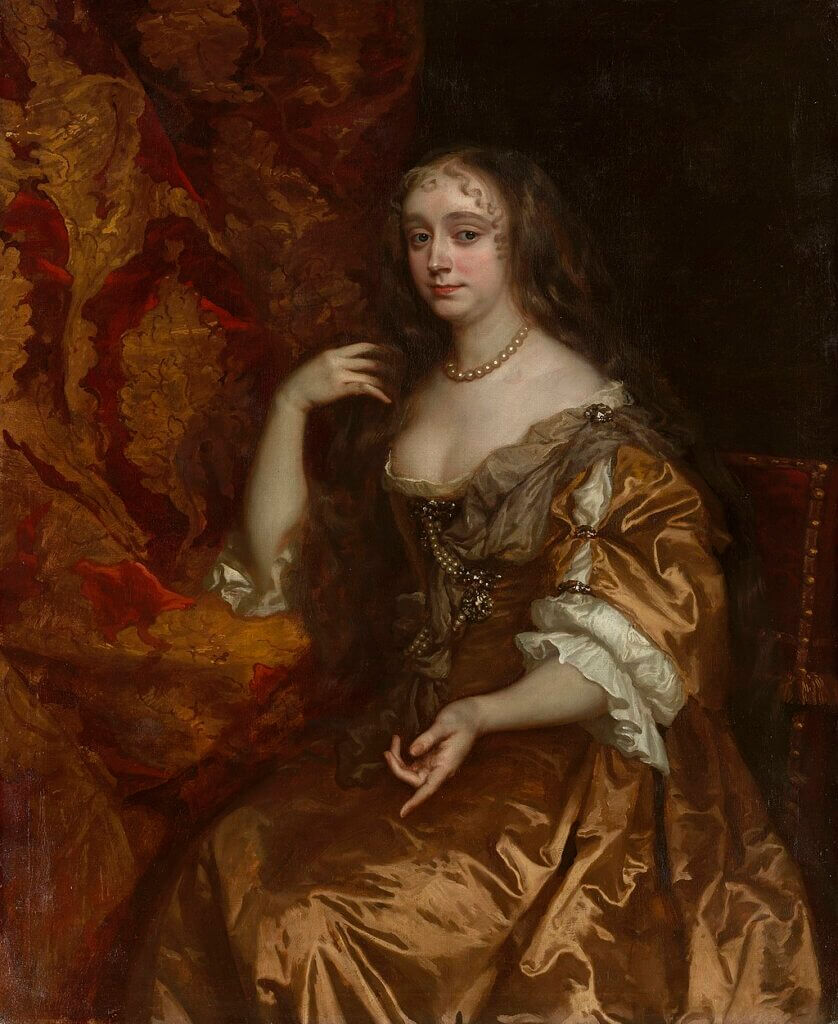
Anne Hyde: A Common (but Catholic) Wife
While on the Continent, James started courting Anne Hyde, who was the daughter of his brother’s chief minister (Edward Hyde). No one was particularly enthused with their engagement in 1659, and with the Restoration in 1660, everyone expected that the engagement would be broken so that he could marry a foreign princess, as the current heir to throne would normally do. However, she was pregnant, and they married on 3 September 1660 in the middle of the night. She gave birth to their son (who didn’t survive past seven months) in October 1660. They had seven more children following him, with the Princesses Mary and Anne (future queens) being the only that survived into adulthood.
Anne became a Catholic in 1669, and this influenced James to do the same in 1670. She sadly died in 1671 of breast cancer, and refused her brothers when they tried to have an Anglican priest attend to her on her deathbed. Anne instead received Catholic last rites. Charles understood that the monarchy was in a somewhat precarious position, and asked him to delay publicly announcing his Catholicism until 1673.

Lord High Admiral
James was made Lord High Admiral of the Royal Navy after the Restoration, and actually held the office this time. He held the office from 1660 to1673, but was removed when The Test Act was brought. Given that as a Catholic he could not swear to Anglican supremacy, he relinquished the office. While he was Lord High Admiral, he was Governor of what would become the Royal Africa Company. Under his direction, the fleet captured several forts on the African coast. This would allow Britain to gain a serious foothold in the Atlantic slave trade, and shouldn’t be underestimated.
James did play a significant role in the Great Fire of London in 1666. Charles gave him the unofficial position of being in charge of firefighting, and James was a much loved figure in London because of it.

A Catholic on the Throne (Though Not For Long)
Charles II died in 1685, converting to Catholicism on his deathbed, and King James II ascended the throne. Although he was a much beloved figure, his reign was difficult. James continually pushed for religious tolerance as a Catholic. Religious dissention had played a significant role in the Civil War, and Parliament was not interested in repeating that. He gave some of the highest offices in government and the military to Roman Catholics, and alienated anyone who had supported him.
His second wife, the Catholic Mary of Modena, gave birth to a son in June of 1688. Court factions, including James’ own daughter Anne, spread a rumour that the baby was not theirs, and another was brought into the birthing chamber in a warming pan, hence the Warming-Pan Scandal. James Francis Edward Stuart was Catholic like both of his parents, and that coupled with James’ attempt to relax penal laws against Catholics, Parliament knew that things could change quickly.
Seven high ranking Protestant lords delivered a request to William of Orange, who was married to James’ daughter Mary, to invade and take the English throne. James fled on 11 December 1688, first captured by William’s troops. He was then let go, and he went to France for safety.
James landed in Catholic Ireland in March of 1689 with French troops in an attempt to regain his throne. Though he tried to build up an Irish army, he was defeated at the Battle of the Boyne by William’s troops. He returned to France permanently, and lived out his later years in simple penitence. He died of a brain aneurysm on 16 September 1701.
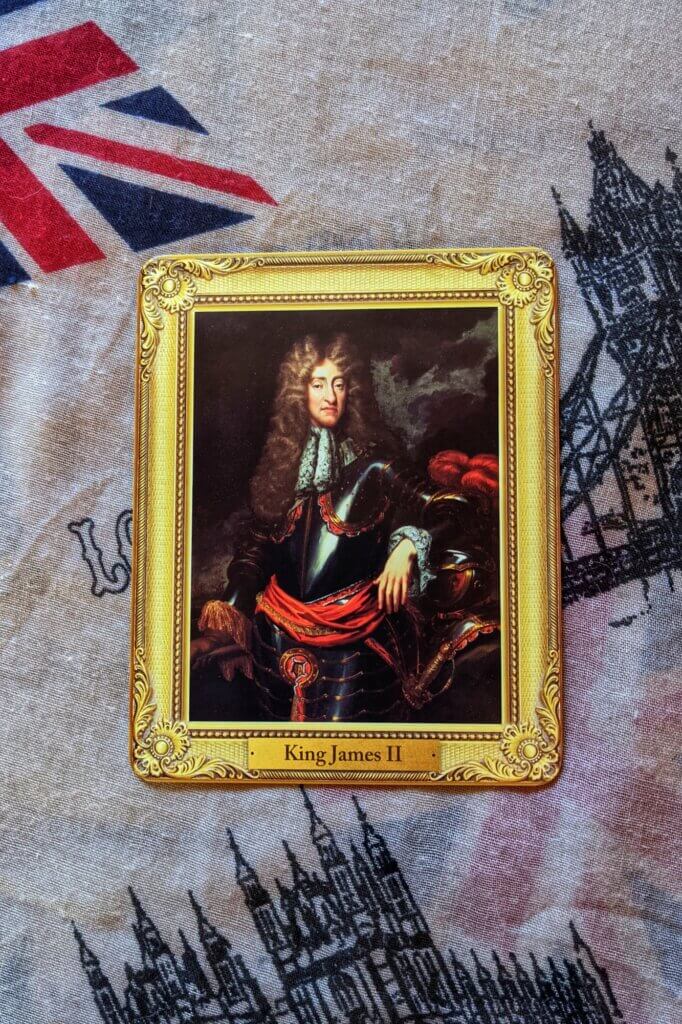
James II: Interesting Facts
– James was the last Catholic monarch of Great Britain.
– His son James Francis Edward Stuart would be known as “The Old Pretender”, and was a rallying point for those who supported the Stuart claim to the throne.
– James faced two rebellions during his short reign, including one led by his nephew (Charles’ illegitimate son, the Duke of Monmouth).
– While he was in Oxford during the Civil War, he was made a Master of Arts.
Further Readings on James II
Vallance, Edward. The Glorious Revolution: 1688, Britain’s Fight for Liberty. New York: Pegasus Books, 2008.
Womersley, David. James II: the Last Catholic King. London: Penguin Books, 2019.
Rex Factor Podcast. James II episode
Looking for my earlier Monarch of the Month posts? Read about:
Mary I
Anne
Edward the Confessor
William IV
Edward IV
James I
George V
Mary, Queen of Scots
George IV
Henry VII
Mary II
I hope you’ve enjoyed this Monarch of the Month, King James II!
Cheers,
The Historian
Facebook | Twitter | Instagram | Pinterest | Bloglovin’


.jpg)


Is it significant that when, after James II’s flight, Parliament passed the Bill of Rights they included a long list of his misdeeds (e.g. use of suspending and dispensing powers, cruel and unusual punishments, standing army in peace time) but did NOT mention the “warming pan plot? Surely, if they had believed it they would have put it at the head of the list!
I still find the Warming Pan Plot entirely ludicrous 🙄 It absolutely speaks volumes about the plot itself- a poor diversionary tactic!