We are taking a bit of a divergence for December with Monarch of the Month- we are heading north to Scotland. She is one of my favourite historical figures, she was born in December, and I knew I had to feature her- it is Mary, Queen of Scots. Mary Stuart features in countless books, films, and television shows. She often gets the short end of the stick, in my opinion, but I will discuss that later. Without any further adieu, let’s get into our December Monarch of the Month: Mary, Queen of Scots!

Mary, Queen of Scots is one of my favourite royal figures. I can’t say that I would have necessarily made the same choices that she made, but I can see that she let her heart make decisions. People often praise Elizabeth I for being a careful and strong ruler and endlessly insult Mary for being emotional, but I think that that is a very simplistic and rather misogynistic view. (Elizabeth is praised for her more “male” traits and approach, while Mary is clearly the faulty female…) The two situations were not alike, and both had very different things to tackle in their reigns. Mary Stuart is fascinating, and deserves our attention and respect, too!
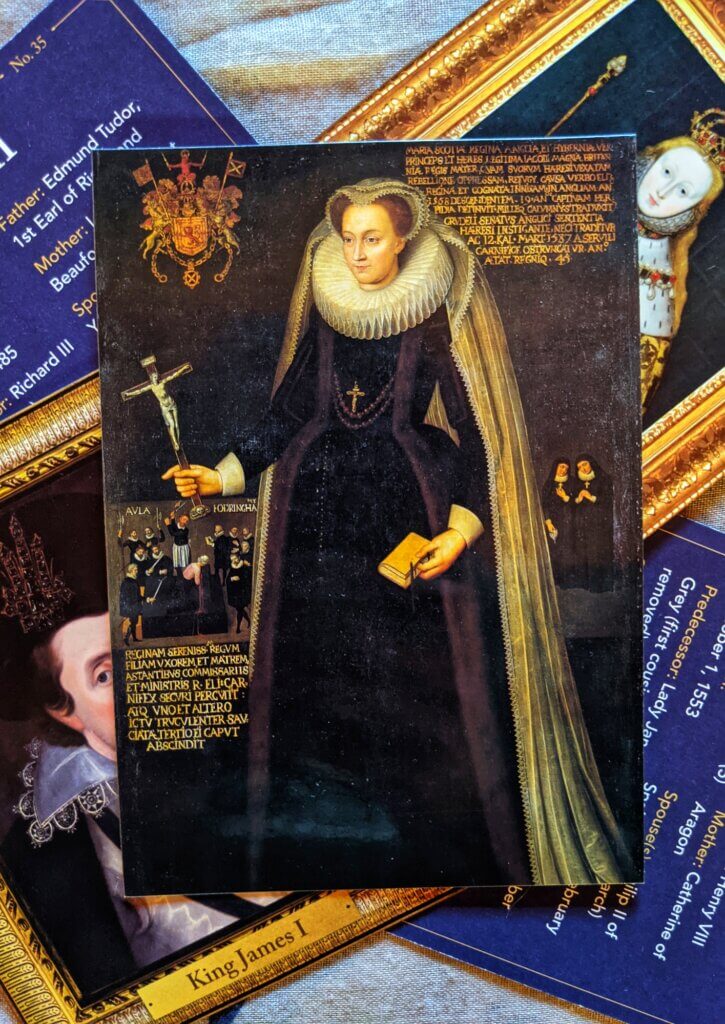
Monarch of the Month: Mary, Queen of Scots Fast Facts
Birth Date: 8 December 1542
Death Date: 8 February 1587
Reign: 14 December 1542 – 24 July 1567
Coronation Date: 9 September 1543
Predecessor: James V
Successor: James VI
House: Stewart (Stuart)
Father: James V
Mother: Mary of Guise
Spouse(s): Francis II of France; Henry Stuart, Lord Darnley; James Hepburn, 4th Earl of Bothwell

Why Do We Know Mary, Queen of Scots?
If you are a big fan of Elizabeth I, you very well may know Mary as the thorn in Elizabeth’s side. And if you are a film buff, you may know her from the titular Mary, Queen of Scots from 2018. In most forms of media (that film included), she generally exists now in opposition to Elizabeth. The one outlying exception to this is Reign! A CW drama from 2013-2017, Reign follows a teenage Mary at the French court, back in Scotland, and then in England at the end. No, it’s not in the least bit accurate but it brought Mary back to focus.

Mary, Queen of Scots- Queen From the Beginning
James V of Scotland married Madeleine of Valois in 1537 in Paris, but she died shortly after landing in Scotland, never having been in good health. In 1538, James then married Mary of Guise, a French widow with two sons from her first marriage. She gave birth to two sons, but both died in infancy. However, their daughter Mary, born on 8 December 1542 survived. Mary was reportedly born premature and was originally said to be sickly and small, but an English diplomat saw her in March of 1543 and wrote back that she was healthy and strong. Her father died only 6 days after she was born, meaning that Mary was Queen of the Scots as of 14 December 1542. (She never knew life as anything other than a queen, and I think that that absolutely plays into her future choices…)

The Regency and Living in France
Obviously, one cannot rule as Queen when an infant. Or even really a child. The Protestant Earl of Arran was able to become Regent with the support of various nobles. By 1554, Mary of Guise was able to remove him though, and serve as Mary’s Regent herself. In 1543, Scotland and England signed the Treaty of Greenwich, which would have seen Mary marry the future Edward VI. However, the Scots then signed a new treaty with Henry II of France in exchange for French military help, and Mary was betrothed to Francis, the Dauphin.
Mary arrived in France in August of 1548, with the four Marys- Mary Beaton, Mary Fleming, Mary Livingstone, and Mary Seton. The young Mary and her ladies were quickly court favourites. She was raised with Henry’s children, including her future husband Francis, and was a vivacious and lively girl. She learned several languages, including French, Greek, Spanish, and Italian (in addition to Scots), horseback riding, dancing, and multiple instruments.

Queen of France and a Return to Scotland
As set out by the treaty, Mary and Francis married on 24 April 1558 at the Cathedral of Notre-Dame in Paris. In 1558, the English Queen Mary I had died and named her sister Elizabeth heir; many Catholic European rulers, including Henry II of France believed that Mary’s claim through her grandmother Margaret Tudor was legitimate and the Protestant bastard Elizabeth’s was invalid. Three weeks prior to her wedding, Mary had signed a secret document that bequeathed Scotland and her claim to the English throne to France if she died. However, Francis died on 5 December 1560.
Francis’ reign only lasted from 10 July 1559 to 5 December 1560. Mary’s mourning included waiting for 40 days to see if she was pregnant, but unfortunately she wasn’t. Her mother-in-law, Catherine de Medici, was already focusing on the next king (and Francis’ younger brother), Charles IX. Given that Mary’s own mother passed away in 1560 as well, the French decided it was time for Mary to return to Scotland. She landed in August of 1561 in a tense and troubled Scotland, with tensions high between Protestant and Catholic nobles.

Catholics Against Protestants
Mary’s illegitimate half brother, James, the Earl of Moray, led the Protestant nobles. She chose James as one of her advisors, which didn’t endear her to Catholic nobles, and all the while, Protestant reformer John Knox continued to preach against Mary for being a Catholic and a female ruler. She knew that she needed a husband and an heir, so after much deliberation (including direction from Elizabeth in England, which Mary ignored), she married Henry Stuart, Lord Darnley. Through a claim on the Scottish throne through James II and on the English throne through Henry VII, their 1565 marriage only strengthened the Scottish claim on the English throne.
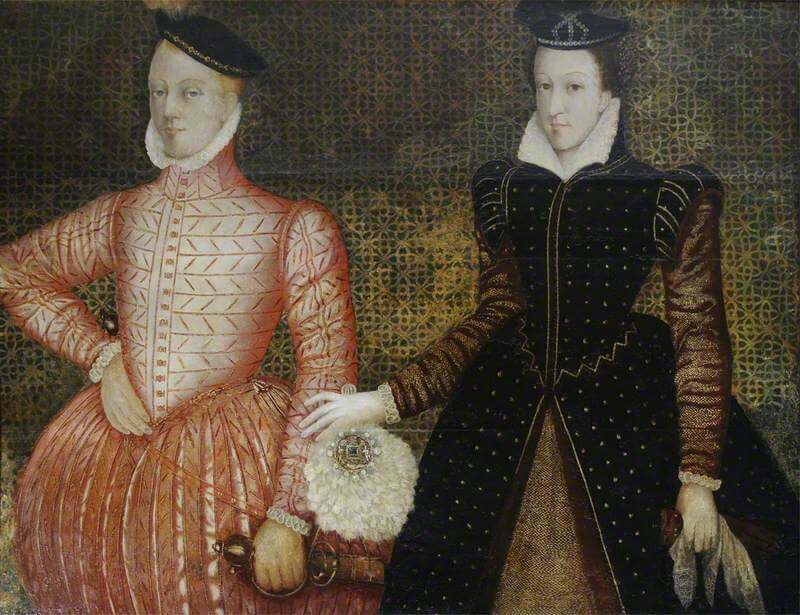
Mary and Darnley: An Ill-Fated Match
However, Mary and Henry were ill-suited. Though she enamoured with him prior to their wedding, things quickly changed. He was fixated on having the Crown Matrimonial (being King of Scotland instead of a king consort), and his arrogance drove Mary away. She was able to conceive though, and gave birth to their son in June 1566. While pregnant, Darley and several Protestant nobles held Mary at gunpoint in her chambers at Holyroodhouse while assassinating her private secretary, David Rizzio. (Gruesomely you can still see the bloodstain on the floor.)

Murder in Edinburgh
Early in the morning of 10 February 1567, Darnley and his valet were both found dead in the garden of the house he was staying at in Kirk o’Field. He had been recovering from a bout of smallpox (or syphilis, depending on which historian you ask.) A large explosion had rocked the house, but neither man’s body was damaged by the explosion. (What actually happened is still a mystery…) Mary was considered a suspect- she was at a wedding that evening but could have theoretically arranged it. Elizabeth implored Mary as a fellow sovereign to find and prosecute the wrong-doers to clear her name but Mary did not.

Mary Remarries and Abdicates
By the end of February, most people believed that James Hepburn, Earl of Bothwell to be guilty of the murder. And on the 24 of April in 1567, Mary was abducted by Bothwell and his men and taken to Dunbar Castle. It is unclear whether or not Mary willingly went, and whether or not Bothwell raped her, but they married on 15 May in Edinburgh in a Protestant ceremony. Catholic nobles didn’t accept the marriage as they didn’t accept Bothwell’s divorce from his first wife or the Protestant ceremony. And Protestants and Catholics alike were horrified that she married the man who may have murdered her husband.
Twenty-six Scottish lords called their own army and moved against Mary and Bothwell. They were captured, and Mary was taken to Edinburgh where she was forced to abdicate in favour of her infant son. She was then imprisoned in Loch Leven Castle where she miscarried twins in the second half of July. Close to a year later, she escaped Loch Leven and after raising a small army, made it to England.

Life in English Captivity and Death
Mary was taken into protective custody, and fully expected her cousin to help her regain her throne as a fellow anointed monarch. Given that Mary still believed she had a legitimate claim to the English throne (more so than Elizabeth), Elizabeth was in a difficult position. Elizabeth’s councillors held an inquisition/trial In York- Mary refused to recognise the authority of any court to try her as a monarch, and Elizabeth forbade her to attend anyways. Mary’s half brother presented the Casket Letters as evidence against her, a set of letters apparently written by Mary and Bothwell that proved her role in the murder. Most historians believe they were forgeries.
There were multiple plots to help Mary escape captivity, but none were successful. After the Babington Plot in 1586, Mary was put on trial for treason at Fotheringhay Castle. On the 25th of October in 1586, she was found guilty of treason and sentenced to death. Elizabeth hesitated to sign her cousin’s death warrant but signed it on 1 February 1587. Ten of her councillors carried out the sentence without her knowledge, and Mary was executed on 8 February 1587. She wore a red petticoat, the colour of Catholic martyrs. After the beheading was complete and her body carried away, her small dog reportedly emerged from her skirts where it had stayed with her until the end.

Mary, Queen of Scots: Interesting Facts
– She is known as Mary, Queen of Scots instead of Mary, Queen of Scotland because she technically ruled over the Scots people, not the actual land.
– Mary used white wine regularly as a face wash, and believed that it even helped with pain management. (She was quite often sick throughout her life.
– She was the first woman to play golf in Scotland.
– Mary was a tall woman, for the period and even now- she reportedly grew to 5’11”.
– Although they never met face to face in real life, Mary and Elizabeth are actually buried quite close together in Westminster Abbey. (This was done in the reign of Mary’s son, King James VI/I.)

Further Readings on Mary, Queen of Scots
Fraser, Antonia. Mary Queen of Scots. New York: Delta, 2001.
Guy, J. A. Queen of Scots: the True Life of Mary Stuart. Boston: Houghton Mifflin, 2005.
Dunn, Jane. Elizabeth and Mary: Cousins, Rivals, Queens. New York: Vintage Books, 2005.
Rex Factor Podcast. Mary, Queen of Scots: Biography 1, Biography 2, Review Episodes.
Looking for my earlier Monarch of the Month posts? Read about Mary I here! And read About Anne here! Edward the Confessor more your speed? Or William IV? Edward IV? Maybe James I? Or our own Queen’s grandfather, George V?
Cheers,
The Historian
Facebook | Twitter | Instagram | Pinterest | Bloglovin’