This month we are deviating from English/British monarchs and heading to Russia! In honour of the second season of The Great premiering on 19 November, and her death on 17 November, we are going to be covering Catherine the Great. She is one of the most famous and infamous rulers, and although we have a lot of information about her, a lot of her reign has been shrouded in misinformation. (If we are being honest, it’s largely due to that horrible crime of being a woman…) The Romanov dynasty is rich with fascinating rulers, but she tops the list for me… Let’s look at our November Monarch of the Month: Catherine the Great!

Monarch of the Month: Catherine the Great Fast Facts
Birth Date: 2 May 1729
Death Date: 17 November 1796
Reign: 9 July 1762- 17 November 1796
Coronation Date: 22 September 1762
Predecessor: Peter III
Successor: Paul I
House: Holstein-Gottorp-Romanov
Father: Christian August, Prince of Anhalt-Zerbst
Mother: Princess Johanna Elisabeth of Holstein-Gottorp
Spouse(s): Peter III of Russia

Why Do We Know Catherine the Great?
Because she is great… But in actuality, Catherine left her mark on Russia in numerous ways. She brought Enlightenment thinkers and texts to Russia. The Hermitage Museum in St Petersburg (in what was the Winter Palace) houses her art collection and library, and the Hermitage actually had to be expanded during her reign. Catherine took the throne from her husband in a blood-less cool, which is also fairly notable.
Also, I don’t like including this because it has literally no basis in truth, but there is that persistent rumour that she had sex with a horse. (I think that The Great handles this perfectly, and shows how a rumour like that gets started…)

Catherine the Great’s Early Life
Catherine was born as Sophie Friederike Auguste von Anhalt-Zerbst-Dornburg in the Kingdom of Prussia (now Poland) to Prince Christian August of Anhalt-Zerbst and Princess Joanna Elisabeth of Holstein-Gottorp. She had a fairly uneventful childhood, in comparison to her later life, and was a tomboy who enjoyed learning.
Sophie met her future husband, the then-Carl Peter, when she was 10, and immediately disliked him. He was a rather frail and sickly boy who preferred to spend most of his time playing with his toy soldiers (a hobby that continued into his adulthood), and drinking… as a child.

To the Russian Court We Go
Empress Elizabeth of Russia ruled from 1741 to 1762 and incredibly (for the period) did not execute a single person during her reign. She was the second-eldest daughter of Peter the Great, and had no children of her own- in 1742, she declared her nephew, Carl-Peter as her heir. And as such, she needed to find him a bride. Sophie was a rather strong candidate from the start. She was beautiful, intelligent, and royal but not from a particularly powerful kingdom- win, win, win!
Elizabeth invited Sophie and her mother, Johanna, to the Russian court in 1744. Johanna was not known for being a particularly maternal figure in Sophie’s life, but she was ready and willing to push her as Peter’s wife. As soon as they arrived, Sophie threw herself into the task of impressing the Empress, her court, and Russia as a whole. She set about learning the Russian language and the tenants of Russian Orthodoxy. Sophie actually studied so much that she ended up falling ill with pneumonia, and then pleurisy. Upon her maybe-deathbed, she asked for an Orthodox priest rather than a Lutheran priest, and Elizabeth knew that Sophie was her choice.

Becoming Catherine
The engagement was set and things started moving quickly. In June of 1745, Sophie was received into the Eastern Orthodox Church, and she took the name of Ekaterina, aka Catherine. (Catherine just happened to be the name of Elizabeth’s late mother, yet another way to impress her.)
Peter and Catherine wed on 21 August 1745. They lived at Oranienbaum, and managed the small duchy. The marriage was not particularly successful, even from the start. Neither Catherine nor Peter grew to like the other, and the marriage was not consummated for several years. Many historians belief that Peter was impotent and unable, but he was undoubtedly too immature. When the pair were instructed to go to bed together, Peter would often play with his toy soldiers in the bedroom and even on the bed into the early hours of the morning. And that drinking problem? Peter did not lay off on that, either…

A Serious Lack of an Heir
Given that Peter and Catherine were ostensibly chosen as heir and wife to provide another heir and continue the Romanov dynasty, their lack of consummation (and resulting heir) was a serious issue. After Elizabeth made several attempts to help (typically with the aid of one of her ladies), they chose the somewhat-nuclear option: they set Catherine up with Sergei Saltykov, a Russian officer.
The pair quickly hit it off, and Catherine gave birth to her first child, Paul, in 1754, and it is largely assumed that Saltykov was the father. He was quite the roamer, and the relationship fizzled out. She also gave birth to a daughter, Anna, in 1759, but she died as a toddler.
Peter knew that he was unlikely to be the father, and became even more difficult to be around. Catherine knew that people were not hugely thrilled with him, but as Grand Duchess, there was little she could do.
Emperor Peter III… For Now
Peter ascended the throne upon Elizabeth’s death on 5 June 1762. And he was deposed by July of that year. Prior to Elizabeth’s death, Catherine and her supporters had quietly begun meeting and feeling out support in the court, the church, and the military. In a swift and bloodless coup, Catherine’s supporters seized power and Peter was forced to abdicate. He was taken to Ropsha, where he died in August. Officially he died of hemorrhoids, but there were (and are) many people who thought that Catherine’s supporters murdered him.

The Empress of Art and Education
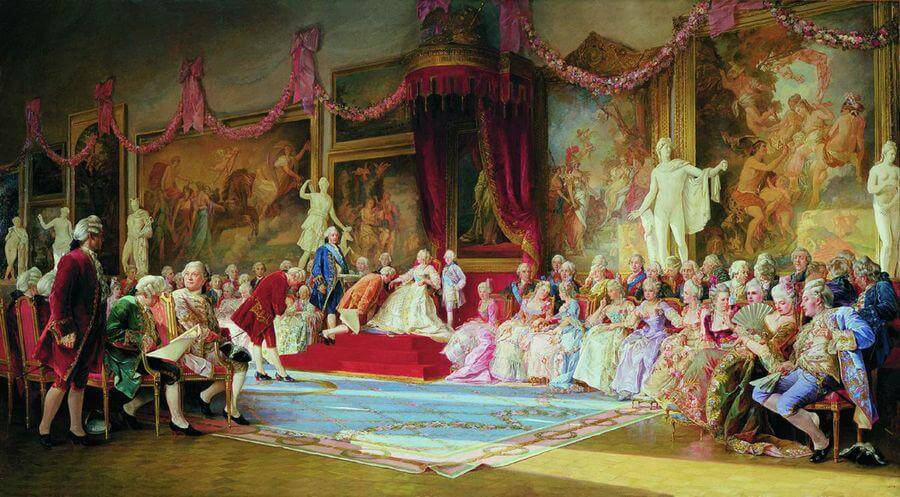
Catherine left her impact on many facets of the Russian court, country, and military; I would argue that her support and promotion of the arts and literature is the most impressive. When reading primary and secondary sources, there are often comments made about Russia being “behind” the rest of Europe. In terms of literacy and philosophy, they were certainly at a different place. Catherine ushered the Enlightenment into Russia, and invited numerous celebrated philosophers, scientists, artists and economists to stay at court. She was particularly enamoured with Voltaire and his works, as well as Diderot. The Russian Enlightenment
The Empress also played a significant role in the founding of one of the first Russian universities, the State University of Land Use Planning. And along with Princess Dashkova, an academic, she founded the Russian Academy in 1783 to centre research on Russian language, literature, and philosophy.
Catherine’s Lovers
Catherine would take many lovers throughout her life after Saltykov. The most significant relationship in her adult life, with Grigori Potemkin, would have lasting impacts. Their romantic and sexual relationship ended in 1776, but Potemkin remained her advisor and friend until his death in 1791. Some of her other partners include Stanislaw August Poniatowski, who would go on to become the King of Poland, Grigori Orlov, who played a crucial role in the 1762 coup, and Prince Zubov, who was almost 40 years her junior.

Catherine the Great: Interesting Facts
-Catherine had to deal with over a dozen uprisings in her reign- she might not have shed blood when she took the throne, but she was forced to later…
-She wrote her own operas- she wrote nine operas, in addition to several comedies and plays.
-Catherine is the longest-serving female Russian ruler in history!
-Russia acquired Crimea during Catherine’s reign.
-Although she was often imagined to be quite tall, Catherine was rather short- she was just shy of 158cm/5’2”.

Further Readings on Catherine the Great
Catherine’s reign transformed many areas of Russian life, including the military and foreign policy. If you want to know more about Catherine and everything she accomplished, I would recommend reading the following books, or my list of Books to Read If You Love The Great!
Massie, Robert K. Catherine the Great: Portrait of a Woman. New York, USA: Random House, 2012.
Montefiore, Sebag Simon. Catherine the Great and Potemkin: The Imperial Love Affair. London: Weidenfeld & Nicolson, 2000.
Queens Podcast, Catherine the Great Episodes: Part One, Part Two, Part Three, Part Four.

Looking for my earlier Monarch of the Month posts? Read about:
Mary I
Anne
Edward the Confessor
William IV
Edward IV
James I
George V
Mary, Queen of Scots
George IV
Henry VII
Mary II
James II
Edward VII
George III
George I
Louis XIV of France
Elizabeth I
How do you feel about our Monarch of the Month: Catherine the Great?
Cheers,
The Historian
Facebook | Twitter | Instagram | Pinterest

.jpg)
.jpg)
.jpg)
.jpg)


.jpg)
.jpg)