This month’s Monarch of the Month jumps across the Channel to France- King Louis XIV! He looms large in history in so many ways. As a ballet dancer, I’ve always had a soft spot for Louis, but luckily I’m not alone in that. (That isn’t to say he was perfect- none of us are close…) Given that he was both born and died in September, it seemed fitting to choose him for this month. So, without any further adieu, our September Monarch of the Month: King Louis XIV!

Monarch of the Month: Louis XIV Fast Facts
Birth Date: 5 September 1638
Death Date: 1 September 1715
Reign: 14 May 1643- 1 September 1715
Coronation Date: 7 June 1643
Predecessor: Louis XIII
Successor: Louis XV
House: Bourbon
Father: Louis XIII
Mother: Anne of Austria
Spouse(s): Maria Theresa of Spain; Françoise d’Aubigné
Why Do We Know Louis XIV?
Well, being honest- we know him for many reasons. I’m going to start with Versailles- one of the most elaborate and incredible palaces in the world. (But also the show Versailles…) The seventeenth century Baroque palace and grounds are still one of the most popular tourist sites in the world. Maybe you know him for his rather long reign (though Queen Elizabeth II might overtake him in a few years). Or perhaps you are like me, and you know him from his pioneering work in the art of ballet. In any case, he is certainly a prominent figure in early modern history.
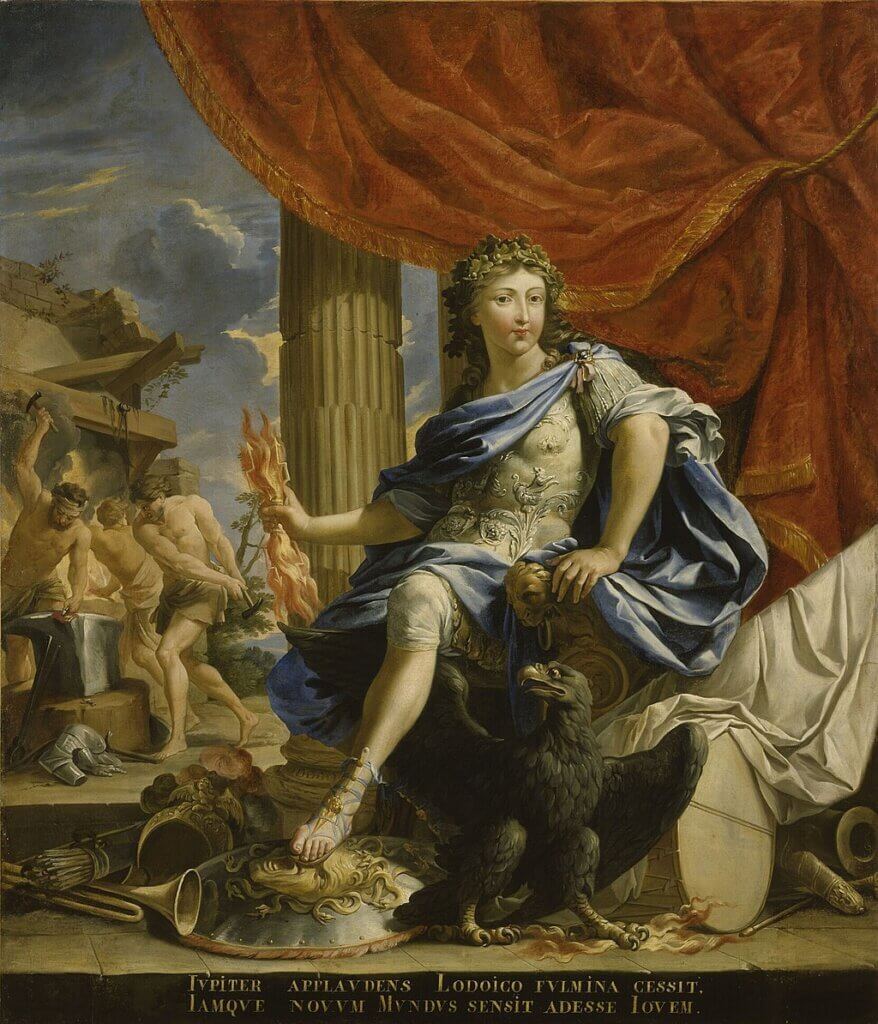
King Louis XIV’s Early Life
Louis was born 5 September 1638 to Louis XIII and Anne of Austria. He was something of a miracle for the couple; married for over two decades, Anne had had four stillbirths before Louis was born. His younger brother, Philippe, the Duke of Orléans, followed a little over two years later. By 1642, his father was ill (possibly with tuberculosis) and knew he would die soon. In breaking with tradition, instead of making Louis’s mother sole Regent for the young boy, he created a regency council instead (with Anne at the head). Upon his death in May 1643, a four and a half year old Louis XIV ascended the throne. He was largely raised by two governesses in his young years, and then educated by a tutor, Nicolas V de Villeroy. Louis spent much of his time with Villeroy’s children and his younger brother.

Louis XIV, Ladies Man
One very popular topic of discussion when it comes to Louis XIV is the women in his life. He married Maria Theresa of Spain on 9 June 1660. Louis was faithful to Maria Theresa in the first year, and she was pregnant by the beginning of 1661. The couple would have six children together, though sadly five would die before reaching adulthood. Maria Theresa died in 1683, quickly of a difficult illness.
Louis had several different mistresses, both official and unofficial. Two of the most notable mistresses are Louise de La Vallière- they were together from 1661 to 1667 and had five children together- and Françoise-Athénaïs, Marquise de Montespan- together from 1667 to 1680 and had seven children together. He often had several mistresses simultaneously, and some held great influence at court.
Louis did remarry, either in late 1683 or early 1684. Françoise d’Aubigné, Marquise de Maintenon was a governess to his legitimised children from the Marquise de Montespan, and he grew to favour her while she cared for his children. Françoise was incredibly religious. Louis was a pious king and observed daily, but she was far more so than he was. Interestingly, it is thought that he stayed faithful to his second wife.

Versailles: Palace of Palaces
If you only know one thing about King Louis XIV, you will know that he built the Palace of Versailles. Versailles was originally one of Louis XIII’s hunting chateaus, a place for the king to rest after a long day of hunting instead of having to return to Paris. In the early 1660s, Louis decided to expand Versailles after visiting the impressive Chateau de Vaux-le-Vicomte. There were three stages of construction on the palace, from 1661 to 1715.
Versailles served many purposes, aside from being a luxurious home. It was the centrepiece of French Baroque architecture, highlighting the talent of French architects, craftsmen, and artists. Once expanded enough, it also housed the entire court- it allowed Louis to maintain control as the absolute monarch that he was. The nobility were forced to follow an elaborate social system, with a set etiquette that defined exactly who everyone was and what they were allowed to do. (More on that later…) In any case, it is still one of the most impressive estates in existence.

The Absolute *Catholic* Monarch
As I mentioned above, Louis was an absolute monarch. What is an absolute monarch, you ask? It is a monarch who has complete control over law and society- they do not need a government or representatives to make decisions. Louis firmly believed in the divine right of kings, and that as God’s anointed king, his decisions were not to be questioned by anyone and he was only answerable to God.
As a devout Catholic, Louis swore that he would defend the Catholic faith at his coronation (unsurprising..). In 1685, Louis issued the Edict of Fountainbleu, aka the Revocation of the Edict of Nantes. The Edict of Nantes was issued in 1598, and granted Huguenots (a Protestant group) the right to practice their religion peacefully. Louis’s edict forced thousands of French Protestants to convert to Catholicism, with another two hundred thousand fleeing France.

Ballet… Of Course…
Obviously we were going to talk about ballet- I am me, of course. The Italian Catherine de Medici brought a form of court dance with her from Italy, and that would evolve into ballet. Much of what we know ballet to be now is because of King Louis XIV. He took part in his first ballet at 14, and at 16 starred in Ballet Royal de la Nuit as Apollo, the Sun God. (Funny how he was known as the Sun King, isn’t it?) He took a daily ballet class, and retired from performing himself in 1670.
Louis’ major balletic accomplishment was codifying ballet. In 1662, he founded the Académie Royale de Danse where the most talented ballet masters would set steps, positions, and progressions. (This company is still performing today- you might know them as the Paris Opera Ballet.) During Louis’ reign, ballet was not performed by professional dancers but rather by nobles, and only men took part. Louis’s elaborate forms of etiquette at court paired perfectly with ballet- another way to keep people in very specific places doing very specific things.

The Legacy of Louis XIV
Louis’ legacy is complex; any monarch’s is, but when you rule for over seven decades, there is a lot to unpack. He is defined as the absolute monarch, and a centralised France that revolved around the king is still the image we have today. Unfortunately, Louis XV and Louis XVI had a bit of a different go of things, and that legacy didn’t last terribly long in the grand scheme of things.
I would also say that both Versailles and ballet can be counted under his legacy. Though neither can be attributed solely to him, he played a massive role in the creation.development of each.

Louis XIV: Interesting Facts
– Louis is currently the longest reigning monarch of a sovereign state, at 72 years, 110 days (as of September 2021).
– He purchased the Hope Diamond in 1668; sadly it was stolen in 1791 (during the French Revolution).
– The state of Louisiana is named for Louis!
– He was almost constantly at war for almost all of his reign, and fought against nearly every European power.
-Apparently a bizarre (referred to as “eccentric) Englishman, William Buckland, ate Louis’ preserved heart.

Further Readings on Louis XIV
Fraser, Antonia. Love and Louis XIV: The Women in the Life of the Sun King. New York: Nan A. Talese/Doubleday, 2006.
Wilkinson, Josephine. Louis XIV: The Power and the Glory. New York: Pegasus Books, 2019.
“The Sun King In Love: Louis XIV and His Mistresses” episode from Not Just the Tudors.

Looking for my earlier Monarch of the Month posts? Read about:
Mary I
Anne
Edward the Confessor
William IV
Edward IV
James I
George V
Mary, Queen of Scots
George IV
Henry VII
Mary II
James II
Edward VII
George III
King George I
What do you think of the September Monarch of the Month, King Louis XIV: the Sun King?
Cheers,
The Historian
Facebook | Twitter | Instagram | Pinterest