On one of many historical stops out on the best day ever, Hisdoryan and I visited the Queen’s Gallery at Buckingham Palace to see the new Romanov exhibition. I don’t think that you can call yourself a royal historian if you don’t have at least a passing interest in the Romanovs. They are the ultimate royal tragedy, and the complex human nature of the dynasty is why it is still studied today. The royal families of Russia and Great Britain enjoyed a particularly close relationship in the nineteenth century, but the relationship was cemented centuries earlier. The Russia, Royalty, and the Romanovs exhibition at the Queen’s Gallery is a look at that relationship through art!

Russia, Royalty and the Romanovs: Key Details
The Russia, Royalty, and the Romanovs exhibition is at the Queen’s Gallery at Buckingham Palace in London. Although Buckingham Palace is not open to visitors currently, the Gallery is. It opened on 9 November 2018 and is open until 28 April 2019- if you want to see it before it closes, I would make my way there soon! A standard adult ticket is £12.00, and I would say that you could allow yourself an hour safely for this exhibition. There is an additional exhibition included in your ticket, Roger Fenton’s Photographs of the Crimea, but we only spent a few minutes there.
Russia, Royalty, and the Romanovs: Featured Monarchs
Obviously, an exhibition about royalty and the Romanovs is going to feature more than one monarch. (It’s the nature of the beast, folks.) The exhibition begins with the man himself, Peter the Great. Peter visited London in 1698 and discovered a love of ship building which would stay with him for the rest of his life. This particular portrait was painted by Sir Geoffrey Kneller during Peter’s visit, and served as the model for future portraits of the Tsar. Because he was the first Russian monarch to step foot on English soil, I find this portrait particularly interesting.

Nicholas I, not a Tsar many of us are familiar with. Ruling from 1825-55 he was the definition of autocracy, and was a politically conservative ruler. Russia’s territory expanded during his reign, but it also ended with huge losses in the Crimean War. You can see that he thought of himself as a military ruler by his uniform and the officer in the background.

Catherine the Great, also known as Empress Catherine II of Russia, is an infamous ruler. Although there are many myths, legends, and rumours that continue to circle her reign to this day, she led a cultural revolution in Russia. She greatly admired Peter the Great, and continued to lead the Russian aristocracy on a Western path. She also worked on the empire’s administration, and during her reign, several of towns and cities were founded. I would love to see a younger portrait of Catherine, but both of these are impressive in their own right! This portrait was quite small, but the detail is exquisite.

And this portrait is simply larger than life, much like the other Russian portraits in the exhibition. (Many of my photos are taken from an angle to avoid glare from overhead lights. In some cases, I wasn’t able to avoid it, but I did my best!) That court mantua is something else, am I right?

And of course, Nicholas II. If you know no other Romanov ruler, you probably know of Nicholas II, the Tsar who lost everything, literally. A family man at heart, Nicholas wholeheartedly believed that he was a divinely appointed autocrat who had complete control over Russia. I was particularly interested in his role in the exhibition- by the late nineteenth/ early twentieth century, the British monarchy is nearly fully ceremonial. (Almost the polar opposite to the Russian imperial family…) However, because most of the pieces of Nicholas were created by Russian artists, it didn’t quite as into that aspect as I would have liked. Still, this is an impressive portrait, and quite a human portrait.

Russia, Royalty, and the Romanovs: Supporting Royals
There were also quite a few “supporting” royals included in this exhibition. Wives, brothers, daughters, cousins, Europe’s royal families are a bit of a logistical mess, all intermingled. I did love seeing all of their portraits, though, as the monarch does not make the royal family on their own.
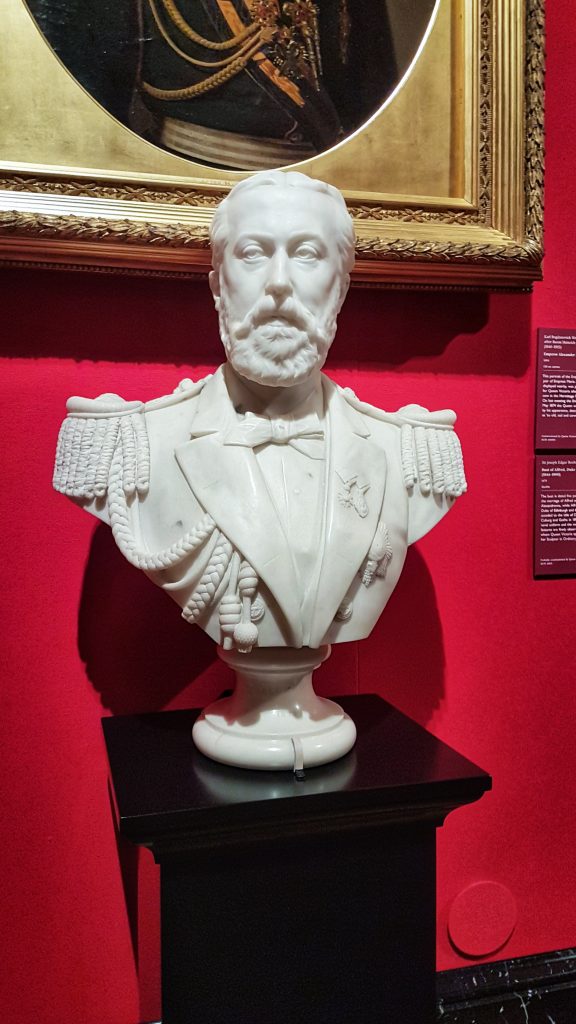
This bust is of Prince Alfred, Duke of Edinburgh, the fourth son of Queen Victoria and Prince Albert. You may ask why he is included in the exhibition. Well, he married Grand Duchess Maria Alexandrovna in the Winter Palace in St. Petersburg in 1874. Not a happy marriage, Maria rather hated life in England and thought she should have precedence over the Princess of Wales given her higher birth. (Queen Victoria wasn’t having it, FYI…)
This gorgeous portrait is of Grand Duchess Alexandra Iosifovna, wife of Grand Duke Konstantin Nikolayevich. You will notice that it is a Winterhalter portrait, which is why the dress looks so incredibly beautiful.

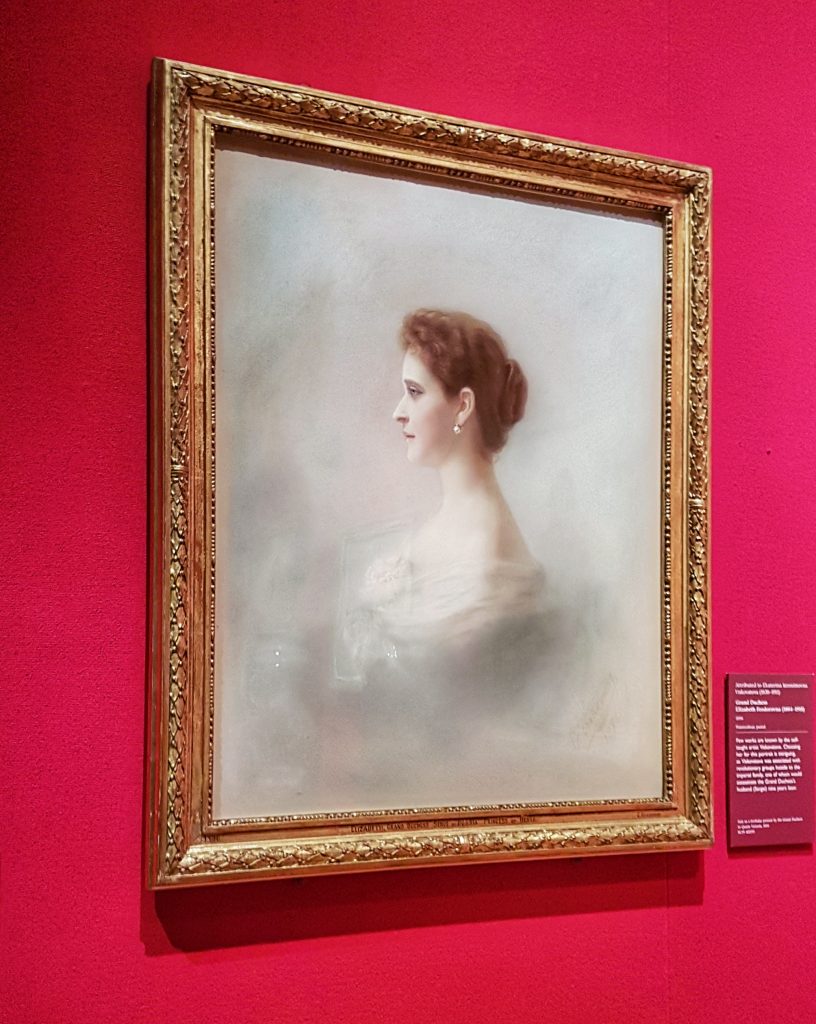
Princess Elizabeth of Hesse and Rhine, also known as the Grand Duchess Elizabeth Feodorovna of Russia, was the Empress’ older sister. She married Grand Duke Sergei Alexandrovich, uncle to the Tsar. After Segei’s assasination in 1905, Elizabeth fully committed herself to a religious life. She became a vegetarian, sold all of her clothing and jewellery, and opened a convent. Sadly, she was arrested and then executed by the Bolsheviks. Elizabeth was canonised in 1981.
Empress Maria Feodorovna, aka Dagmar of Denmark, a lasting figure in the Romanov family. You may know her as Angela Lansbury’s grandmother in the Fox Anastasia film, but Maria was a loved Empress. Sister to the future Queen Alexandra (consort to Edward VII), the people and the aristocracy loved her alike. I admit, this is one of my favourite portraits in the exhibition, the way you can see the texture of the lace in her dress is spectacular.

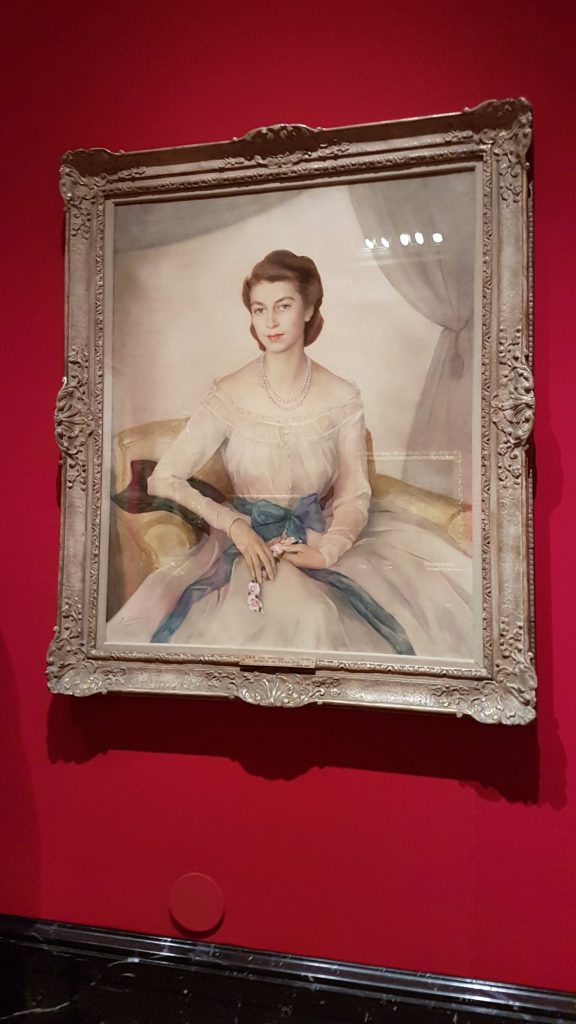
I loved the inclusion of modern portraits, as well. These portraits of Queen Elizabeth (now the Queen Mother) and Princess Elizabeth are quietly beautiful, and I think that they are quite intimate.

How young does our Queen look here? Normally, the portraits we see now are from the later years of her reign, but I loved this portrait from when she was heir to the throne.
Russia, Royalty, and Romanovs: Fabergé Pieces
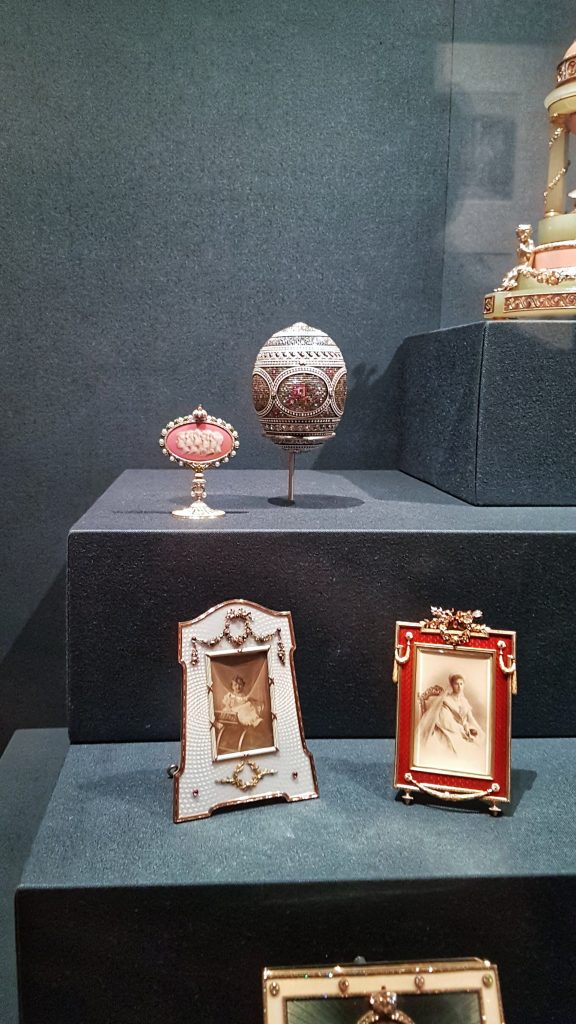
I think that the Fabergé pieces were the highlight of the exhibition for many people. The one downfall of Fabergé eggs in an exhibition is that you can either see the egg closed or open with the magic inside showing, you can’t see both. These eggs were closed, but you still can’t be too upset given how gorgeous they are. There are also picture frames, cigarette cases, and other knick knacks included. This particular egg featured side portraits of all five Romanov children, and it is shown beside the egg here.
This colonnade egg and stand is gorgeous- I can see how this is a present, as it isn’t just an egg but an entire centrepiece. Fabergé and his employees knew exactly how to make a showstopper, and they certainly went above and beyond for the Russian imperial family.

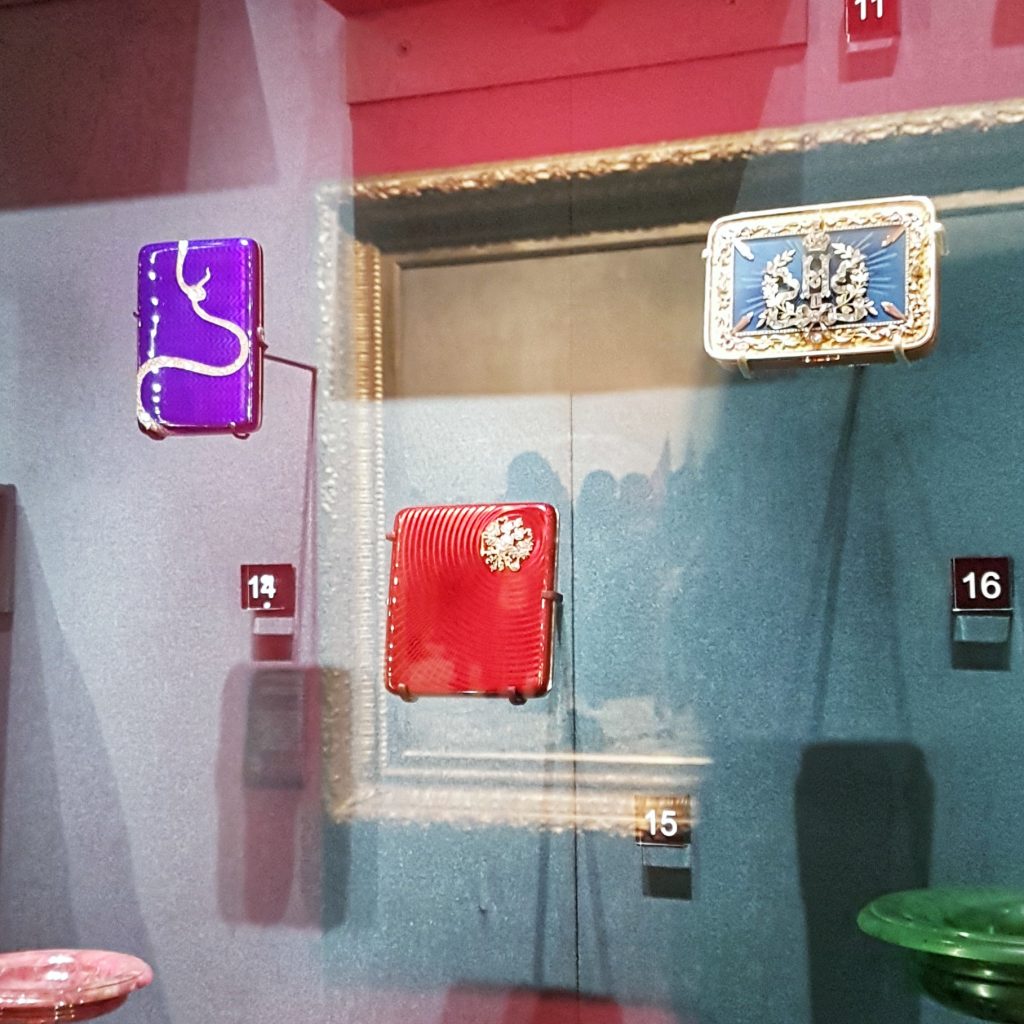
Although smoking isn’t as common now, these cigarette cases are gorgeous. They are simple cases but they are exquisite. (I would probably use it as a business card holder, should I ever somehow get my hands on one!)
Russia, Royalty, and Romanovs: “Other” Pieces
There were a variety of other pieces in the exhibition, as well. I enjoyed seeing all of the different items that were exchanged between the Russian and British royal families, and I think they are wonderful witnesses. This painted fan caught my eye; I’m not sure if it is my fan work from ballet or seeing so many fans in Jane Austen, but it is beautiful in person.

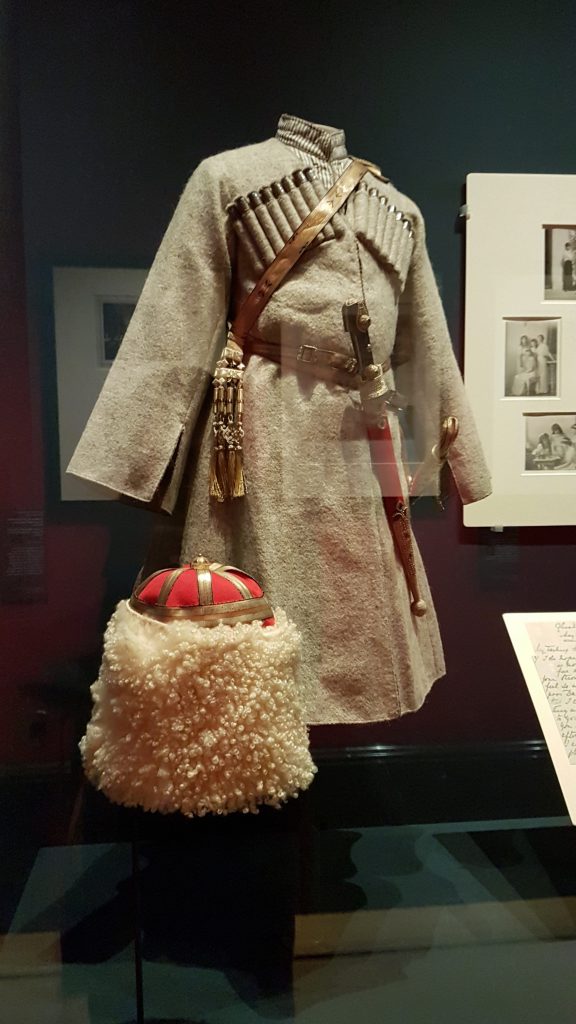
This uniform belonging to the young Tsarevich is one of the most tragic pieces in the exhibition. It was so small, and although it wasn’t fromt he time of his death, it only reminded me just how young he was. I also loved the inclusion of it, as there weren’t many textiles included in the exhibition.
And of course, the tiara. This is formally known as the Grand Duchess Vladimir Tiara, as is worth with pearls or emeralds hanging. We have seen it on Queen Mary, Her Majesty the Queen, Diana, Princess of Wales, and the Duchess of Cornwall, usually with pearls. This was probably my favourite piece in the entire exhibition, because who doesn’t love tiaras?! (The display case had bizarre lighting that made it near impossible to take a good picture.)

Thoughts
Overall, I did enjoy this exhibition! I thought it was lacking in jewellery, specifically tiaras. I was disappointed, given that Queen Mary bought several Russian pieces in the later half of her life, and they are still in the royal collection. However, they do belong to the Crown/the Queen, and they are her’s to do what she will. The Faberge pieces were as gorgeous as I thought they would be, and one of my new goals is to see a Faberge exhibition with many pieces, particularly more eggs. I didn’t buy the exhibition book, as it weighed almost 3kg and was over $100 CAD with the exchange rate. (If I was more interested in art history, I would have considered it.) I think that if you have ever been interested in the Romanovs and their history, you should absolutely make your way there. It is small but interesting, and not too expensive! I will say, I didn’t spend more than a few minutes in the side exhibition on Roger Fenton’s Photographs of the Crimea, though.
Have you been to Russia, Royalty, and the Romanovs?
Cheers,
The Historian
Facebook | Twitter | Instagram | Pinterest | Bloglovin’

Hey, I was curious if you had a clearer photo of the painting you’ve got labelled “Princess Elizabeth of Hesse and Rhine”
It’s difficult to see some of the features due to the glare on the varnish
Unfortuantely I do not- this exhibition was *particularly* bad for glare. I have had great luck in asking the RCT for images of artwork, though!
Late to the party but…
The woman in the gorgeous portrait is not Maria Alexandrovna. She is Grand Duchess Alexandra Iosifovna, wife of Grand Duke Konstantin Nikolayevich (Maria’s uncle).
The following photo of a portrait (“Empress Alexandra Feodorovna”) is actually of Alexandra’s sister Grand Duchess Elizabeth Feodorovna.
Thank you for this!! My photos got shuffled for some reason, and I thought some of the info placquards might not be with their original image! I will be updating these tonight, thank you again 🙂
I think that pearl tiara has my name on it!! 🙂
I know it’s literally impossible, but I would have loved to see it with both pearls and emeralds haha! (Emeralds are my birthstone, so I think I have to go with emeralds!)