For Women’s History Month, I knew that I wanted to highlight a female monarch. Enter: Queen Victoria. She is one of the most recognisable figures on the planet. Her name is used for streets, cities, lakes, and pretty much every geographic feature around the world, the remnants of her British Empire still very much seen today. The second longest reign in British history, she was the last British monarch to celebrate their Golden Jubilee before our current Queen. Let’s jump into our March Monarch of the Month: Queen Victoria!
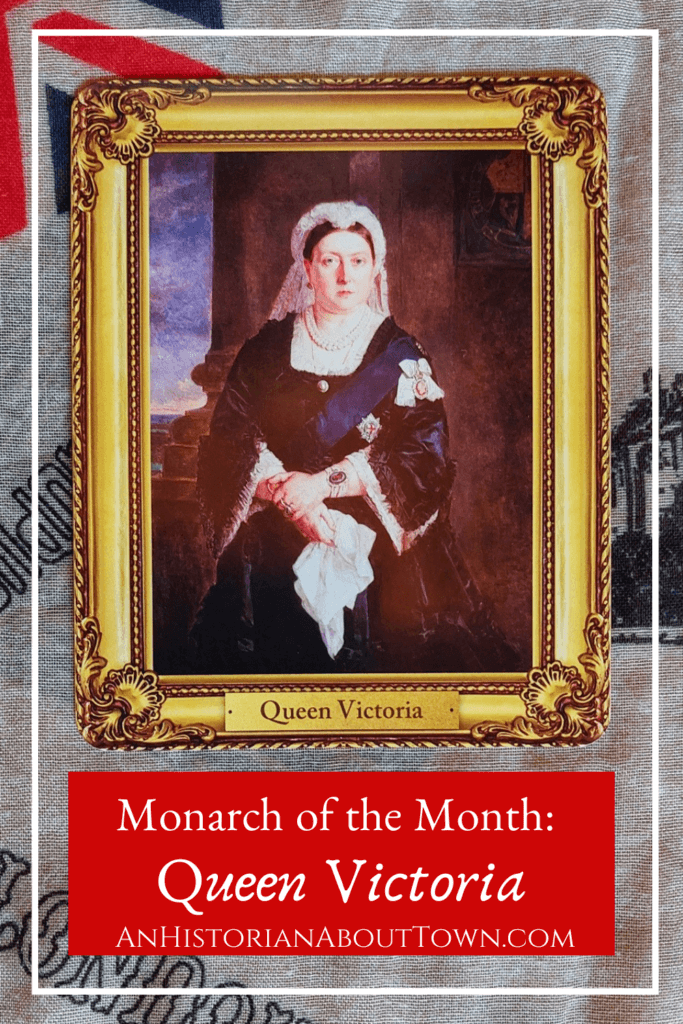
Monarch of the Month: Victoria Fast Facts
Birth Date: 24 May 1819
Death Date: 22 January 1901
Reign: 20 June 1837 – 22 January 1901
Coronation Date: 28 June 1838
Predecessor: William IV
Successor: Edward VII
House: Hanover
Father: Edward, Duke of Kent
Mother: Victoria of Saxe-Coburg-Saalfeld
Spouse(s): Albert of Saxe-Coburg and Gotha

Why Do We Know Victoria?
I’m going to take a safe guess and posit that nearly all of us know Queen Victoria from the British Empire. The vestiges of the British Empire are still felt across the globe in the twenty-first century. While we are looking at the Empire critically through a Postcolonial framework, you can’t deny that the name and face of Queen Victoria is still found in countless countries.
And in the UK specifically, you can see her likeness everywhere. The Victoria and Albert Museum is not only named for the pair, but has their faces all over the place (including in the stained glass windows in the cafe). And the Victoria memorial outside of Buckingham Palace, and Princess Louise’s statue outside of Kensington Palace, and then the statue outside of Windsor Castle… To put it bluntly, she is still everywhere.

Queen Victoria’s Early Life
Although King George III and Queen Charlotte had thirteen children survive into adulthood, they were relatively short on legitimate grandchildren. Their seven sons had quite a few mistresses and there were illegitimate children in many cases, but none that could inherit the throne when the time came. Thus in 1817 when the Prince of Wales’ daughter and only heir died in childbirth, there was a crisis.
Prince Edward, Duke of Kent, broke off with his long-time mistress at age 50 and married Princess Victoria of Saxe-Coburg-Saafeld. The Princess was a widow and had two children from her first marriage.
Princess Alexandrina Victoria of Kent was born in May 1819 at Kensington Palace. She was christened in the Cupola Room at Kensington Palace, and was named in honour of her godfather, Tsar Alexander I of Russia, and her mother. Her uncle, the then-Prince Regent vetoed a number of other names, including Georgina and Charlotte.
Her father died of pneumonia in January of 1820, when Victoria was barely half a year old. She and her mother would remain at Kensington Palace, relying on her father’s family to support them.

A Very Limited Adolescence
If you are familiar with Kensington Palace at all, you will know of the Kensington System. Victoria was closely watched throughout her childhood and adolescence. She was very limited in where she could go and who she could spend time with, and was watched so closely that she was not allowed to walk down the stairs by herself. (You can see said staircase in question above- it’s not a particularly steep or challenging staircase.)
Her mother’s household was run by Sir John Conroy, her very controlling comptroller. (Yes, people think that they may have been lovers but there is no proof.) Conroy’s system was set up to control Victoria from the beginning and ensure that the Duchess (and Conroy unofficially) made Regent should she take the throne before reaching the age of majority.
In 1830, Conroy and her mother took a young Victoria on a tour of country houses and towns. While royal tours and visits seem normal now, it was rather a novel concept at the time.
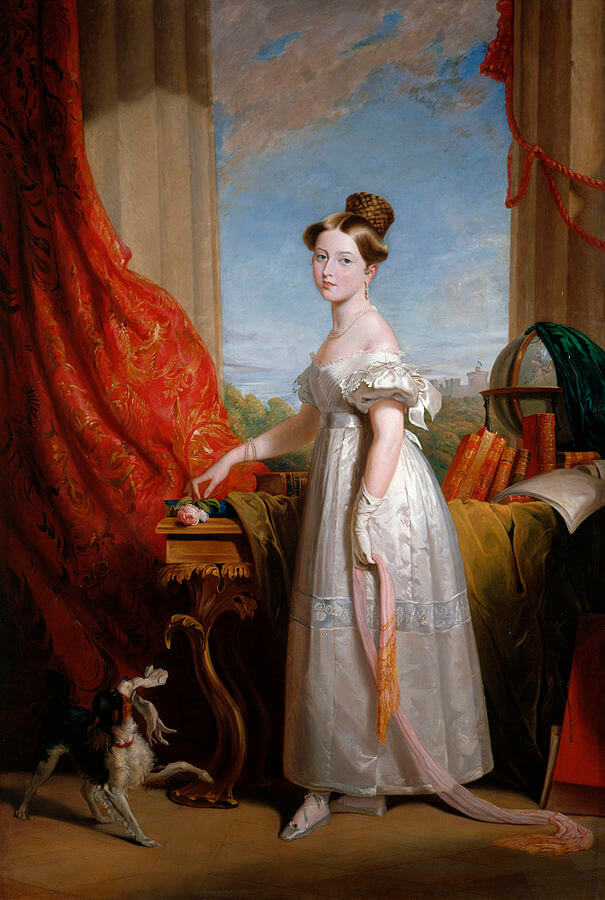
A Young Queen
In 1837 Victoria’s uncle, King William IV, died just days after she turned 18 (meaning she would not need a regent). She was woken up at 630 in the morning, and met with the Archbishop of Canterbury and Lord Conyngham who informed her that she was now Queen.
Victoria’s coronation was held in June 1838, and hundreds of thousands of people flocked to London to celebrate. After both of her uncles’ reigns (including George IV’s tenure as Prince Regent), the young Queen was a breath of fresh air.
Given that her education and upbringing was fairly limited, she relied on her Whig prime minister, Lord Melbourne, to guide her through the early years of her reign. While the ITV series Victoria romanticises this relationship, we don’t have any evidence for this supposed pairing, either. In 1839, when the Whigs lost the election, Victoria refused to remove her Whig Ladies of the Bedchamber with Tory women (as would normally happen), elected leader Robert Peel refused to form a government.
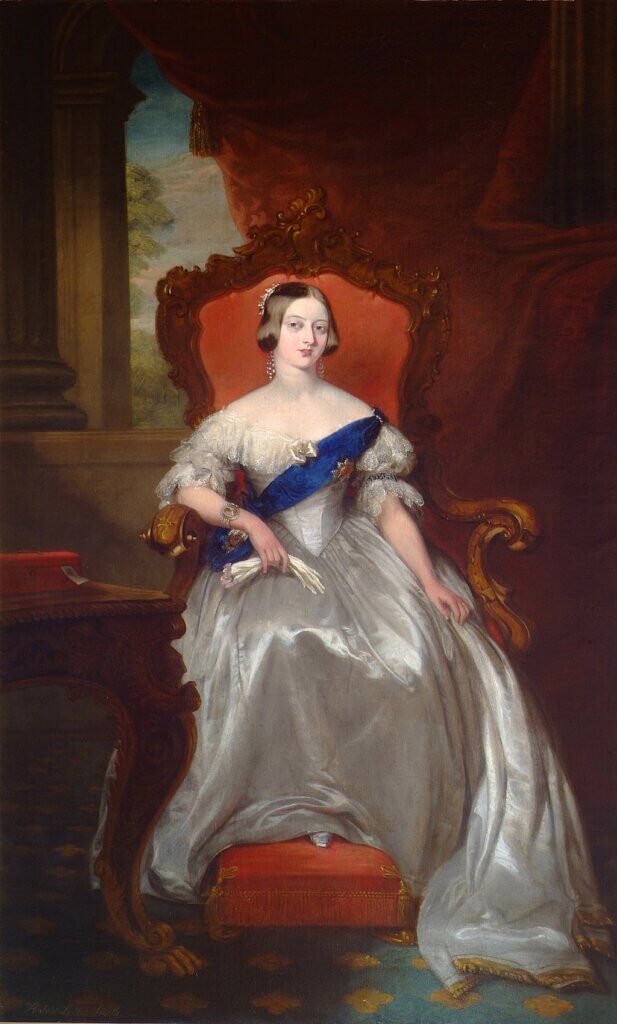
Prince Albert…
Not unexpectedly a lot of people were in a hurry for Victoria to get married and give birth to that all-important heir. Her uncle, King Leopold of the Belgians, felt strongly that his nephew would be a perfect choice, Prince Albert of Saxe-Coburg-Gotha. From a twenty-first century perspective, the idea of first cousins marrying is a horrifying prospect for many of us, but at the time, it was not uncommon in the aristocracy.
They met in 1836 when Albert visited England, and Victoria seemed favourable to him but her uncle was not open to a Coburg match. When Albert again visited in the autumn of 1839, Victoria proposed to him just five days after his arrival. They married on 10 February 1840 at St James’s Palace.
Their relationship is often romanticised as a grand sweeping romance that is the pinnacle of love. However, with a modern perspective, it takes on a very different hue. The couple argued a great deal, and Albert would often treat her like a child when she was upset, simply not responding until she was behaving in a manner he agreed with. While they were passionate in all regards, I can’t say that I think this very codependent relationship was a good thing.

A Family That Spread Throughout Europe
Victoria and Albert very much planned from the beginning for their children to be married into various European royal families. They had nine children, and all nine children survived into adulthood. Albert played a direct role in their oldest daughter, Victoria, marrying into the Prussian royal family, and he and Victoria selected Princess Alexandra of Denmark as a bride for the Prince of Wales, though he wouldn’t live to see the wedding.
They had made plans for several of their other children, and their sons and daughters continued to marry into different families. (Notably, Princess Louise was the only child to marry into a British family.) It quickly becomes easy to see why she is known as the Grandmother of Europe. (Interestingly, Alexandra’s father, King Christian IX of Denmark, was known as the Grandfather of Europe.)
Unfortunately, Victoria passed on the gene that manifests itself as haemophilia to her children. Given that her daughters married into several different families, it spread the disease throughout the royal houses of Europe. Notably, her daughter Prince Alice passed it onto her daughter who would become the last Empress of Russia; the last Tsarevich, Alexei, suffered from haemophilia and the family struggled to bear the weight of the disease and keep it secret for most of his life.

Widowhood
Prince Albert died in December 1861, of typhoid fever. Earlier in the autumn, Albert had found out that the Prince of Wales was having an affair with an Irish actress while completing military training. Albert was fairly strict in his morality, and was angry and horrified to learn this. Victoria’s relationship with her son was permanently damaged with Albert’s death, as she largely held him responsible for it.
Victoria had heavily depended on her husband for their entire marriage. He had carried out a lot of the monarch’s work on her behalf, and taken the lead on raising their family, as well. She immediately went deep into mourning, moving the court to their holiday home on the Isle of Wight. Victoria struck up a close relationship with Scotsman John Brown in the 1860s, another much-romanticised relationship. She somewhat emerged from mourning in the mid-1860s to make public appearances, attending the State Opening of Parliament in 1866 for the first time since Albert’s death. She remained in partial mourning for the remainder of her life; the image of Victoria in her widow’s weeds is imprinted on the collective memory.

A Victorian British Empire
Victoria’s mark was certainly left everywhere through the British Empire. “The sun never sets on the British Empire”, or at least not during her reign. The British subjugated and colonised millions and millions of people across the globe. At the time they believed they were “civilising” these populations, but the ramifications of these actions are still being unpacked now well into the twenty-first century.
If you visit anywhere that was in the British Empire, you will recognise her influence. For example, in Canada, the British Columbian capital of Victoria is named after her, as is the capital of Saskatchewan, Regina (Latin for Queen). Her name is on hospitals, schools, street names, geographic features, theatres, anywhere and everywhere. Or it at least was- many jurisdictions are renaming things with the growing understanding of the harm the British Empire caused.
In 1857, Victoria picked up the title of Empress of India after Britain incorporated all of their Indian holdings into the Empire. Her grandson, King George V, would be the first and only British emperor to set foot in India.
The role that Victoria herself played in the ever-expanding British Empire is debatable. Even by the nineteenth century, the monarch made few decisions in terms of foreign policy, and after Albert’s death, she withdrew from many of her duties anyways. However, these actions were still carried out in her name.

Victoria: Interesting Facts
-The young Princess Victoria adored the ballet and the opera, and attended Covent Garden several times a week as a teenager.
– Alfred, Lord Tennyson was one of her favourite authors.
– Queen Victoria survived no less than eight assassination attempts during her reign.
– She was just over five feet tall!

Further Readings on Queen Victoria
Baird, Julia. Victoria the Queen: An Intimate Biography of the Woman Who Ruled an Empire. New York: Random House, 2017.
Cadbury, Deborah. Queen Victoria’s Matchmaking: The Royal Marriages That Shaped Europe. New York: PublicAffairs, 2019.
Worsley, Lucy. Queen Victoria: Daughter, Wife, Mother, Widow. London: Hodder & Stoughton, 2018.
The Rex Factor podcast. Queen Victoria: Part I episode, Part II episode, Part III episode, Part IV episode, and Part V episode.
Looking for my earlier Monarch of the Month posts? Read about:
Mary I
Anne
Edward the Confessor
William IV
Edward IV
James I
George V
Mary, Queen of Scots
George IV
Henry VII
Mary II
James II
Edward VII
George III
George I
Louis XIV of France
Elizabeth I
Catherine the Great
Edward VIII
Charles I
George VI
How do you feel about our Monarch of the Month: Queen Victoria?
Cheers,
The Historian
Facebook | Twitter | Instagram | Pinterest

_%E2%80%93_Queen_Victoria_%E2%80%93_ABDCC001065_%E2%80%93_Aberdeen_City_Council_(Archives,_Gallery_and_Museums_Collection).jpg)

_-_Queen_Victoria_(1819-1901)_-_RCIN_405021_-_Royal_Collection.jpg)
