Queen Victoria is known for many things. An undying love for her beloved Prince Albert, an often raging temper, a vast and never-ending empire. However, it is only in the last few decades that her interest in the arts is coming to prominence. Several books on her watercolours and sketches have been published, but her interest in the performing arts also deserves attention. She frequented the ballet, opera, and theatre, and it played a big role in her formative years. Today I’m going to be looking at the relationship between Queen Victoria and ballet, particularly Marie Taglioni!

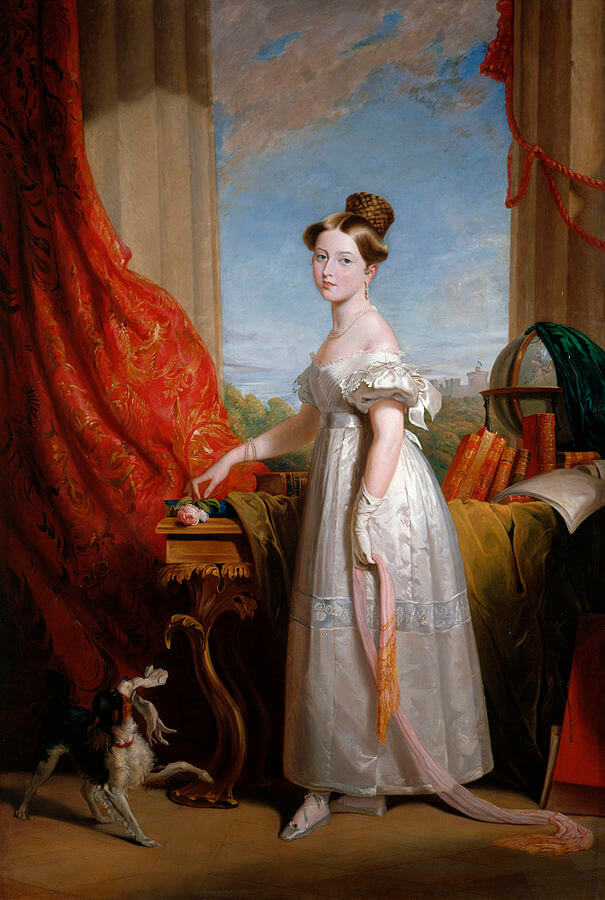
When you read biographies of Queen Victoria, her love of ballet, the theatre, and opera is usually reduced to a line or two in her adolescence. And it often comes across as, “she was young and foolish, and liked ballet and opera”. However, in her younger years, she lead quite a reserved and isolated life- she had very friends of her own age, and none that she could trust. Her outings to see the ballet and theatre in Covent Garden were the highlights of her days, and she would often visit as many as three times a week. Queen Victoria had a particular interest in the infamous ballerina Marie Taglioni, and her admiration was unrelenting; although she was quite rigid and staid in her later years, her interests in adolescent and young adulthood included the exciting and talented Taglioni.
Who Was Marie Taglioni?
Marie Taglioni was infamous in the mid-nineteenth century. She was born in 1804 to an Italian dancer, Filippo Taglioni, and a Swedish dancer, Sophie Karsten. Her father (and his family) was known for acrobatic and comic dancing, but Filippo “also had a strong allegiance to the old French noble style”. (1) Taglioni did start dancing at a young age, much like the rest of her family. Although body type preference wasn’t quite as specific in the nineteenth century, she did have a few issues. Her arms were longer than ideal, and a slightly rounded back. In an attempt to counteract these issues and her unimpressive dancing, Filippo developed a very specific training method for her. “[T]wo hours in the morning dedicated to a series of arduous exercises, repeated many times on both legs, and two hours in the afternoon on adagio movements… in which Marie honed and refined the poses and postures of ballet, matching them to the line and proportions of Green statuary.” (2) Her training also included holding several positions for one hundred counts, a difficult feat even for dancers today. And then finally her day finished with a further two hours on jumps.

This training, as well as developing a unique posture in which she was leaning slightly forwards, created an incredibly unique dancer. She would be known for the rest of her life as a virtuoso performer with spectacular petite allegro. However, her pointe work was also one of her notable techniques. She was not the first dancer to perform en pointe, but she certainly helped secure its spot in ballet. Early dancers would shoot up to pointe, hold it for a few moments, and then release back down. Taglioni thought this was crass, though, “she practiced for hours so that she could rise to her toes elegantly, without raising her arms, grimacing, or in any way revealing the effort involved.” (3) Her pointe work is not what we have come to expect today- she danced on a three quarter point, rather than a full pointe. And given her shoes, it is rather amazing. “Made of soft satin, they had leather soles and a rounded or square toe, with delicate ribbons attached at the arch that laced up around the ankle; they were not hard or boxed like today’s pointe shoe but soft and round except for a layer of supportive darning sewn underneath the metatarsal and toe.” (4) All in all, audiences adored her and flocked to her performances across Europe.

Why Did People Love Taglioni?
Women in England were enthralled by Taglioni. They adored her dancing, and ate up any and all press items about her. They also attempted to dress in the style of La Sylphide, all in a bid to emulate their favourite ballerina. Women could purchase “gauze sylphide, tissu sylphide (“new and very pretty for walking bonnets”), satin sylphide (described as “exceedingly soft and brilliant), and the rose-colored mouselline sylphide” (5), among other items. Although the young Princess Victoria (the future Queen Victoria) was too young to wear most of the Sylphide inspired clothing, she did have some. “There are touching descriptions of Victoria playing Sylphide-inspired dress-ups with her young relations” (6), and recorded several different entries of her younger cousins enjoying playing as Sylphide.

Queen Victoria and Ballet
Princess Victoria was one of Taglioni’s biggest fans. She had dolls of the ballet dancer in her collection, and the Royal Collection Trust also has pencil sketches that Victoria did of Taglioni after seeing her dance. “Princess Victoria saw La Sylphide at the King’s Theatre twice in June 1833 after seeing it performed at Covent Garden the previous year. In her journal entry of 22 June 1833, Princess Victoria records seeing La Sylphide and describes how Taglioni ‘danced beautifully! & looked very pretty’.” (7) Victoria also made several sketches and watercolours of Taglioni in other productions such as La Bayadere, and there are sketches from other members of the royal family, as well.
You can see some of my favourite sketches from the RCT here, here, and here!
Victoria’s love of dance continued into adulthood. Obviously she was not a ballet dancer (no royal would have been at the time), but she would spend many nights in her earlier reign dancing at balls until the early hours of the morning. And interestingly, she would only ever waltz with Prince Albert. At the time, it was considered rather scandalous, and she would only waltz with her husband. Sadly, after his death, Victoria did not particularly enjoy balls or dancing (or many other things…).

Queen Victoria and ballet: id you know that a future Queen Victoria loved dancing?
Cheers,
The Historian
Facebook | Twitter | Instagram | Pinterest | Bloglovin’
Bibliography
- Homans, Jennifer. Apollos Angels: a History of Ballet. London: Granta, 2011. 136.
- Ibid, 139.
- Ibid, 140.
- Ibid, 140-141.
- Lehmann, Caitlyn. “La Syl-Fever: How Marie Taglioni and La Sylphide took 19th century popular culture by storm.” Vintage Point. http://vintagepointe.org/wp-content/uploads/2018/04/Sylfever.pdf Accessed on 14 October 2019.
- Ibid.
- Royal Collection Trust. “Mlle Taglioni as La Sylphide dated 1833.” Royal Collection Trust. https://www.rct.uk/collection/980015-cu Accessed on 14 October 2019.