Many of the palaces that we’ve covered in this series are well over three hundred years old. Some are even edging closer to the four hundred and five hundred year marks. However, there are absolutely younger palaces. (Yes, younger in this context means under two hundred years old.) This is one of Europe’s newest working palaces and has strong connections to Napoleon. For our November working place history, we have the History of the Royal Palace in Oslo- the official home of the Norwegian monarch.

The History of the Royal Palace in Oslo
A Joint Throne
To understand the Royal Palace, you have to understand where the Norwegian monarchy was in the early nineteenth century. In 1814, Sweden and Norway agreed to a personal union where the Swedish monarch would rule over Norway. King Charles XIII of Sweden also became King of Norway. He however did not have an heir, and the Swedish government had made Jean Bernadotte his heir and Crown Prince. Bernadotte’s sister-in-law was married to Napoleon’s brother, meaning that offering the future throne to him was a great way to tie themselves to the Napoleonic empire.
He took the name King Carl XIV John when he became King of Sweden and King of Norway; his Norwegian coronation was held on 7 September 1818.
The Early History of the Royal Palace in Oslo
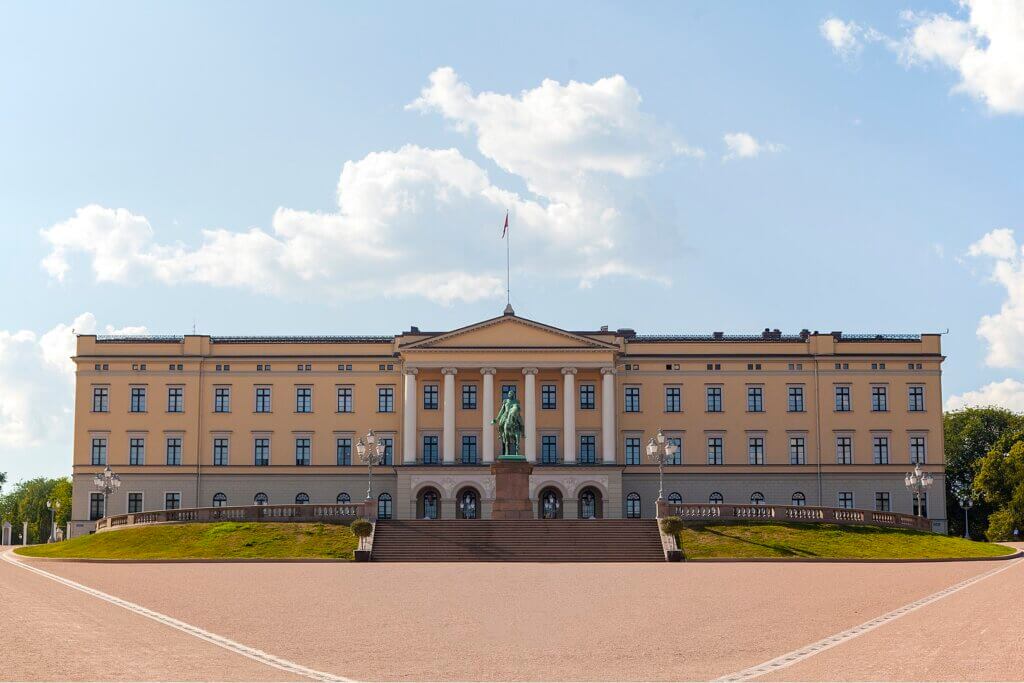
The new Norwegian King knew that he needed a palace in Oslo befitting his title. Previously, the royal family would stay in a luxurious townhouse. Carl Johan chose the site of his new palace in 1821 and the Storting (Norwegian parliament) approved a set budget. He chose Danish architect Hans Linstow to design the palace; the cornerstone was finally laid in 1824.
The project continually ran into issues and ran over budget fairly quickly. By 1827, the Storting refused to approve any further funds and nothing happened again until 1833. The interiors of the palace were not completed until the late 1840s, meaning it took two decades to build the Neoclassical palace. Given that the royal family spent much of their time in Sweden, it was not as pressing as it could have been. Carl Johan was never able to live in the palace but his son and heir, King Oscar I, lived there with his wife, Josephine of Leuchtenburg.
A Permanent Norwegian Monarch
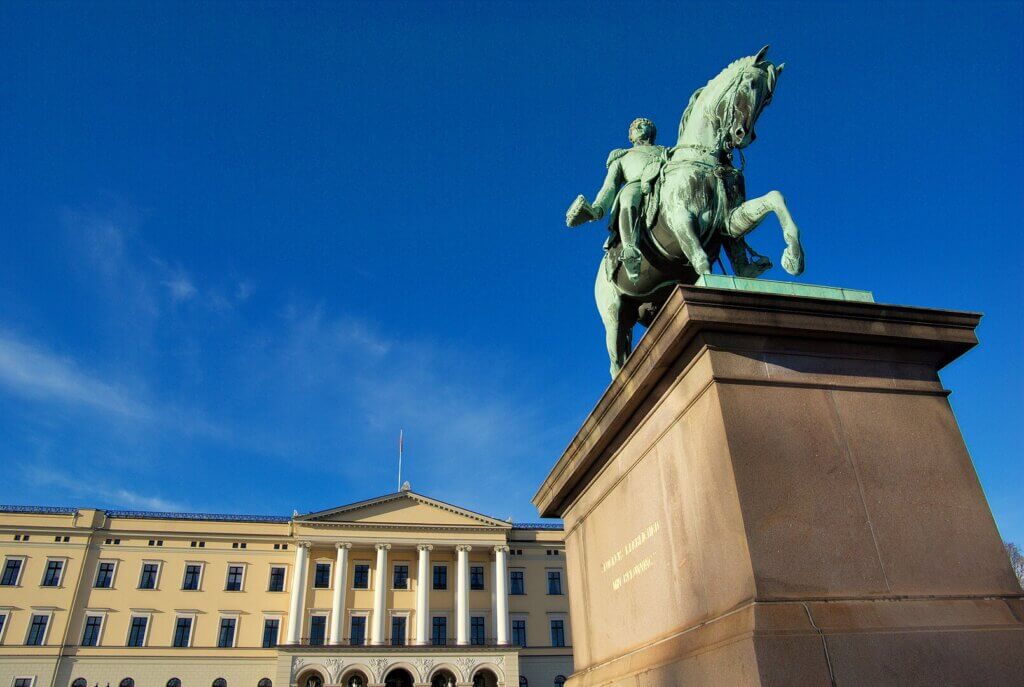
In 1905, King Oscar II renounced his claim to the Norwegian throne. The Storting first originally offered the throne to one of Oscar’s younger sons but the family declined. It was then offered to Prince Carl of Denmark. Married to Princess Maud of Wales (the daughter of King Edward VII and Queen Alexandra of Denmark), Carl was well-connected across Europe.
Carl took the regnal name of King Haakon VII. King Haakon and Queen Maud moved into the Royal Palace in Oslo and made it their home. All Norwegian monarchs since have officially lived in the palace. The monarch holds their Council Meetings in the Council Chamber weekly, the room that also holds the Norwegian throne.
The Crown Prince does not live at the Royal Palace, though. The Norwegian Crown Prince (and partner) live at Skaugum, an estate that is southwest of Oslo.
Interested in more book previews, period dramas, royal news, and more? You can subscribe to my biweekly substack newsletter here: https://anhistorianabouttown.substack.com/!
The Royal Chapel
The Royal Chapel was built in 1844, also by Linstow. While many royal families will hold religious ceremonies and events in specific cathedrals, the Norwegian Royal Family uses the palace chapel. Any royal christenings and confirmations are held in the Royal Chapel; the chapel was actually restored prior to Princess Ingrid-Alexandra’s christening in 2004. Notably, both King Haakon VII and King Olav V laid in rest in the chapel so that people could pay their respects.
Queen Sonja Leaves Her Mark
Queen Maud made her mark on the palace by expanding the stables considerably and adding an equestrian facility (including a riding hall). (She based the new stables on the Royal Mews in London.)
The building fell out of use when the family stopped keeping horses and largely served as a storage space for several years. However, King Harald V gave the space to his wife, Queen Sonja, in 2017 for her 80th birthday. The newly renovated Queen Sonja Art Stable has exhibitions on from March to December every year that showcase items from the Norwegian Royal Collection.
Want to know more about the history of other royal palaces?

The History of Buckingham Palace
The History of Amalienborg Palace
The History of the Palace of Brussels
The History of the Royal Palace of Madrid
The History of the Huis Ten Bosch Palace
The History of the Palace of Holyroodhouse
Have you visited the Royal Palace in Oslo?
Cheers,
The Historian
Facebook | Twitter | Instagram | Pinterest | Threads