While the British Royal Family and their residences claim most of the public’s attention, the Danish Royal Family has been giving them a run for attention. With Queen Margrethe II’s abdication on 14 January and King Frederik X’s ascension, our eyes have been on Copenhagen. And unsurprisingly given that the Danish monarchy is over 1,200 years old, the Danes have some spectacular royal residences of their own. We are exploring the history of Amalienborg Palace in Copenhagen today, the site where King Frederik X was first spotted on 14 January.

The Early History of Amalienborg Palace
The first palace built on this site was the Sophie Amalienborg; it was built between 1669 and 1673, and was the pleasure palace of the consort of King Frederik III, Queen Sophie Amalie. If a pleasure palace is a new term for you, a pleasure palace was considered to be a private residence for a royal. They would often go there to escape their official duties, so this is not a building with state apartments or reception rooms. Sophie Amalie spent much of her time at the Baroque palace, and her son, King Christian V, inherited it upon her death in 1685. The original palace burned down in 1689 after theatre decorations caught on fire at a birthday opera performance for the King.
King Frederik IV, Sophie Amalie’s grandson, rebuilt the palace, though he built a smaller summerhouse with orangeries. Frederik’s palace was demolished in the eighteenth century to create Frederiksstaden, a new district/complex in Copenhagen.

Frederiksstaden
King Frederik V created the Frederiksstaden district beginning in 1748. He intended for it to mark the 300th anniversary of the Oldenburg dynasty in Denmark. While the district survives to this day and features several notable buildings that survive to this day, it did mean that many surviving structures were demolished to make way. This major complex in Britain is one of the largest rococo projects in Europe.
A Fire Changes Everything
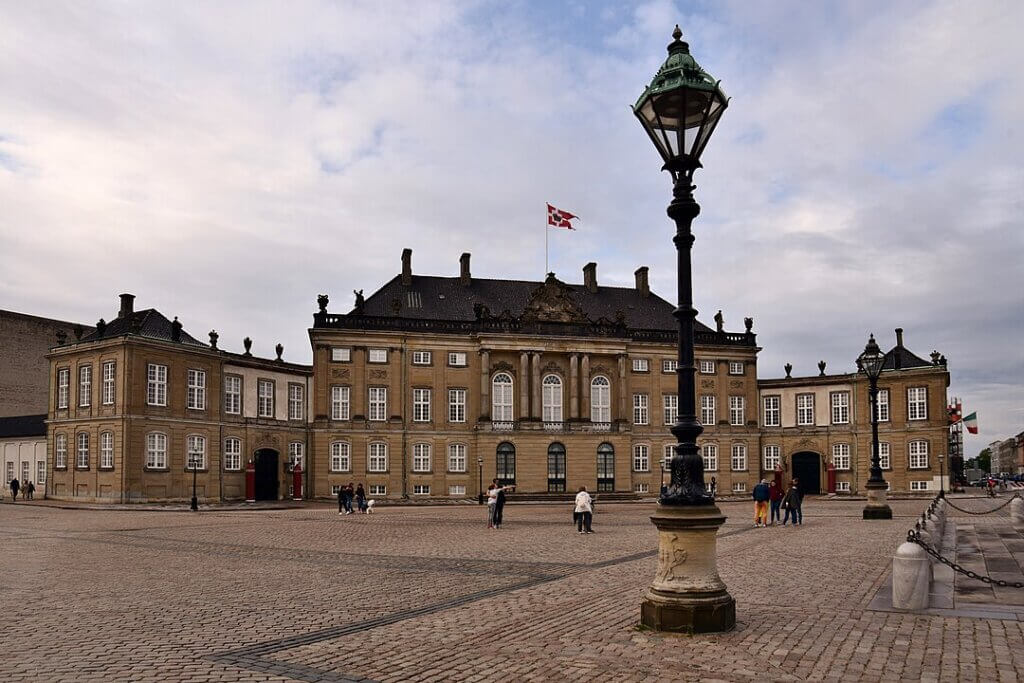
Like Buckingham Palace, the current Amalienborg Palace was not originally a royal residence. With Frederik’s new district, the land where the original two palaces sat were allocated to four aristocratic families. Danish architect Nicolai Eigtved designed the four matching mansions for the families,
However, after Christiansborg Palace burned down in 1794, the Danish Royal Family needed a new home and quickly. The four aristocratic families were almost immediately willing to sell their mansions to the King after they were offered much higher offices and a great deal of money.
The Four Palaces at Amalienborg
The four palaces still survive at Amalienborg today, preserving that earlier history. It is currently used as a winter residence for the Danish monarch and their heir. The southwestern palace was originally the Moltke Palace and is now known as Christian VII’s Palace, while the Levetzau Palace in the northwest of the square is Christian VIII’s Palace. Brockdorff’s Palace in the northeast is Frederik VIII’s Palace and it is the home of the current King and Queen of Denmark. Christian IX’s Palace was originally Schack’s Palace, and Queen Margrethe has lived in this palace since 1967. (Yes, King Christian IX is the father of Queen Alexandra.) On 14 January 2024 when King Frederik and Queen Mary appeared on the balcony to greet crowds, it was from their home.
You will also notice that there is a large equestrian statue at the heart of the square. The four palaces have an excellent view of a large statue of Frederik V.

The Changing of the Guard
Much like at other royal palaces across Europe, you can see the changing of the guards at Amalienborg when the sovereign is in residence. The King’s Guard will be on duty when the King and Queen are at Amalienborg. There are also smaller ceremonies when there is a regent staying in the palace (and there has to be a regent if the Danish monarch is out of the country) and if there is no royal currently at the palace. If you are visiting Amalienborg Palace, you should also be able to visit King Christian VII’s Palace and King Christian VIII’s Palace.
Have you visited Amalienborg Palace?
Cheers,
The Historian
Facebook | Twitter | Instagram | Pinterest