Lucile was one of the most popular designers in the late Victorian and Edwardian eras. And with it being LM Montgomery Month on the blog, she fits perfectly. If the name doesn’t sound familiar, you may know her by her actual name- Lady Duff-Gordon. Along with being one of the most fashionable designers, she also is closely connected to the sinking of the Titanic. So, for Style File Friday, let’s dive into the style history of Lucile!

If you have missed any of my other LM Montgomery Month posts, you can find some of them here!
The Best L.M. Montgomery Resources

The Early Life of Lucile
Lucy Christina was born to Douglas Sutherland, a British civil engineer, and Elinor Saunders, his Anglo-French-Canadian wife on 13 June 1863 in London, England. Sutherland was chosen to help build the Grand Trunk Railway in Canada, and married Elinor in 1860. Although they lived in London when Lucy was born, her father died from typhoid fever in 1865, and Lucy was raised in Guelph, Ontario. Her mother remarried in 1871, and the family (including Lucy’s sister, the future novelist Elinor Gwyn) moved to the Isle of Jersey. It was during her childhood and teenage years that she discovered her love of fashion. She had an ever-growing collection of fashion dolls, and liked to study the clothing in family portraits.

An Unhappy Marriage and a Necessary Career
Lucy first married in 1884, to James Stuart Wallace. Although her daughter came of the marriage, it was an unhappy union- he was an adulterous alcoholic, and Lucy sought solace with her own lovers. They separated in 1890 and divorced in 1893.
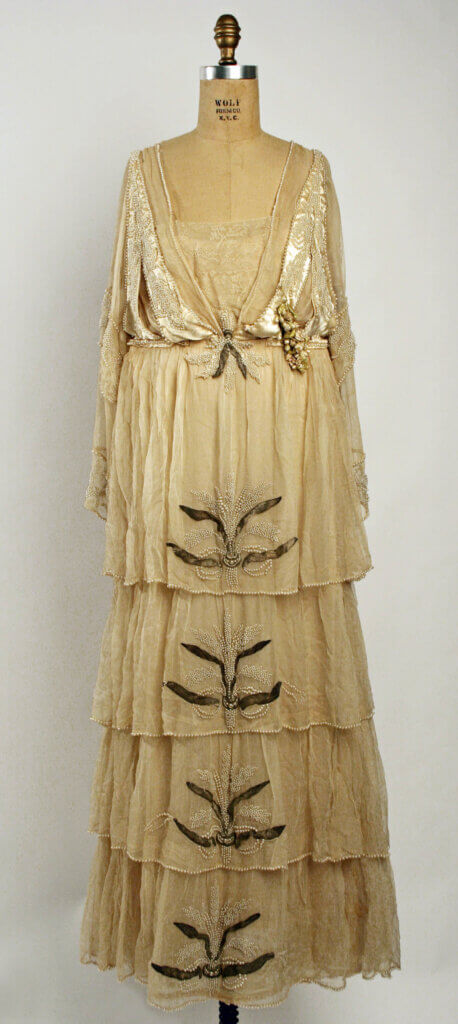
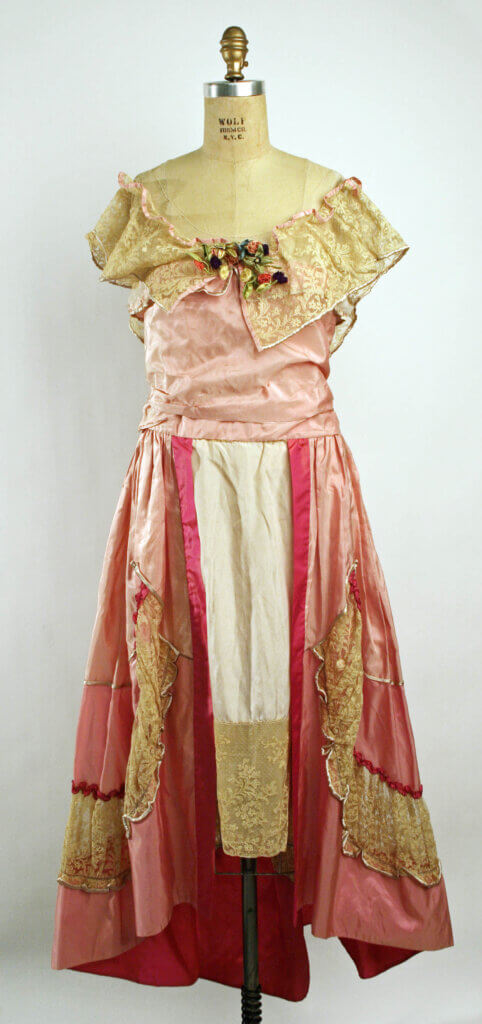
Lucy needed a way to support herself and her daughter, and started her own dressmaking business. Originally out of their home, she opened the Maison Lucile in the West End in 1893. She focused on draped, layered garments, often made in pastel colours with floral accents. Lucy’s designs were popular with the tastemakers of society; actresses, socialites, and royalty were often seen wearing her designs.

A Second Marriage and Further Expansion
In 1900, Lucy remarried, to Sir Cosmo Duff-Gordon (a Scottish Baronet, landowner, and sportsman.) In 1897, she had moved to a bigger space at 17 Hanover Square for more space, and then again 1903/1904 to 14 George St., Oxford. She took the step of incorporating and became Lucile Ltd. in 1903, and moved to 23 Hanover Square where she stayed for the next two decades.
In 1910, she opened a New York branch, in 1911, she opened one in Paris, and in 1915, she opened a third branch in Chicago. Lucy is given credit for training the first mannequins (aka fashion models) and staging what we now know as catwalk shows. As early as 1904, Maison Lucile employed at least one sketch artist to catalogue designs. When the business quickly expanded, she had several more sketch artists helping (specifically in the US), including Edward Molyneaux.
Lucile designs were seen on the theatre stages, including the 1907 London premiere of The Merry Widow opera and the Zeigfield Follies revues on Broadway for several years. If you have ever watched any Pathé newsreels from the period, you may also have seen her designs there.
The Titanic…
If you have heard the name “Lady Duff-Gordon” but have no idea about fashion, I’m guessing that you know her in relation to the Titanic. The Duff-Gordons, along with Lucy’s personal assistant, sailed on the Titanic for Lucile Ltd.’s US business expansion. Obviously the ship was struck by an iceberg, and being in first class, the trio escaped on a lifeboat carrying 12 people instead of the 40 person capacity. Lucy apparently made a comment about her assistant’s lost clothing, and one of the crew members reported that they had lost everything and it couldn’t be replaced as they had no jobs. Duff-Gordon personally wrote them all cheques, and this would later turn into the rumour that they had paid the lifeboat crew to continue without more passengers.
The couple gave testimony during the hearings for the British Board of Trade inquiry into the sinking of the Titanic, and the press covered them extensively. The final report showed that the couple did not pay the lifeboat to push on, but the rumours would follow them for the rest of their lives.
Stretched Too Thin
In 1917 in a New York Court appeal, Lucile (as she went by now) lost the right to her name- her agent was given the sole right to marketing her professional name. She also had to declare bankruptcy when sales fell after she admitted that she was designing few of the pieces bearing the Lucile Ltd. name in 1918-19 during a restructuring. In the twilight of her career, she sold imported designs from other houses, but it was nothing like the success she had in her own right.
She was one of the first designers to use the press to her advantage. She published monthly fashion pages, in addition to writing columns for journals like Harper’s Bazaar and Good Housekeeping. After her design house closed, she continued to write fashion columns.
Lucy Duff-Gordon died of breast cancer (which brought on pneumonia) on 20 April 1935 in London.

Further Reading on Lucile
Bigham, Randy Bryan. Lucile, Her Life by Design: Sex, Style and the Fusion of Theatre and Couture. San Francisco: MacEvie Press Group, 2014.
Etherington-Smith, Meredith, and Jeremy Pilcher. The “It” Girls: Lucy, Lady Duff Gordon, the couturière “Lucile”, and Elinor Glyn, Romantic Novelist. London: H. Hamilton, 1986.
BBC- Radio 4 Woman’s Hour- Lady Duff Gordon
“WW1 Era Clothing: Archive of Art and Design Resources for Re-enactors and Costumers” from the V&A Blog

Note: As it stands right now, this is the last of my Style History posts. I have profiled all of the designers I am interested in and that have information available. If I discuss more, or information becomes more readily available, I may pick up the series again! (If there is a designer that I haven’t covered on the list, please let me know. I don’t plan on covering Chanel, but I’m open to others/can look for more.)
If you are interested in reading some of my other Style History profiles, you can find them below:
Were you familiar with the history of Lucile?
Cheers,
The Historian
Facebook | Twitter | Instagram | Pinterest


,_1913.jpg)


