“It is ever so much easier to be good if your clothes are fashionable.” I’ve always thought that LM Montgomery got fashion. Between Anne’s puffed sleeves and Emily’s longing for full-length dresses, fashion is important in her novels. If you poke around on Pinterest, you will find countless ideas for how to dress like Anne Shirley. However, this Style File Friday is going to look at the fashion of LM Montgomery’s life. She was born in the later Victorian period, and saw the Edwardian period, the inter-war period, and beyond- fashion evolved rapidly. Because much of her adulthood was in the Edwardian period, and many of the adaptations of her work now are set in the period, I’ve chosen some of my favourite Edwardian trends.

Fashion plays a significant role for many of Montgomery’s characters; they know how certain clothing makes them feel, and that it can be an important part of your personal image. I’ve chosen some of my favourite pieces that either made me think of Montgomery and her novels when I saw them (which happens more than you might think).
If You Like Anne of Green Gables, You Should Read…
The Best L.M. Montgomery Resources
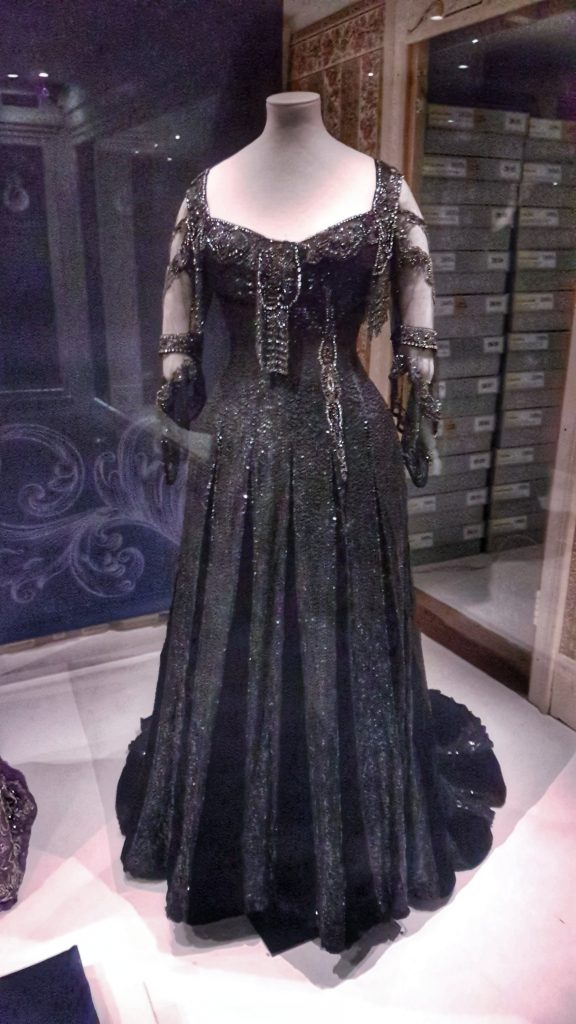
Queen Alexandra’s Evening Gown, 1910 (Fashion Museum)
I knew that I had to include at least one of Queen Alexandra’s gowns, as Emily has to look at the picture of her so often while she is away at school. (You can find that in Emily Climbs, the second book in the Emily trilogy.) Alexandra was Queen Consort (to King Edward VII) from 1901 to 1910, and was a royal fashion icon from the moment she sailed to England to marry the Prince of Wales in 1863. She preferred a sleeker, more tailored silhouette, and you can see that in this 1910 gown. Alexandra continued to wear her preferred style decades after it had been popular, even in her later years. (We often see royal women hang onto the styles of their younger years, particularly if they were widowed.)
I was lucky enough to see this in person, at the Royal Women exhibition in Bath. This was discovered in an attic, and donated to the Fashion Museum after the exhibition had already opened. It is thought that she ordered it prior to Edward’s death, and never wore it.
While I don’t know that Montgomery would have frequently attended events with fashion like this, it was quite the fashionable style.
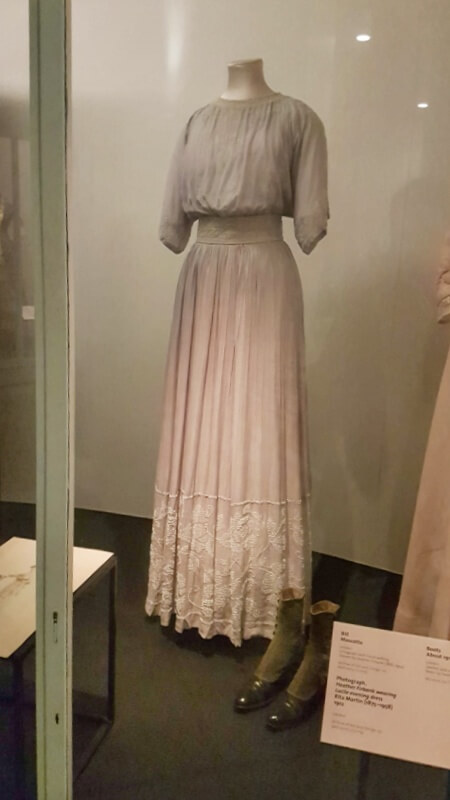
Summer Dress, 1910 (V&A)
While the V&A was a fashion history day for me, given everything I saw, this summer dress still stands out in my mind. I remember thinking, “it feels very Emily Starr”, especially in Emily Climbs and Emily’s Quest or possibly an Avonlea piece. (When I think “the fashion of LM Montgomery”, this is exactly what I picture.) It is described as a “Pale lavender lawn cotton dress with white bead embroidery and lace edging at collar and cuffs.” Although the colour looks quite different on display, it is still quite a lovely and under-stated piece.
When we look at gowns like Queen Alexandra’s, they don’t necessarily translate well to the lower levels of society. The rich fabrics and elaborate beading and embroidery would be an expensive extravagance that most people simply couldn’t afford. However, this simpler day dress style would be adaptable and functional for a much wider group of people.
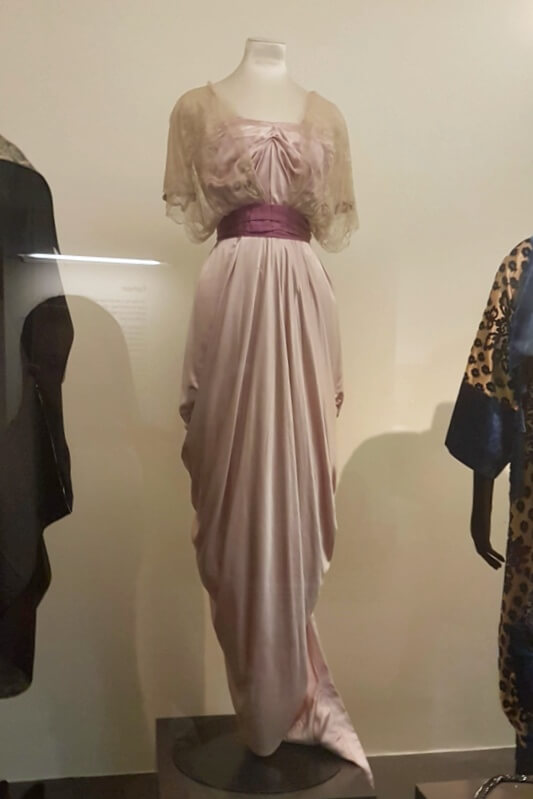
Jays Ltd.- Evening Gown, 1912 (V&A)
Although this evening gown dates to the same period as Queen Alexandra’s, it absolutely is moving into a newer style. The V&A describes it as,
Evening dress of pink satin and lace with fushia satin empire band and small train. The bodice has a straight front which is overlaid with lace to create a V-neck. Short net sleeves, trimmed with beads. The back of the skirt is caught up to create a hobble-skirt.
The hobble skirt is an interesting moment in fashion history. Many historians will debate whether this was designed by men to limit women’s movement and freedom (as it makes it incredibly difficult to walk or move in them), or if it is from women who have chosen it of their own free will. I have to say, I don’t think that Montgomery would have been a big fan of the hobble skirt. It is hard to imagine Anne or Emily being thrilled with a very limited range of movement. (If you ever see this gown in person, you will get strong Mary Crawley vibes.)
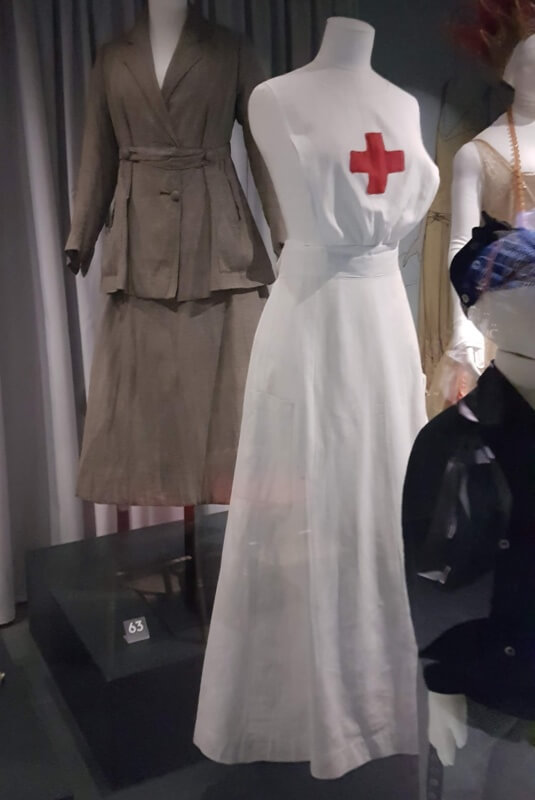
Nurse’s Apron, 1914 (Fashion Museum)
This might seem an obvious statement, but the First World War was a significant event in Montgomery’s life. Although Canada was geographically distant from the front lines, countless Canadian men went to fight in British units. Montgomery was initially horrified upon hearing recounts of the Rape of Belgium, and passionately argued for the war as necessary for saving civilisation. She wrote regular pieces in various newspapers and journals, encouraging patriotic support in every way possible.
This nurse’s apron dates to 1914, and the exhibition states that “this starched white cotton uniform apron with its hand-stitched Red Cross symbol, was worn by a VAD nurse during the First World War.” The VAD (Voluntary Aid Detachment) offered nursing services throughout the war, and was a way for women to take an active role in war efforts. (That is how some people described it, but that isn’t to discount all of the work done on the home front.)
If you are more interested in Montgomery and the war, her novel Rilla of Ingleside is set during the period. L.M. Montgomery and War is a non-fiction collection of essays examining Montgomery and her works in the context of the war.
Do you enjoy the fashion of LM Montgomery and her novels?
Cheers,
The Historian
Facebook | Twitter | Instagram | Pinterest