Madeleine Vionnet is not a household name by any stretch. However, although we don’t all inherently know her, she made an incredible impact on modern fashion history. The French fashion designer was a contemporary of Coco Chanel and Paul Poiret, and was considered one of the leading designers of the Inter-War period in Paris. And it is time to celebrate her! In honour of Women’s History Month in March, I’m going to be diving deeper on the history of Madeleine Vionnet. So, who exactly is Madeleine Vionnet and what did she do for fashion?

Madeleine Vionnet is one of those designers who will show up in your Pinterest search for vintage clothing, or in a book about vintage French fashion. Because the house closed with the Second World War in 1940, and did not re-emerge until the mid-1990s, it is largely unknown in pop culture.
History of Madeleine Vionnet- Who Was She?
Madeleine Vionnet, similar to Jeanne Lanvin, grew up in late nineteenth century France where female education was optional. She was born in June of 1876 to a poor family in Chilleurs-aux-Bois, and then moved to Aubervilliers with her father in 1881. (Aubervilliers is a commune that is now in the North-East part of Paris, but was a separate town in that period.) She did briefly attend school but had left by the age of 12. It was then that she became an apprentice seamstress. After a disastrous and terrible short marriage at 18, Vionnet moved to London. Most notably, she worked as a fit for British dressmaker Kate Reily.
Reily focused on copying French fashions, and Vionnet picked up many skills and styles in this time. However, she also brought in new skills. (She then returned to Paris afterwards.) If you hear anything of Vionnet, nine out of ten times, you will hear, “She is the queen of the bias cut”. And there is a good reason for that.

Vionnet and The Bias Cut
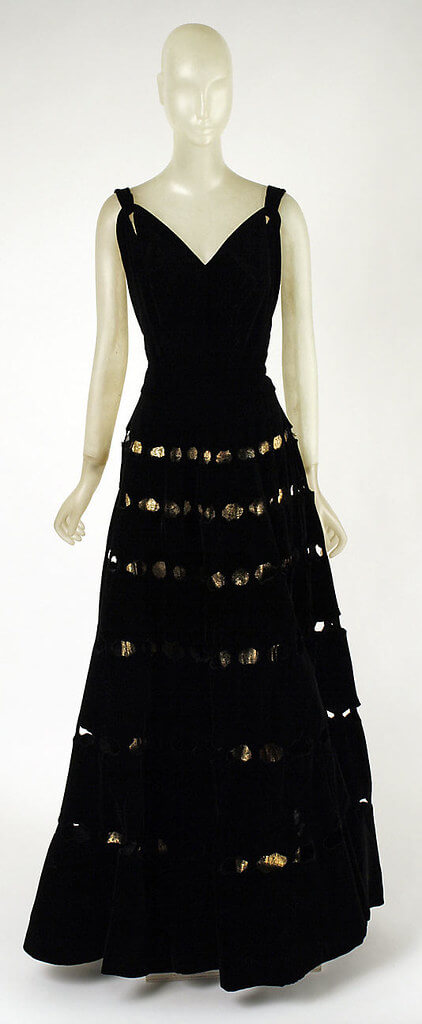
The bias cut is a rather important development in fashion history, and a difficult skill to master. It is defined as: “(of a garment or fabric) cut obliquely or diagonally across the grain.” This very particular manner of cutting the garment diagonally across the grain of the fabric creates a specific garment. The bias cut leads to a fluid and draping fabric, which is particularly useful in evening gowns and dresses. You will commonly see bias cut garments in 1930s fashion, particularly in Hollywood in the period.
Vionnet was largely influenced by the modern dancer, Isadora Duncan, and Greek sculpture and artwork. She preferred a looser, flowing cut, that accentuated natural curves rather artificially creating a shape through padding and corsetry. You will notice that the bias cut lends itself extremely well to this style… You can see her influence in John Galliano’s and Marchesa’s design work now. (Fashion is a cycle, right?)
The House of Vionnet
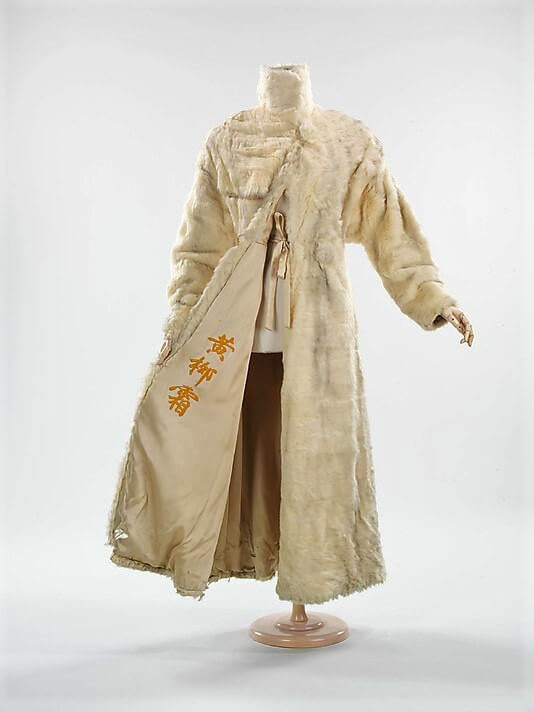
Vionnet opened her eponymous house in 1912, but closed at the outbreak of the First World War in 1914. Sadly, the House of Vionnet did not reopen until 1923, when she established an atelier on Avenue Montaigne. (You might recognise the name if you know your French fashion brands, as Dior, Louis Vuitton, and Chanel, among many others, have shops there.) Interestingly, she also opened a shop on Fifth Avenue in New York City in 1925. The New York shop sold ready-made garments that were tailored for the customer, rather than pieces created specifically for one person. (I find it quite sad that later designers are lauded for being willing to skip across the Atlantic, when Vionnet did it first)
Her simplistic designs were not quite as popular in the 1910s and 1920s, but as I mentioned above, she found massive popularity in the 1930s. Like many designers, Hollywood catapulted her. Marlene Dietrich and Katherine Hepburn both wore Vionnet gowns, along with several other Golden Age stars. Unfortunately, the House closed in 1940 with the outbreak and spread of the Second World War, and she did not re-open.
I have to say, Vionnet was a revolutionary business woman. She was passionate about copyright laws for designers, to protect their work and creations. She also set out to create the best possible working conditions for her employees. Vionnet included a doctor and a dentist on staff, and offered paid maternity leave and day-care on the premises. I think that being a female designer set her apart from the largely male dominated field of design, and led to a very different way of thinking (for the better).
Madeleine Vionnet’s Legacy
Sadly, Vionnet largely disappeared from the world of fashion. She was a private person to begin with, so she quietly closed her doors, and that was that. The bias cut wasn’t particularly popular in the years after her retirement, as we saw the resurgence of Dior’s New Look and Balenciaga’s structural creations. She donated many of her garments to the now Musée de la Mode et du Textiles. The Vionnet label was purchased by the Lummen family in 1988 after laying dormant for decades. (The family is known for resurrecting dormant brands, á la Sleeping Beauty.)
The Lummen family began by focusing on perfumes and accessories, rather than fashion itself. It wasn’t until 2006 when Sophia Kokosalaki was brought in as Creative Director, to first launch a SS2007 collection. She was replaced by Marc Audibet in 2007, and then different designers after that. Arnauld Lummen wanted the focus to be on the label itself, rather than individual designers. As of 2018, the house underwent voluntary liquidation in order to recreate itself as a sustainable brand (see Vogue). It relaunched in 2019 with a sustainable collection.

Further Reading
Much like other designers that I’ve covered for Style File Friday, there are not a lot of easily available sources on Madeleine Vionnet. There are out of print books available, but most of them are over $125 CAD (secondhand). Please let me know if you’ve read any books and have recommendations!
You can visit this article by the V&A, “Four haute couture dresses by Madeleine Vionnet” here.
Betty Kirke has a fantastic article, “Dressmaker Extraordinaire: Discovering the Secrets of Madeleine Vionnet’s creativty” that you can find here.
♠
If you are interested in reading some of my other Style History profiles, you can find them below: (If you are interested in female designers, I would start with Schiaparelli and Jeanne Lanvin!)
Are you familiar with the history of Madeleine Vionnet?
Cheers,
The Historian
Facebook | Twitter | Instagram | Pinterest | Bloglovin’