I’m diving back into my history of ballet series this week! With over 500 years of history behind it, ballet has seen quite an evolution from its beginnings. Ballet started life as a courtly performance, evolving to the spectacular art we know today. We have looked at queens and kings who loved ballet, and a prima ballerina loved by all. Today we are moving to the start of modern ballet as we know it- Russia. Ballet flourished in the court and theatres of Russia in the nineteenth century. This quick history of ballet in Russia will explain a lot of what you see on stage today!

History of Ballet Series
Looking for the early beginnings of ballet? Read my post on the origins of ballet here!
Wondering about Marie Taglioni and the early schools of ballet? Head here!

Peter the Great and Ballet
Peter the Great inherited quite a medieval Russia. Aristocrats and nobles still lived in simple wood homes, wore plain Russian dress, and lived relatively rough lives. However, Peter was not impressed with this, and set out across Europe to change this. In addition to his time spent in London and England, Peter visited several European courts, including those in France and the Italian states. (You will remember that ballet flourished in both France and Italy….)
Peter strove to “European-ise” Russia, and bring it into the modern age. (What we would consider the early modern!) He idolised Louis XIV and his court. He adored Louis’s elegance and gravitas, the structure of his court, and the etiquette and ritual that came with it. And what was a major part of the French court? Ballet, of course! Peter’s court was structured with fourteen different ranks, with specific etiquette and rules for each rank.
To acquire proper comportment and manners, aristocratic children were taught to dance from an early age by French and Italian ballet masters, and courtiers were required to learn the latest dances for balls and ceremonial events….Classical ballet thus came to Russia as etiquette and not as art. This mattered: ballet was not initially a theatrical “show” but a standard of physical comportment to be emulated and internalized… Thus from the moment ballet entered Russia, it was inextricably bound up with the Westernizing project that would shape the country’s history for generations to come. (Apollo’s Angels, 247)

Catherine the Great and Ballet
Catherine the Great, another infamous Russian ruler, also pushed the boundaries of Russian ballet. She, like Peter, dreamed of a European Russia, and her cultural programs reflected this. Catherine established three different theatres in St. Petersburg, along with three companies. Although there was a strict code of etiquette, the theatres were open to people of any social class. Yes, it has to be said that Catherine largely decided what was in taste and therefore what would be performed, but it is one of the first cases of ballet being performed for anyone.
Russian theatres had an advantage over other European theatres. Many wealthy landowners ran their own “serf theatres”, their own estates mimicking Russia and the state theatres. These landowners were invested in ensuring that their own performers knew the latest dances and productions. It is debateable whether or not these theatres gave the serfs a better or worse than other serfs, but it did lead to a couple generations of culturally motivated and artistic serfs. Why is this important? It means that ballet was longer performed solely by the aristocracy and visiting European dancers.
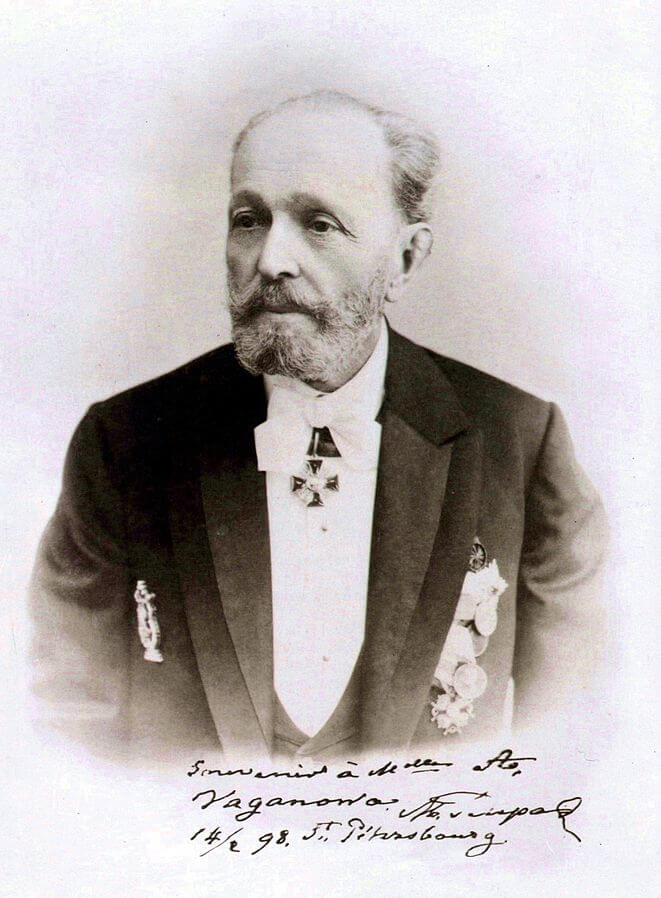
Marius Petipa, the Father of Russian Ballet
Petipa is still a very common name to hear in ballet today, and is crucial in the history of ballet in Russia. Although he died 110 years ago, his work still lives on in classical ballet to this day. Known for being the Father of Russian Ballet, he was the St. Petersburg Imperial Theatres’ First Ballet Master from in 1873 until 1901. A Frenchman, when he arrived in Russia, he was not particularly well-known. His career before was rather unremarkable. He worked as a choreographer and ballet master in Madrid and Paris for several years. In 1847, his more successful dancer brother, Lucien, arranged a position for him in the Imperial Theatres.
Petipa began his career in Russia as a lesser ballet master, under Jules Perrot. Because he wasn’t as well-known as many of the foreign dancers and creatives, he was paid less and had to spend years working up the ladder. Largely known for expanding the Romantic ballet, Perrot would stage ballets that were four to five hours in length, unheard of in Paris. Combining this French training from Perrot with inheriting the Bournonville tradition from the Swedish Johansson, also at the theatre, Petipa developed a mastery of ballet. He used this decade of training to his advantage.
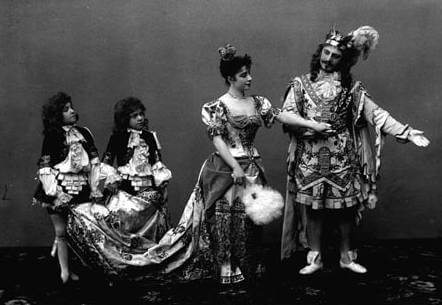
Petipa went on to create many of the classical story ballets that we still know and love today. Four years after taking the helm of the Imperial theatres, he created La Bayadère , an exotic story about a temple dancer and her love. The Kingdom of the Shades with 32 dancers slowly travelling down the stage is still one of ballet’s most iconic images. Petipa also developed a close working relationship with composer Tchaikovsky. In 1890, The Sleeping Beauty premiered, a ballet still regularly staged today. Although it is a beloved production now, St. Petersburg audiences thought it was low-class and pandering.
Even today’s most skilled performers find Petipa’s fairy variations a test of classical precision: the slightest false move or cheat– a leg straying off centre or a step out of line — immediately shows and throws the whole dance into disarray… Performing these dances well is a matter of technical acuity and cast-iron discipline but also of style: a dancer cannot plausibly get through them without a modicum of charm. (Apollo’s Angels, 276-7.)
Petipa’s most infamous ballet has to be The Nutcracker, though, performed for millions every holiday season. Poorly received in Russia; an American restaging brought The Nutcracker back to life.
Vaganova School of Ballet
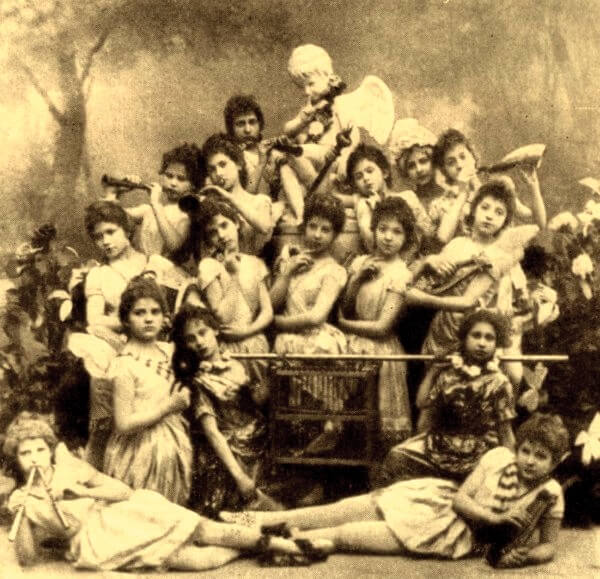
Vaganova, the Russian school of ballet, is still widely taught in professional academies and companies across the globe. Established as the Imperial Ballet School in 1738, it was renamed by the Soviets as the Leningrad State Choreographic Institute, and was finally renamed the Vaganova Academy of Russian Ballet in 1958. Agrippina Vaganova, graduated from the Imperial Ballet School in 1898, and after an illustrious performing career, took to teaching. She updated the Imperial method in the 1930s. She felt that there were shortcomings in the style of Petipa’s day. You can usually spot a Vaganova dancer. Russian “training produces powerful, expansive, and expressive dancers… Their grand allegro is truly grand, with immense, soaring leaps. Soviet training favors a line made possible by a very pliable upper back and high extensions. Especially at the Bolshoi, they go for bravura.” (The Ballet Companion, 70.) (Most dancers nowadays will have experience in more than one school of training.)
♠
The Russian companies are world-renowned; the Bolshoi and the Kirov/Mariinsky are incredibly popular. If you are looking for a history of the Bolshoi, I would recommend Simon Morrison’s Bolshoi Confidential.

*Homans, Jennifer. Apollos Angels: a History of Ballet. London: Granta, 2011.
*Gaynor Minden, Eliza. The Ballet Companion: A Dancer’s Guide to the Technique, Traditions, and Joys of Ballet. New York: Fireside, 2005.
Hopefully this history of ballet in Russia helps you understand what you are seeing on stage! And don’t worry, Anna Pavlova and the Ballet Russes will be in the next post!
Cheers,
The Historian
Facebook | Twitter | Instagram | Pinterest | Bloglovin’