Welcome back to my series on the history of ballet, this is the second instalment! While we covered the early origins of ballet in the first post, we will be moving onto what I refer to as the middle history of ballet. And this period does greatly impact the dancers that we see today, so it is quite important. (It’s also going to be quite helpful if you are ever looking into the history of a particular ballet.) This post is going to be looking at the different nineteenth century schools of ballet, that developed into the various styles that we now know and love, and one of the most infamous ballet dancers of all time!

Note: Before I get any further into this post, I’m going to explain the term “different schools of ballet”. I’m not referring to schools or academies where dancers studied, but the different schools of thought/technique. But first, we must address one particular dancer…
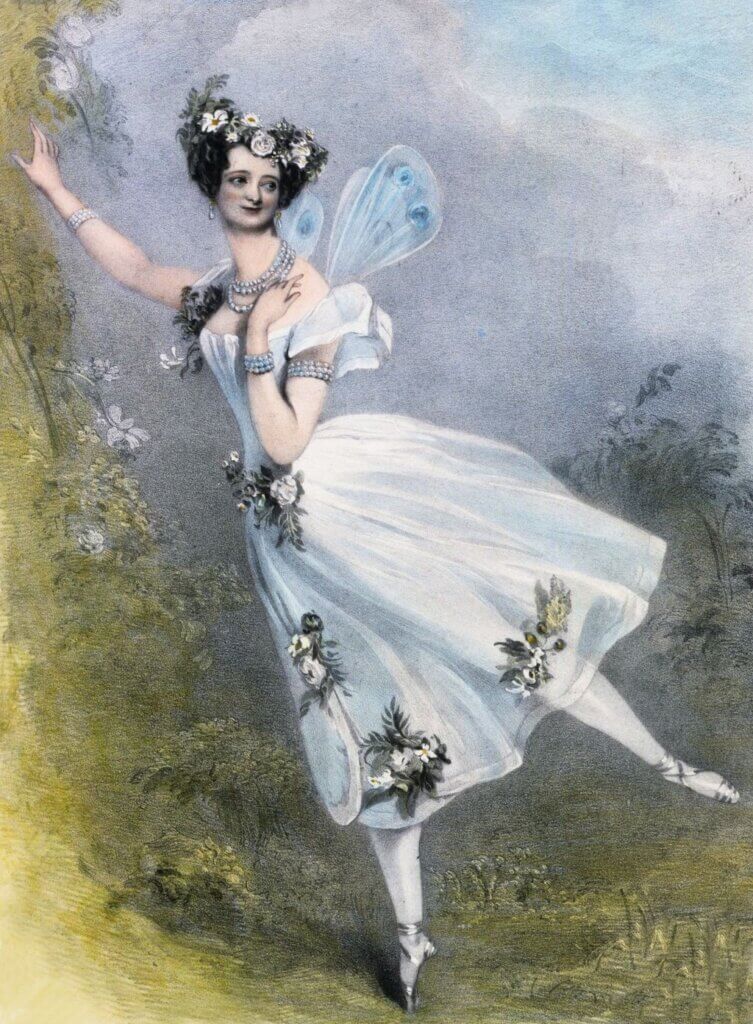
Marie Taglioni: The First Ballerina?
If you know anything of the history of ballet, you have probably heard of Marie Taglioni. We will come back to her in a second, but we need a touch of geography. Ballet was largely centred in France (and to a lesser extent, Italy) in the sixteenth, seventeenth, and eighteenth centuries. In the late eighteenth century, courts starting forming their own companies, but they would often hire French dancers. Sweden was one of the first countries to adopt ballet, with Queen Christina hiring a French company to permanently perform. King Gustav III established the Royal Swedish Ballet in 1773, and it is one of the oldest ballet companies in the world.

Marie Taglioni’s mother, Sophie Karsten, was a premier dancer at the Royal Swedish Ballet, and her father was an Italian choreographer. She spent much of her own career at Her Majesty’s Theatre in London, and was wholly European. And why do we care about Taglioni so much? Taglioni was the first dancer to dance en pointe (on her toes), and her rise to fame ushered in the cult of the ballerina. Taglioni actually was not an overly impressive dancer in her youth, and her father created an incredibly difficult training regiment for her. (She would hold positions for 100 counts at a time. ONE HUNDRED.) She was known for her showmanship and quick footwork, a clever way to disguise her less-than-perfect stature. Her slightly rounded back and odd posture is camouflaged nicely when she was en pointe, as it forces you forward.
Dancing en pointe: Taglioni’s shoes were “not hard or boxed like today’s pointe shoe but soft and round except for a layer of supportive darning sewn underneath the metatarsal and toe.” (*Apollo’s Angels, 141) And while dancers now will fully dance on the tops of their toes, Taglioni would have been on a 3/4 pointe. Further than half pointe but not a full pointe, it would be quite a difficult position to maintain. And maintain it she did. She was so popular that there are urban legends that rabid fans would eat her shoes. (Please don’t eat any sort of ballet shoe…) However, her Italian and Swedish upbringing, and time performing in Germany, England, and Paris shows that ballet was quickly growing in popularity everywhere!
Nineteenth Century Ballet Schools
Knowing the different schools of thought/technique in ballet can make a difference in how you watch your favourite dancers and companies. You may wonder why a dancer is doing something a particular way, or why a production looks a certain way. Many times it will come down to the training of the dancer or choreographer. A professional dancer will be technically strong enough to move across schools and styles, but there is usually a preference. If you look up the schools that dancers have trained at, the methodology they use is typically the first information you can use. I’m going to be looking at two schools that developed in the nineteenth centuries. (The English, Russian, and American will be in the next post!)
The Danish Ballet School: Bournonville
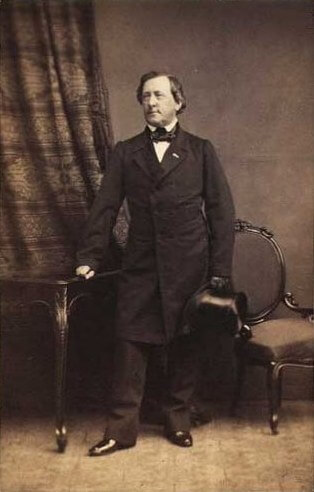
August Bournonville (1805-1879), the Danish ballet master and choreographer, was not particularly popular during his lifetime. However, in the twentieth century, there was a resurgence in his methods. Famed Russian/American choreographer George Balanchine trained under the Bournonville method, and the legacy dominates American ballet. (But more on that in the next post in the series!) According to ballet historian Jennifer Homans, Bournonville’s style
had all the attributes of the Vestris school and French ballet circa 1820: the jumps, pirouettes, and bravura male technique, the pointed feet and fully extended knees, the open and turned-out legs and épaulment through the torso and shoulders. Yet is was also different: more contained, less inclined to spectacular tricks and overextended movements. It prized decorum and propriety, clean and lines and unfettered gestures. (Apollo’s Angels, 189)
The Danish style often features miming work- you will often see miming in Danish productions. La Sylphide is arguably Bournonville’s most celebrated work, and there is miming all over the place in it. What I love about miming is that with a tiny bit of introduction (typically the director or a staff member will explain prior to a performance), it can easily convey so much information. And you will see the influence of this method in companies like the Royal Ballet in London, and of course the Royal Danish Ballet.
The Italian Ballet School- Cecchetti
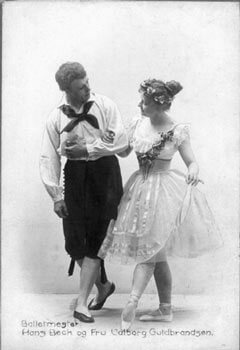
Although France does receive most of the credit for ballet, Italy still continued to develop and produce their own dancers and productions. While France tended to blend their ballets and operas together, the Italian kept the two art forms entirely separately. The Italian style also used mime, and was known for “animated gesticulations mixed with leaps, turns, and acrobatic feats ‘similar to flying’,” (Apollo’s Angels, 208) However, it did struggle comparatively- unlike in France, dancers tended to be independent and move from production to production. It does allow for developments to spread more quickly, but also means that it is difficult to sustain a tradition. Ballet in Italy also tended to be more mobile than in France, as companies weren’t based around a particular court or city.
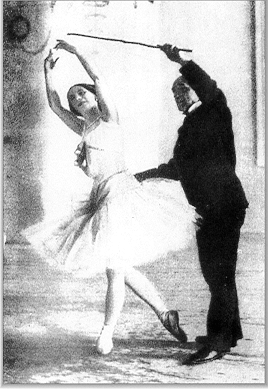
However, Enricho Cecchetti changed that all. Cecchetti (1850-1928) trained under teachers who were trained Carlos Blasis, an Italian dancer who trained in the French style. Blasis emphasised strong technique and an adherence to a strict training regiment. He had an impressive career as a dancer, and then went on to train some of the most famous dancers of the twentieth century, including Anna Pavlova. Cecchetti developed his own method, of training largely influenced by Blasis, and the Cecchetti method is also practiced today, widely. The method still focuses on that regimented training, and produces virtuosic dancers.
We still see both of these schools used in training and companies today, and they have played quite a role on the twentieth century schools that we will be looking at next time. And of course, the French school/method was incredibly strong in the nineteenth century, and remain so to this day.

If you are looking for the first instalment of this series on the Origins of ballet, you can visit it here!
*Homans, Jennifer. Apollos Angels: a History of Ballet. London: Granta, 2011.
Did you know about the different schools of ballet? And are you a fan of Marie Taglioni (like Queen Victoria)?
Cheers,
The Historian
Facebook | Twitter | Instagram | Pinterest | Bloglovin’


Yes I am a fan of Marie Taglioni – and can tell the difference between Marie Taglioni and her brother Paul’s Daughter Marie who you show twice in her father’s ballet Satanella.
Hello Keith, thank you for pointing this out. In the future, an email would be a better place to send a correction rather than a comment.