I think we all (maybe sadly?) have accepted that advertising is a part of modern life. Companies, marketers, and brands continuously dream up new ways to get us to buy things, sign up for subscriptions, and believe their slogans. And the holiday season is no exception to that. For centuries now, holiday-specific advertising has been aimed at us common folk. While they employ many of the same tactics that all other advertising does, they also hit other notes for us. Today, we are going to explore the history of Christmas adverts!

The First Christmas Adverts
One of the first recorded holiday ads dates back to 1728 when a jeweller placed an ad in The Country Journal claiming that you could buy the same necklace that the queen gave to her own children. (At this time, the queen would have been Queen Caroline of Ansbach, wife of King George II.) Earlier in the 18th century, lamplighters and newsboys had begun to hand out printed leaflets encouraging their clients to give generous Christmas gifts. (Yes, the tipping debate is nothing new…)
In The World Encyclopedia of Christmas, Gerry Bowler notes that “Though most Christmas advertising was directed at those buying for young people, servants, or other dependents, a 1770 ad from the New York Journal targeted the upper classes: jewellery, teapots, dress swords, and pocket pistols were deemed to be ‘proper Presents to and from Ladies and Gentlemen this season’, showing the socioeconomic status has always played a role. (p. 3-4)
Coca- Cola and the Santa
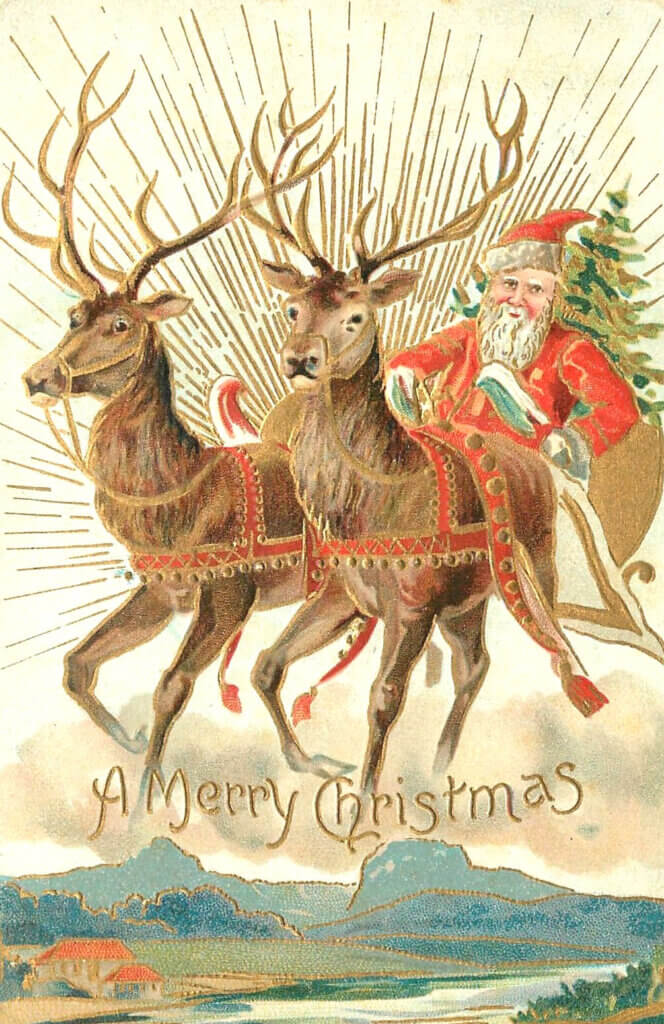
By the middle of the nineteenth century, we see a proliferation of ads. With mass-manufacturing making goods more available to all socioeconomic groups, more and more people were targeted. And Santa Claus was a big part of holiday advertising by the 1830s.
It is in the 1920s that we get one of the most iconic ads- and images- of the holiday season, the Coca-Cola Santa. Artist Haddon Sundblom drew the Coca-Cola Santa, a Christmas staple even now. Although he did not invent the idea of Santa in the red suit, white trim, and black boots, he cemented our modern concept of Santa. Sundblom drew the iconic ads from 1931 until 1964.
Interestingly this year, Coca-Cola has released three entirely AI-generated ads for the holidays. I’m curious to see if it will translate to increased sales, given that AI material is still controversial. Personally, they did not really grab me but perhaps they will grab others.
The John Lewis Christmas Advert
In the last fifteen or so years, Britain in particular has seen a resurgence in holiday adverts. While paper advertising has really fallen off (so few of us are receiving paper flyers and catalogues now, if they are even being produced), television ads* have made a comeback.
In 2007, John Lewis released a holiday ad after three years without and it is an understatement to say that it caught on. Now, you can find many UK retailers releasing their own holiday adverts, including Marks and Spencer, Barbour, and Waitrose. And the release of holiday adverts marks an unofficial start to the holiday season in the UK. (I will admit, I have a soft spot for Kevin the Carrot from Aldi.) I’ve included several of my favourites throughout this post, including Waitrose’s festive mystery!
*Note: My theory on why tv ads have been successful in the UK in particular is because of tv licenses. I suspect that there may be more people still watching standard tv with the BBC, ITV, Sky, etc (as opposed to solely streaming) than in North America. Just a theory, though- I’m still looking for numbers!
Want to know more about our favourite holiday traditions?
The History of Advent Calendars
The History of Christmas Window Displays
The History of Christmas Cards
Does anything surprise you about the history of Christmas adverts?
Cheers,
The Historian
Facebook | Twitter | Instagram | Pinterest | Threads