My holiday history posts this year have covered different aspects and traditions that we still commonly see. Advent calendars are seemingly more popular than ever. And Christmas trees (or some form of greenery) are in the majority of western homes. However, this is one tradition that seems to be dying out- Christmas cards. Even before 2020, Christmas cards are becoming more and more of a rarity. You will probably receive many “Happy Holiday” emails from stores that you or may not have shopped at. So, before they are gone entirely, let’s look at the history of Christmas cards!

The First (Unofficial) Christmas Cards
Although these weren’t Christmas cards as we know it, the first “Christmas cards” appeared in the early part of the 19th century. Schoolboys would write letters home at the holidays, to show their parents how their writing skills had improved. We also see decorative notepaper in the early 19th century, for both Christmas and Valentine’s Day. And “[b]y 1840 it was recognized as socially acceptable to buy a printed card to express a personal sentiment.” (Bowler, Encyclopedia, 36.) A lot of people skip over this though, and tend to ignore it in favour of Henry Cole…

Henry Cole and the First Commercial Christmas Card
Henry Cole was the first Englishman to commission commercially produced Christmas cards. He asked John Calcott Horsley to create an illustration. “These hand-tinted lithographs featured a multi-generational family enjoying a glass of punch, flanked on either side by depictions of seasonal charity: clothing and feeding the poor. The inscription read “Merry Christmas and a Happy New Year to You’.” (Bowler, Encyclopedia, 36.) He ordered 1,000 of the cards that he could send to family and friends, but given that they were quite expensive at one shilling apiece, it’s not surprising that they didn’t catch on widely.

Christmas Cards Finally Catch On
Christmas cards became more widely popular in the 1850s with the advent of mass-produced holiday cards and cheaper postal rate. “In the 19th century, traditional Christmas themes made their first appearance: winter landscapes, Santa Calus, robins (a favourite on English cards since the 1850s), Nativity scenes, etc, but this was also a period of floral patterns, jewelled cards, fringed borders, seascapes, painted porcelain, and other fancies that did not stand the test of time.” (Bowler, Encyclopedia, 36.)

Christmas Cards in the 20th Century
By the time we arrived in the 20th century, Christmas cards were a mainstay of the holiday season. And they remained that way, even throughout World War I, the Great Depression, and World War II. It was an easy way for people to let others know that they were thinking of them during the holidays without having to purchase a gift for everyone. People would send them to distant relatives, friends and coworkers, and businesses would widely send them to clients. In the later decades of the 20th century, there was a shift to more eclectic and humorous cards, and a broadening beyond strictly Christmas.
Christmas Cards Now
Christmas and holiday cards are in an odd place, well into the 21st century. In the 1990s, the US alone sent 2.6 billion holiday cards annually and that is already down to 1.3 billion in 2018.
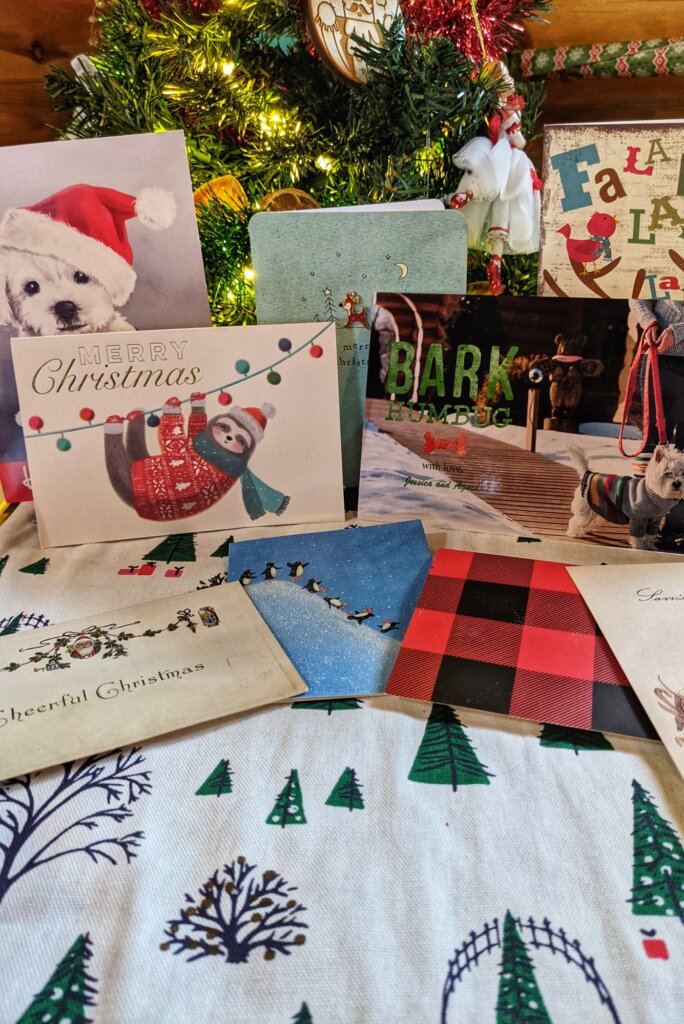
I do still send out Christmas cards to friends and family. (As you can see a, I’ve got an Agnes theme happening.) It can get a little expensive depending on how many stamps I have to buy but it’s one of my favourite holiday traditions.

However, I’m sad to see from different social media feeds that a lot of people just put them straight in the garbage or recycling bin. (No one I know personally has said this.) If someone has gone to the effort of mailing or dropping off a card, I think it is a nice gesture to at least keep it during the holiday season. Between knowing that many people just toss them and people so very rarely send them in the first place, I think it is a real shame that Christmas cards seem to be on the way out.
If you don’t like holiday cards for the sustainability aspect, there are a few things you can do. You can buy cards made of recyclable materials, and you can save the ones you do receive for holiday crafting or cutting them into gift tags. And for anyone wanting to be creative, you can buy holiday cards with wildflower seeds embedded in them that people can plant in the spring!
Were you familiar with the history of Christmas cards? And do you still send them now?
Cheers,
The Historian
Facebook | Twitter | Instagram | Pinterest | Bloglovin’

Yes, I send them, but only a few
I have a set stamp budget, so I can only send as many as I have stamps!