Given that it is the 250th anniversary of Jane Austen’s birth, I knew that I had to do a Jane Austen reading list in case you have an Austenite on your Christmas list! (Or maybe you want to treat yourself- I have acquired all of these books myself…) We have been truly spoiled over the last few years for fantastic new books on our beloved Jane. These books are all fantastic, and I wholeheartedly recommend them to everyone who is even briefly interested. (Three are on my list of all-time favourite books, which is quite the accomplishment.) These are my favourite non-fiction books about Jane Austen, aka the perfect gift guide!
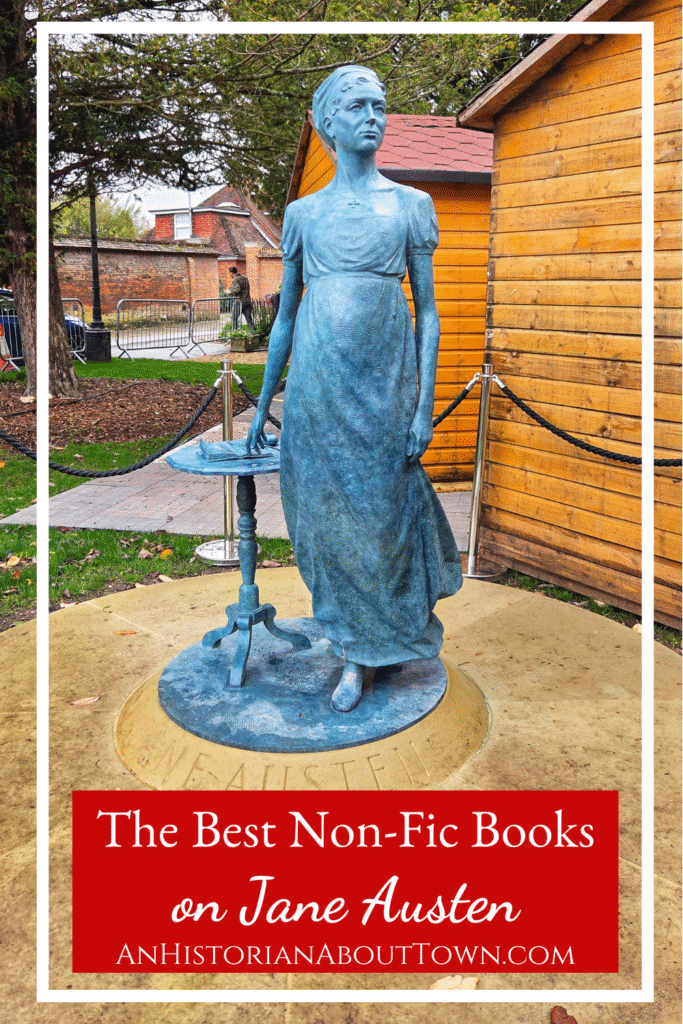
My Favourite Non-Fiction Books about Jane Austen
You will notice that this list does not include any strict biographies. You can absolutely find many different Austen biographies if that is your desire- there are some great ones to choose from. I wanted to focus on books that come at Austen, her works, and her legacy from a different or newer angle.

Jane Austen’s Bookshelf, Rebecca Romney
Long before she was a rare book dealer, Rebecca Romney was a devoted reader of Jane Austen. She loved that Austen’s books took the lives of women seriously, explored relationships with wit and confidence, and always, allowed for the possibility of a happy ending. She read and reread them, often wishing Austen wrote just one more.
But Austen wasn’t a lone genius. She wrote at a time of great experimentation for women writers—and clues about those women, and the exceptional books they wrote, are sprinkled like breadcrumbs throughout Austen’s work. Every character in Northanger Abbey who isn’t a boor sings the praises of Ann Radcliffe. The play that causes such a stir in Mansfield Park is a real one by the playwright Elizabeth Inchbald. In fact, the phrase “pride and prejudice” came from Frances Burney’s second novel Cecilia. The women that populated Jane Austen’s bookshelf profoundly influenced her work; Austen looked up to them, passionately discussed their books with her friends, and used an appreciation of their books as a litmus test for whether someone had good taste. So where had these women gone? Why hadn’t Romney—despite her training—ever read them? Or, in some cases, even heard of them? And why were they no longer embraced as part of the wider literary canon?
Why You Should Read This…
This was one of my favourite reads this summer, to the point that I went out of my way to find a copy on my London trip! (I wanted the paperback which isn’t out in NA until March 2026, and it’s close to $10 CAD more to buy it here…) Romney’s book is part memoir, part biography, part history, and I am here for all of them. It makes for an easy-to-read book, and it makes for an interesting read for anyone, regardless of their familiarity with Austen. You also get great intros for a wide number of authors and their major works, and even if you know them, you will take something away.
I loved Romney’s honesty throughout. You will find a lot of people who won’t admit when they have or have not read a book. (I haven’t read Cecelia yet- one day I will tackle it.) She shares when she has read something, when she hasn’t, when she’s read something “late”, etc, and it is entirely refreshing. This is a must-read for any Austen fan, and for anyone interested in literary history in general!

Wild for Austen: A Rebellious, Subversive, and Untamed Legacy, Devoney Looser
Thieves! Spies! Abolitionists! Ghosts! If we ever truly believed Jane Austen to be a quiet spinster, scholar Devoney Looser puts that myth to rest at last in Wild for Austen. These, and many other events and characters, come to life throughout this rollicking book. Austen, we learn, was far wilder in her time than we’ve given her credit for, and Looser traces the fascinating and fantastical journey her legacy has taken over the past 250 years.
All six of Austen’s completed novels are examined here, and Looser uncovers striking new gems therein, as well as in Austen’s juvenilia, unfinished fiction, and even essays and poetry. Looser also takes on entirely new scholarship, writing about Austen’s relationship to the abolitionist movement and women’s suffrage. In examining the legacy of Austen’s works, Looser reveals the film adaptations that might have changed Hollywood history had they come to fruition, and tells extraordinary stories of ghost-sightings, Austen novels used as evidence in courts of law, and the eclectic members of the Austen extended family whose own outrageous lives seem wilder than fiction.
Why You Should Read This…
This book covers pretty much every major area of discussion related to Austen. We’ve got her novels, her life (and lives of her family), her connections with literature, and even the modern relationship with Austen (including screen adaptations, festivals, and even Austen erotica). Yes, I kept thinking throughout, “oh, *this* won’t be covered, and lo and behold, it was. (It was almost eerie…)
What truly grabbed me about Wild for Austen is Looser’s love of the topic. I find that many, many academics write Austen off for either being too popular (and thus covered too often) or being too frivolous, but Looser obviously hasn’t done this. Her research is so wide-ranging, both in timeframe and scope. The inclusion of recent Austen-related news items was a big highlight for me, as Austen is still very much relevant and she just gets it. She is indeed a talented academic, but she can also write for the general audience and I love that she is making Austen entirely accessible to everyone.
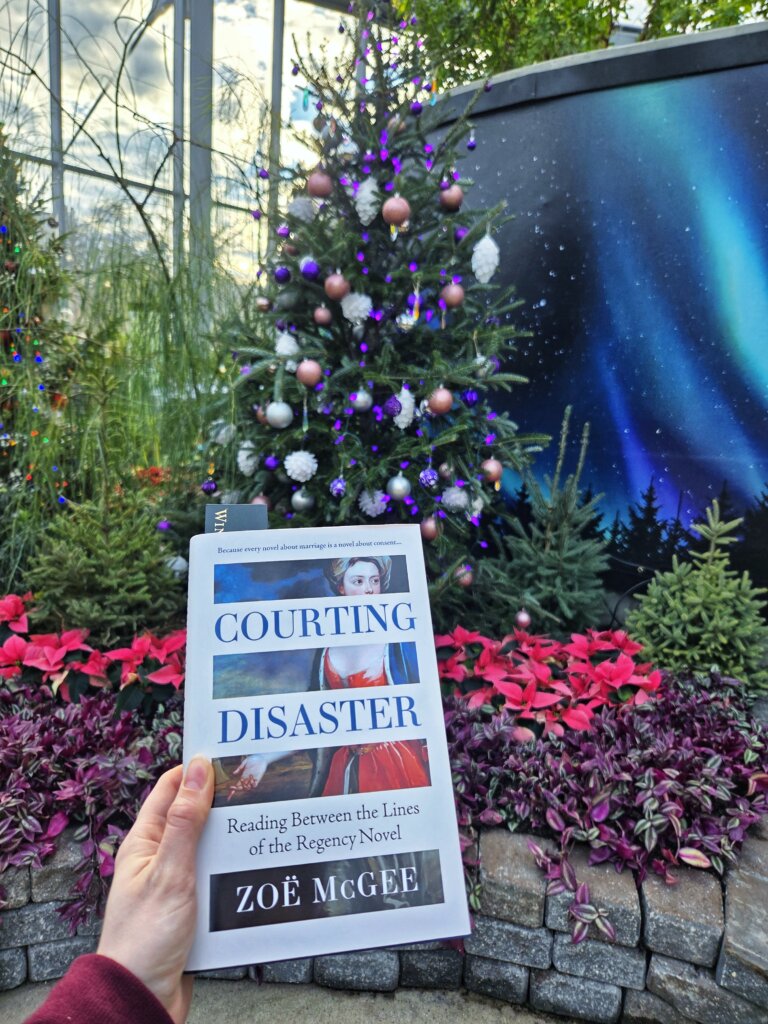
Courting Disaster: Reading Between the Lines of the Regency Novel, Zoë McGee
Drawing parallels with the #MeToo movement, this book explores how a series of brilliant female authors in the eighteenth and nineteenth centuries cleverly used the novel as a vehicle for ground-breaking discussions about consent.
What do #MeToo and Jane Austen have in common? More than you might think.
Ever since the novel was invented, women have used it as a platform for sharing ideas about sexual consent. Dr Zoë McGee reveals how Jane Austen, Frances Burney and their now-overlooked contemporaries used their stories to try to change society’s mind about rape culture – and to reassure survivors they were not alone.
Courting Disaster takes a timely deep-dive into a series of classic novels, comparing them with both historic court records and current events to show that our arguments about consent are not a new phenomenon. With the wit and wryness of a courtship novel, McGee reads between the lines to unveil a quiet feminist movement that still resonates today. Because every novel about marriage is also a novel about consent.
In an era that’s clamouring for a return to the values of the past, Courting Disaster asks what that would really mean, and whether anyone actually liked it back then anyway…
Why You Should Read This…
There will be a post up soon about the talk (I will link here when it is up) where I saw Devoney Looser and Zoë McGee talking about all things Jane Austen and the Regency, but that is where I grabbed this book. I will admit, originally I was debating whether or not to get Courting Disaster– I was feebly trying to stick to a budget on the trip, and I thought, maybe I will get it at home. I couldn’t find it on sale in Canada when I was looking before the talk though, and McGee was so interesting, I bought a copy then and there to get it signed.
Courting Disaster does have a darker theme- consent tends not to be a particularly light topic. However, McGee weaves humour throughout (appropriately) and tackles a very necessary topic. (Especially given that women’s rights are being walked back in a lot of places…) I love that a lot of the book focuses on what wasn’t explicitly stated but would have been understood in the period, as we modern readers often miss it and therefore have very different interpretations.
I will admit, I had to specifically stop myself from rushing through this book. I wanted to wait for when I could really savour it and think on it, and while it took me a little while, it was totally worth it. (I read it at the botanical gardens when I went to see the new gardens, and it was one of my best reading sessions. Is it arguably an odd book to photograph against Christmas trees? Maybe but I can do what I want…)

Living with Jane Austen, Janet Todd
Fanny Price, in Mansfield Park, tells her persistent suitor that ‘we have all a better guide in ourselves…than any other person can be’. Sometimes, however, we crave external guidance: and when this happens we could do worse than seek it in Jane Austen’s own subtle novels. Written to coincide with Austen’s 250th birthday, this approachable and intimate work shows why and how – for over half a century – Austen has inspired and challenged its author through different phases of her life. Part personal memoir, part expert interaction with all the letters, manuscripts and published novels, Janet Todd’s book reveals what living with Jane Austen has meant to her and what it might also mean to others. Todd celebrates the undimmable power of Austen’s work to help us understand our own bodies and our environment, and teach us about patience, humour, beauty and the meaning of home.
Why You Should Read This…
This is a fascinating book. It is part literary analysis, part Austen biography, part memoirs. And that makes it all the more interesting as the reader. Todd is quite obviously an expert in Austen’s writings, and she has not only immersed herself in it but has taken the time to reflect on what it means on a more personal level. While Austen’s works mean something different to all of us, Todd’s reflections then in turn led to several of my own. (I very much appreciate that for many of us, Austen is not something to rush through but rather to sit with and ruminate on.)
This book is an academic-style of literary analysis but I think that Todd makes it accessible to anyone. Even if you’ve only read one of Austen’s novels, she explains and cites things in a way that makes you feel very familiar with it.
♠
What are your favourite non-fiction books about Jane Austen?
Cheers,
The Historian
Facebook | Threads | Instagram | Pinterest