As you would probably expect, I have many reviews for you from my London trip in November. However, one of the exhibitions I went to stood out from all of the others (and I saw seven on this trip, so I feel qualified to say that). Marie Antoinette Style is one of the V&A’s major exhibitions of 2025/2026 and is the first British exhibition to focus on the tragic French queen. These are my Marie Antoinette Style exhibition highlights and why you need to see it.

Basic Info: Marie Antoinette Style (Open until 22 March 2026), V&A South Kensington
A complex fashion icon, Marie Antoinette’s timeless appeal is defined by her style, youth and notoriety. Explore the lasting influence of the most fashionable (and ill-fated) queen in history – with over 250 years of design, fashion, film and art.
More on the exhibition, including buying tickets here!

My Marie Antoinette Style Highlights
I will definitely be sharing more from this exhibition over the coming months but I wanted to share the pieces that stood out to me! (And that is saying something, given that there is a LOT in this exhibition.) This is quite possibly the best exhibition that I have ever seen, which is a feat. I never thought that the 2019 Christian Dior exhibition could be beat, but this has an amazing mix of history, creativity, and fashion, it is beyond exceptional!
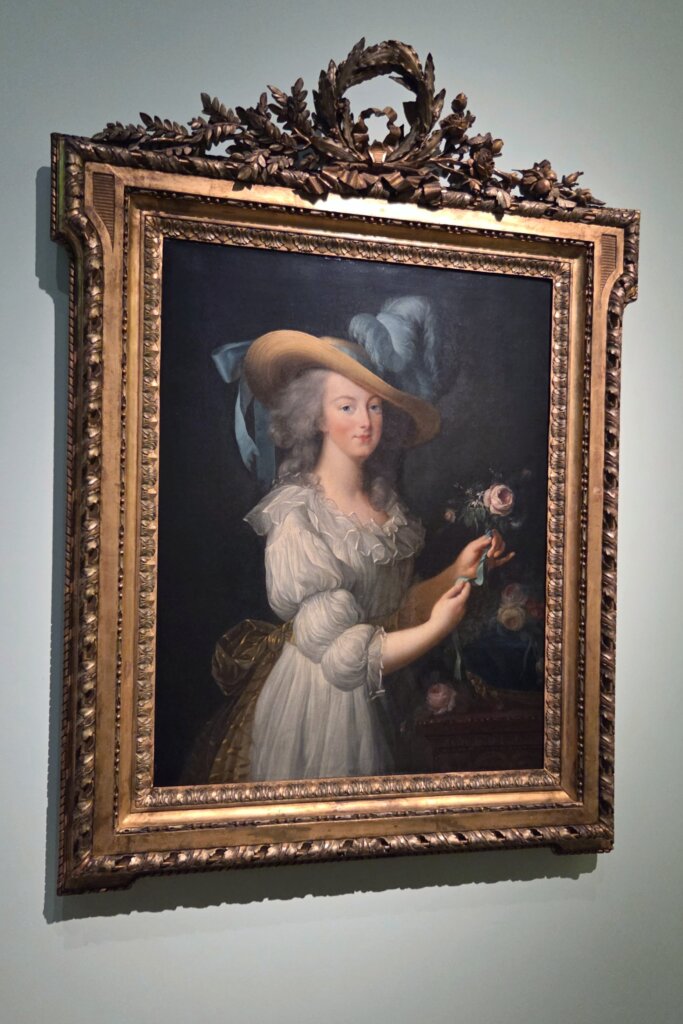
Enchanted by ‘Marie-Antoinette à la rose’
We are going to jump in partway with one of the most enchanting portraits I’ve ever seen. And interestingly, I didn’t think that it was staged to particularly stand out- you could easily miss it! Elisabeth Vigée Le Brun’s ‘Marie-Antoinette à la rose’ is quite possibly one of the most gorgeous paintings of Marie Antoinette. This normally hangs in the Petit Trianon at the Palace of Versailles, but Versailles graciously agreed to loan it for the exhibition. This is a big win for the V&A, as it is ‘only lent on the rarest of occasions’. It is an incredibly detailed portrait- one of Vigée Le Brun’s best- and I spent a good five minutes in front of it. (Probably longer if I am being honest.)
Want to know more about Elisabeth Vigée Le Brun? Check out my post here!
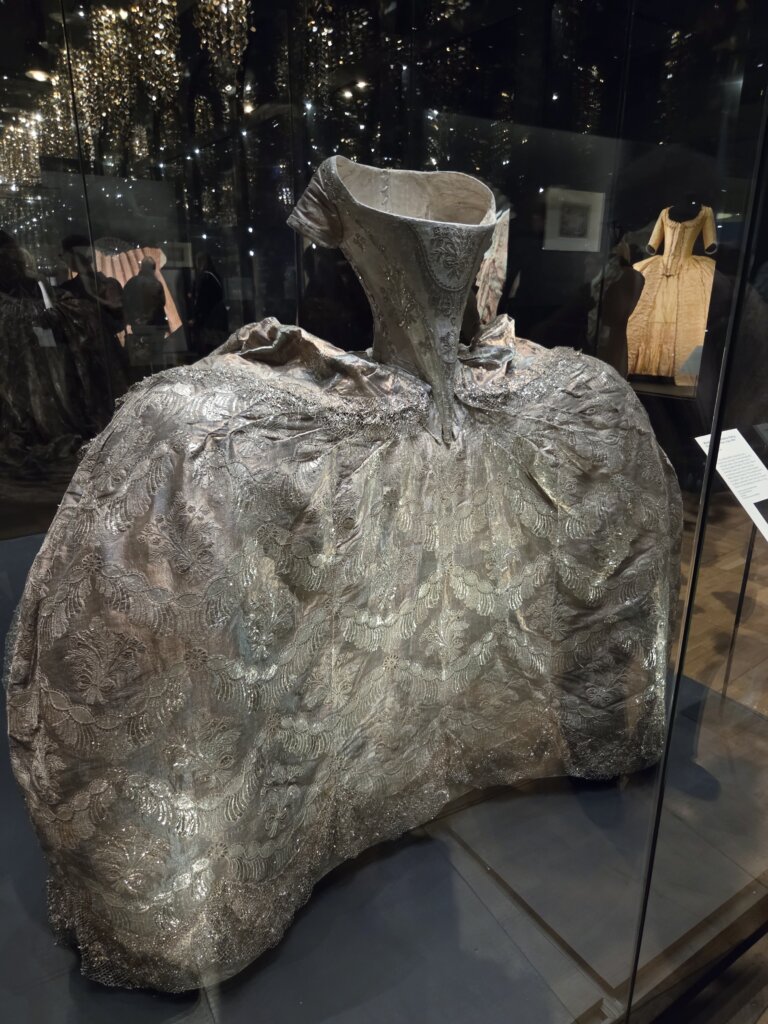
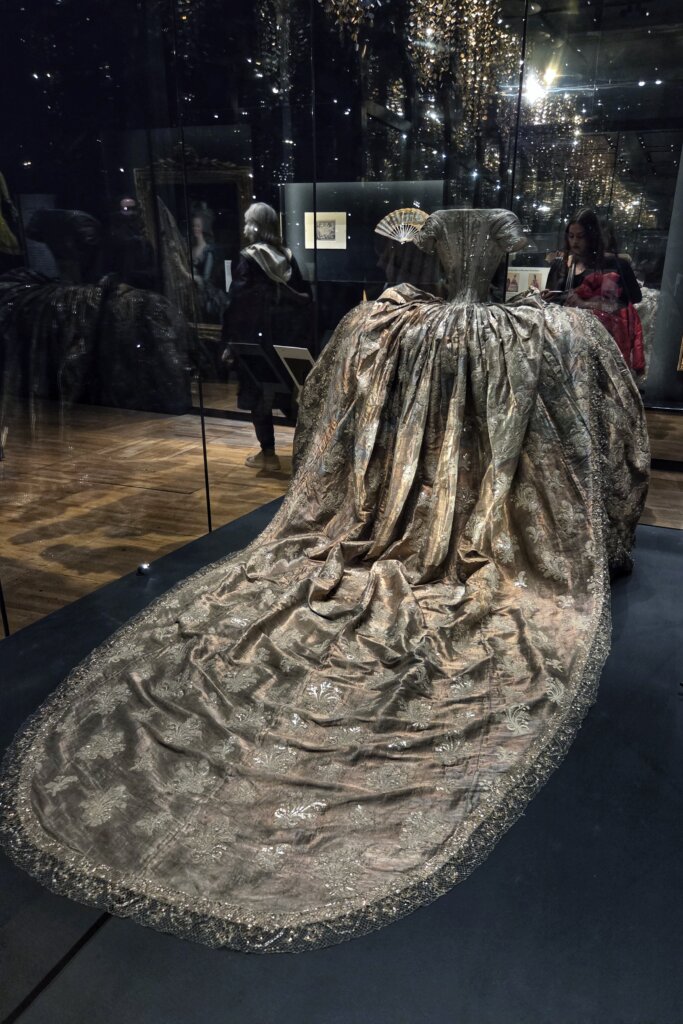
The Ballroom
The first grouping of gowns, along with other items including two of Marie Antoinette’s shoes and a lace choker, is in the first main room which I nicknamed the ballroom. There are several chandeliers (which is why you might notice specks of light on some photos) and classical music, and it really sets the scene for the exhibition.
You are greeted by a stunning silver wedding gown from 1774. The gown is a copy of the Comtesse d’Artois’ wedding gown, and was similar to Marie Antoinette’s! (She was MA’s sister-in-law, so it is not surprising that they would be similar.) My first thought when I saw it was, “sumptuous”. The incredible wealth (both in funds and time) that went into this gown is no joke.
I will say, I have seen many complaints that Marie Antoinette’s wedding gown wasn’t on display, so I will get this out of the way. The different factions who took over during and after the French Revolution went out of their way to destroy anything connected to the ancien regime (aka the monarchy) and we are lucky that anything survived at all.

The Diamond Necklace Affair
If you missed the Diamond Necklace Affair, here is your TL;DR: a couple of conartists tricked a cardinal into paying for a very extravagant diamond necklace that Marie Antoinette declined to purchase due to the cost under the belief that she did buy it. Despite her refusal, the opulent necklace was stolen and broken up and sold, and Marie Antoinette was largely believed to have bought it.
Marie Antoinette Style features a replica of the necklace in question, and woof, does it pack a punch. Created in the early 1960s, the replica gives a good idea of just how big and substantial the necklace was (it seems like necklace is not enough of a word for it…), and why it would have caused such an issue. If you already believe your foreign queen is over-the-top and spends too much and she apparently buys this piece, it would be very easy to get angry…
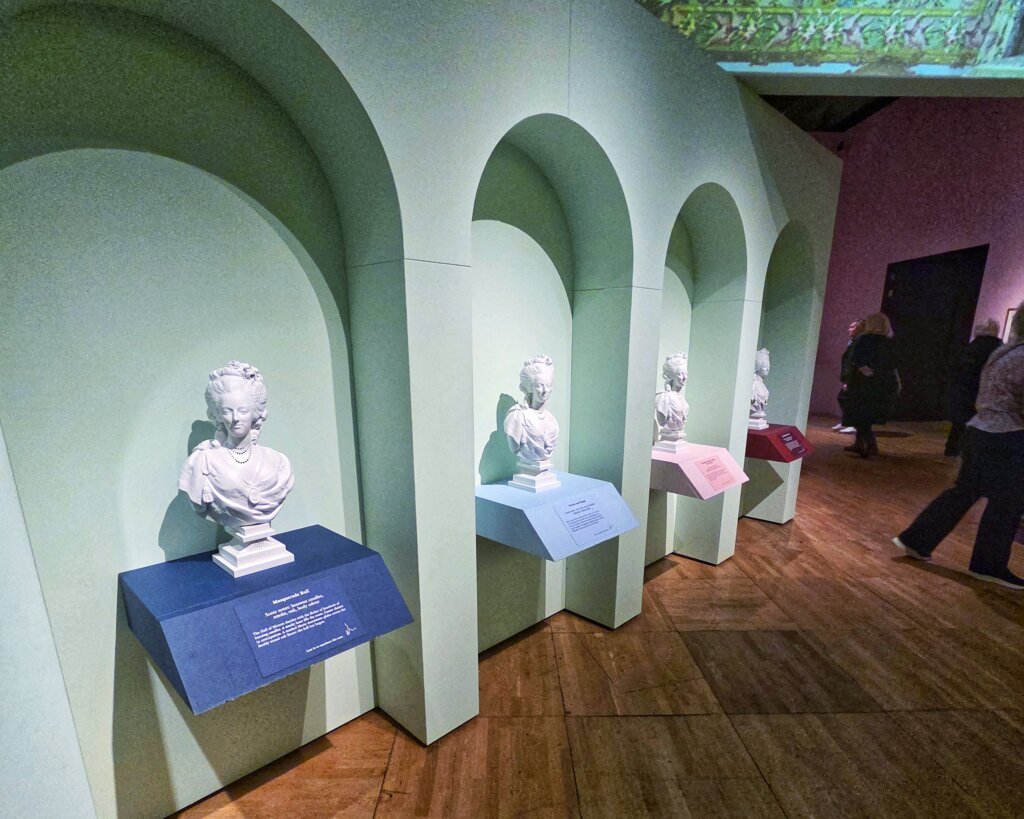
The Scents
I think that this portion of the exhibition may be the most creative that I have ever seen. There were four identical plastic busts together, copies of a ceramic bust elsewhere in the exhibition, and I could not figure out why you want to see identical copies when you can see the real thing until I spotted the explanation.
“A Perfumed World
These portrait busts, modelled after Felix Lecomte’s 1783 marble portrait of Marie Antoinette, are infused with four fragrances informed and inspired by historical research. They recreate the scents of Marie Antoinette’s world.”
There were holes in the neck area of each bust to mimic a necklace, as well as holes in the hair area, and a different scent was released from each. (It is not terribly strong- you need to lean in close to smell them, so if you are sensitive, you shouldn’t be bothered.) It is a fantastically creative way to pull you back into the past and get a better understanding of what people would have experienced, and it was executed so well.
There was a powder and rouge scent to mimic her toilette (notes: orris root, rose, lavender, tuberose, violet, musk), a masquerade ball scent (notes: beeswax candles, smoke, oak, body odour), The Queen’s English Garden, Petit Trianon (notes: grass, lilac, English roses, honeysuckle, violet), and a final one, her Conciergerie Prison Cell (notes: mildew, cold stone, sewage, river, juniper). The prison cell scent was actually not as disgusting as you would expect, either. It was not good, but it wasn’t horrifically bad.

The Chemise
If you want to see something that Marie Antoinette wore herself, that would be the chemise that survives from her incarceration. She was allowed very little clothing in while she was imprisoned, and what she was given was plain and utilitarian. Miraculously, this simple chemise survived the revolution and post-revolution through to today. And its simplicity is what struck me- compared to the gowns and jewellery that opened the exhibition, and this is what survived.
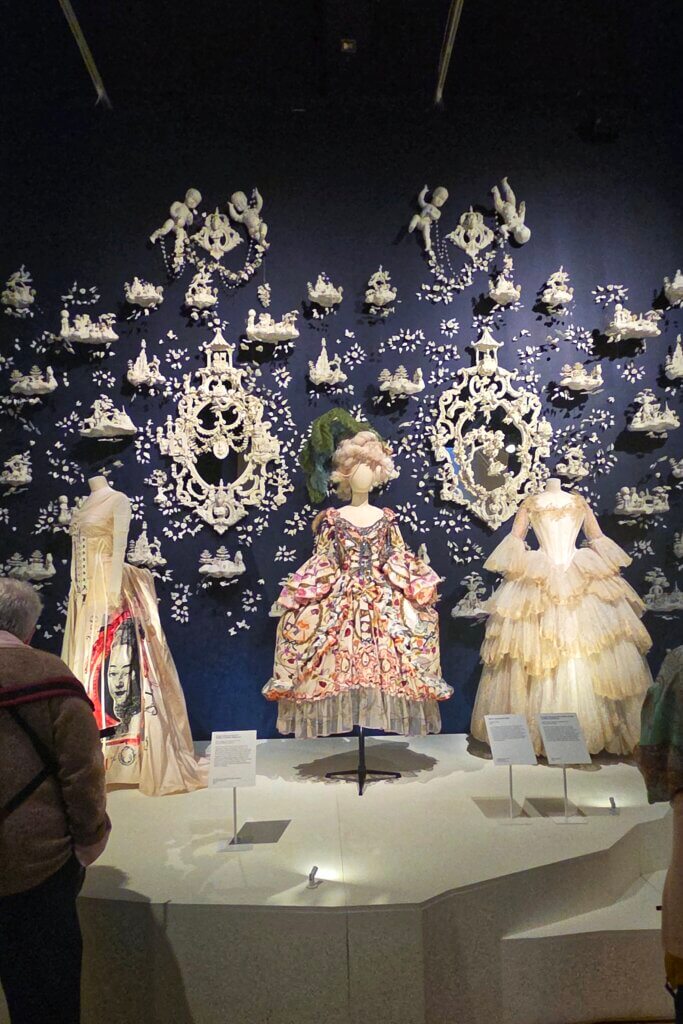
Marie Antoinette’s Influence on John Galliano (for Dior)
I will certainly be getting further into the fashion of the exhibition but Galliano’s Dior gowns were a fantastic way to start the final room of the exhibition. The staging was beautiful, with a created toile of sorts on the wall, and the three gowns really stood out in a room of incredible pieces. Galliano is a rather questionable designer personally, but I will say, his work was perfect to showcase Marie Antoinette’s enduring legacy.
Want to read more about Marie Antoinette? I’ve got a reading list for you!
I hope you’ve enjoyed my Marie Antoinette Style highlights and that you will get a ticket to go yourself!
Cheers,
The Historian
Facebook | Threads | Instagram | Pinterest