With more Coronation news announced each week, and more royal events taking place around Europe, I am getting excited to see more jewels coming out of hiding this year. And I am thoroughly enjoying myself as I research and write this Royal Jewellers series, it is one of my favourites in the last few years. First up was Fabergé, the Russian jewellers whose pieces are still coveted to this day. Then we looked at Cartier, the French jewellery house that has pieces in every royal jewellery collection. We jumped over the channel to wander through the history of Garrard, the English firm that maintained the UK’s Crown Jewels for over a century. This week we are back to France again for Style File Friday, to explore the history of Boucheron!

Royal Jewellers- Who Are They?
These posts each focus on a different jeweller. There are many pieces that we do not know who the jeweller that created them is. Sometimes the record gets lost over the centuries, sometimes the royal family and/or the jeweller does not want that information shared (usually the royals), and sometimes we do not know that the piece even exists. (British Royal Family, we are looking at you…)
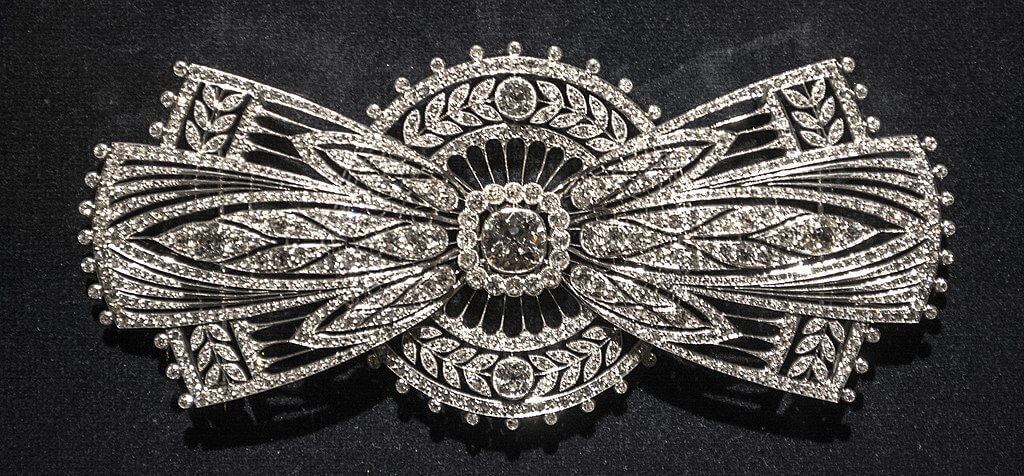
The Early History of Boucheron
Frederic Boucheron opened the first Boucheron store in 1858 in Paris. (That actually makes it the youngest jeweller in this series!) He had a royal connection from the beginning, as he opened his business the Galerie de Valois at the Palais-Royal. (The Palais-Royal was built for Cardinal Richelieu during King Louis XIV‘s reign.) The company started winning competitions fairly early on, with Boucheron winning the Gold Medal at the International Exposition of 1867. Much like the other jewellers covered in this series, the company also started innovating in design. Boucheron created a clasp-less necklace, meaning that women would be able to put their jewellery on without assistance.
The house first started making timepieces in the 1850s, with their first watch available in 1859.

Royal Connections
Like any respectable jeweller, Boucheron had several royal patrons throughout the decades. It has to be noted: there is a pervasive story going around that Prince Felix Youssoupoff purchased a diamond corsage from Boucheron in 1878. However, the Prince was born in 1886, so it seems unlikely that he purchased it nearly a decade before his own birth… The Prince did purchase from Boucheron, though not until he was actually of an age to do so.
Several members of the Russian Imperial family were Boucheron clients from the 1870s to the 1910s, and the company worked closely with French Emperor Napoleon III to outfit his mistress in jewels. Boucheron was also one of few jewellers invited to bid at the auction of the French Crown Jewels in 1887.
Interestingly, in 1930 Louis Boucheron (son of Frederic) was named the Official Guardian of the Imperial Treasure of Persia by the Shah of Iran.
Greville Honeycomb Tiara
If you are at all familiar with the British Royal Family, I will assume that you have come across the Greville Honeycomb Tiara. Lady Greville, a society hostess, left a substantial jewellery collection to Queen Elizabeth (later the Queen Mother). This tiara in particular became one of the Queen Mother’s favourite pieces. She wore it frequently until her death in 2002. It has the fascinating history of being connected to both Boucheron and Cartier, though. Lady Greville commissioned the tiara from Boucheron in 1919, but Elizabeth had Cartier adjust the design to create even more height.
Upon the Queen Mother’s death in 2002, Queen Elizabeth II inherited the Greville Tiara (as it is officially known). She loaned it to her daughter-in-law, the future Queen Camilla, who wore it at nearly every tiara event. (It will be interesting to see if Charles keeps as tight a hold on the tiaras…)
Swedish Laurel Wreath Tiara
This tiara has an interesting history- it actually belongs personally to Crown Princess Victoria of Sweden rather than belonging to the trust like many of the Swedish jewels. This is a convertible piece, meaning it can be worn as a tiara or as a necklace. Princess Margaret of Connaught received this Boucheron piece upon her wedding to Crown Prince Gustaf Adolf of Sweden in 1905. Margaret solely wore it as a necklace, and after her death in 1920, it was not seen again until Princess Lillian, her daughter-in-law, wore it in 1972. She was a Welsh-born commoner who married Prince Bertil. The couple had to wait over three decades to be able to marry, however. Lillian bequeathed the floral diamond piece to her great-neice, Crown Princess Victoria- a sign of their close relationship.
The Greville Emerald Kokoshnik Tiara
Another British piece bequeathed by Lady Greville! This tiara has made waves in the last few years as it was suggested to be one of the tiaras that the Duchess of Sussex had wanted to wear for her wedding. (The Duchess of Sussex also looked beautiful in her wedding tiara.) However, Princess Eugenie of York wore this tiara for her autumn 2018 wedding to Jack Brooksbank, and it looked stunning on her. As the official press release from Buckingham Palace explained,
The tiara was made by Boucheron for Mrs Greville in 1919 in the fashionable ‘kokoshnik’ style popularised in the Russian Imperial Court.
The tiara is made of brilliant and rose cut diamonds pavé set in platinum, with six emeralds on either side.
While we have yet to see the York sisters at official events requiring tiaras, I do hope that they can attend at least a few so that we can see tiaras like the Greville emerald piece.
Were you familiar with the history of Boucheron?
Cheers,
The Historian
Facebook | Twitter | Instagram | Pinterest

.jpg)
