I am asked about introductory books and sources for the Regency period and Victorian period regularly. (As an historian, I am always more than happy to get these questions!) And more often than not, this is the first book that I recommend. In addition to introducing me to Jane Austen and her novels, my grandfather also gave me this book as a teenager. And not only have I read it cover to cover multiple times, I still use it as a reference regularly. As we continue on with Jane Austen Month, let’s look at What Jane Austen Ate and Charles Dickens Knew by Daniel Pool!
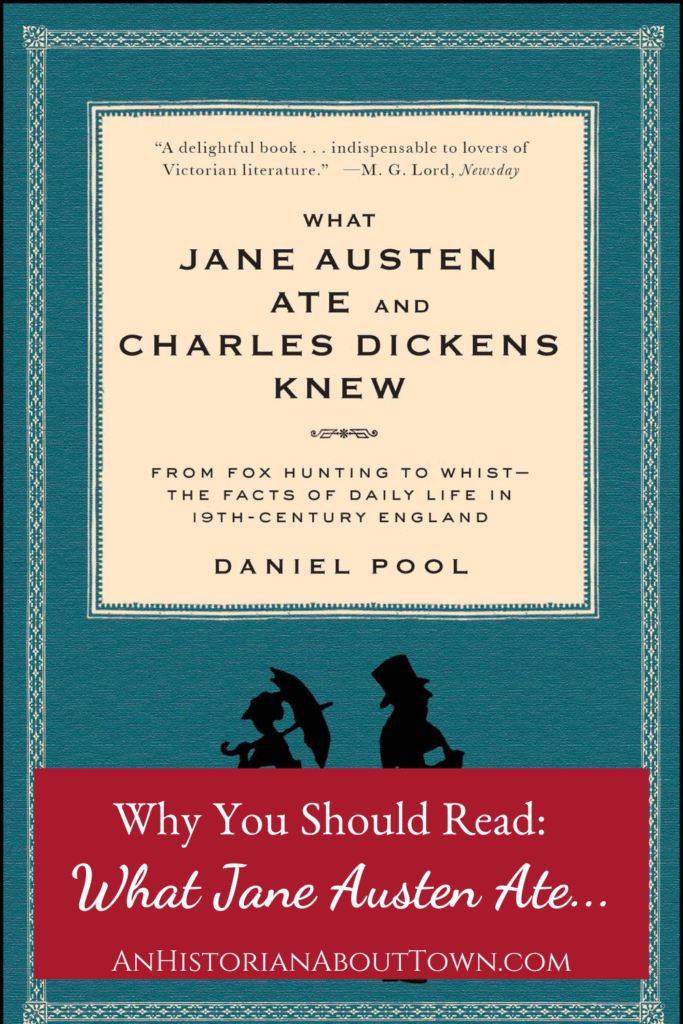
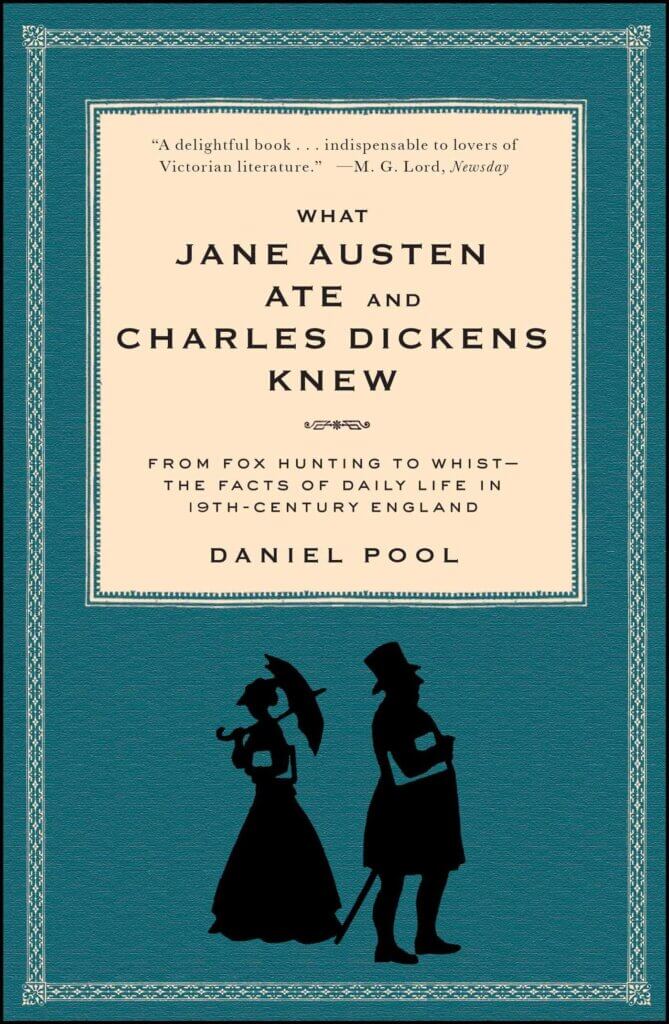
What Jane Austen Ate and Charles Dickens Knew: From Fox Hunting to Whist- the Facts of Daily Life in 10th-Century England, Daniel Pool
A “delightful reader’s companion”; (The New York Times) to the great nineteenth-century British novels of Austen, Dickens, Trollope, the Brontës, and more, this lively guide clarifies the sometimes bizarre maze of rules and customs that governed life in Victorian England.
For anyone who has ever wondered whether a duke outranked an earl, when to yell “Tally Ho!” at a fox hunt, or how one landed in “debtor’s prison”; this book serves as an indispensable historical and literary resource. Author Daniel Pool provides countless intriguing details (did you know that the “plums” in Christmas plum pudding were actually raisins?) on the Church of England, sex, Parliament, dinner parties, country house visiting, and a host of other aspects of nineteenth-century English life—both “upstairs” and “downstairs.”
An illuminating glossary gives at a glance the meaning and significance of terms ranging from “ague” to “wainscoting,” the specifics of the currency system, and a lively host of other details and curiosities of the day.
Why You Should Read This…
This book was originally published in 1993 but it is still one of the most easy-to-read and accessible books on the nineteenth century that I’ve read. (And I’ve read more than I should admit to.) Although it’s essentially an encyclopedia, I found it read very easily. (And far more humorous than I was expecting!) The language isn’t technical but it still covers all of the major points and covers a massive range of topics (making it a useful source).
Pool touches on both public and private life and many, many topics contained in both. What is “the season” and when is it? What clothing did women and men wear? What card games did they play? How did people travel before trains? What is the proper form of address? These and more are all included in the book. If you have watched Bridgerton or Pride and Prejudice and wanted to ask, why did they do X, Y, or Z, you need to read this.
I also very much appreciated that Pool doesn’t limit the book to the gentry and aristocracy, as so many authors do. The last chapter of the main text explores the types of things that the lower classes would have experienced (something often not covered in Austen-ish texts). And after that, we have a great glossary and bibliography, very helpful for anyone who wants to do further research.
♠
Want more Jane Austen?
Must Visit-Places for Jane Austen Fans
Five Authors Who Inspired Jane Austen
My Favourite Austen-ish Period Dramas
The Best Jane Austen Biography Books and Sources
Book Bite: The Friendly Jane Austen
Is What Jane Austen Ate and Charles Dickens Knew by Daniel Pool on your to-read list?
Cheers,
The Historian
Facebook | Threads | Instagram | Pinterest