Behind the Ballet is back again! If you are newer to the site, this is a series where I explore the history of a classical ballet and highlight anything that you might want to know if you are going to see it. I know that a lot of people can feel overwhelmed when they start going to the ballet, and even though you absolutely do not need to know anything, it can be helpful. This is one of my favourite classical ballets that is finally seeing a resurgence again. Welcome to Behind the Ballet: Raymonda– the history of the last ballet by one of the greatest choreographers in ballet history!
Raymonda Synopsis
I have included a brief synopsis from the Marius Petipa Society below. The Dutch National Ballet has a much longer synopsis that can be found here if you want a scene by scene breakdown!
Set in the 12th century, the beautiful young countess, Raymonda is waiting for the return of her beloved fiancé, Jean de Brienne, the noble knight of the Crusades. However, when the Saracen knight, Abderakhman arrives and sets his sights on Raymonda, she receives a terrible warning from the legendary White Lady that her life is in danger. Luckily, Jean de Brienne returns in time to save Raymonda from the hands of the Saracen when he attempts to abduct her and all is well.

Marius Petipa’s Last Hurrah
Marius Petipa is a crucial figure in the history of ballet. The nineteenth century choreographer was the ballet master of the Imperial Ballet in St. Petersburg and created some of the most beloved ballets to this day, including Swan Lake, The Sleeping Beauty, and The Nutcracker.
Raymonda is Petipa’s last major success. He created the ballet at 80 in 1898, at an age when most of us are retired. This is considered a “grand spectacle” ballet, one that has a lighter plot line and focuses on an overall spectacle. (Much like Sleeping Beauty– SB has a fairly thin plot when you factor in the amount of time spent with different characters dancing at court.)
Petipa’s inspiration for this ballet came from author Countess Lydia Pashkova’s libretto and composer Alexander Glazunov and proved to be the perfect combination for Petipa to allow the pure talent and technique of the dancers to shine.

Pierina Legnani
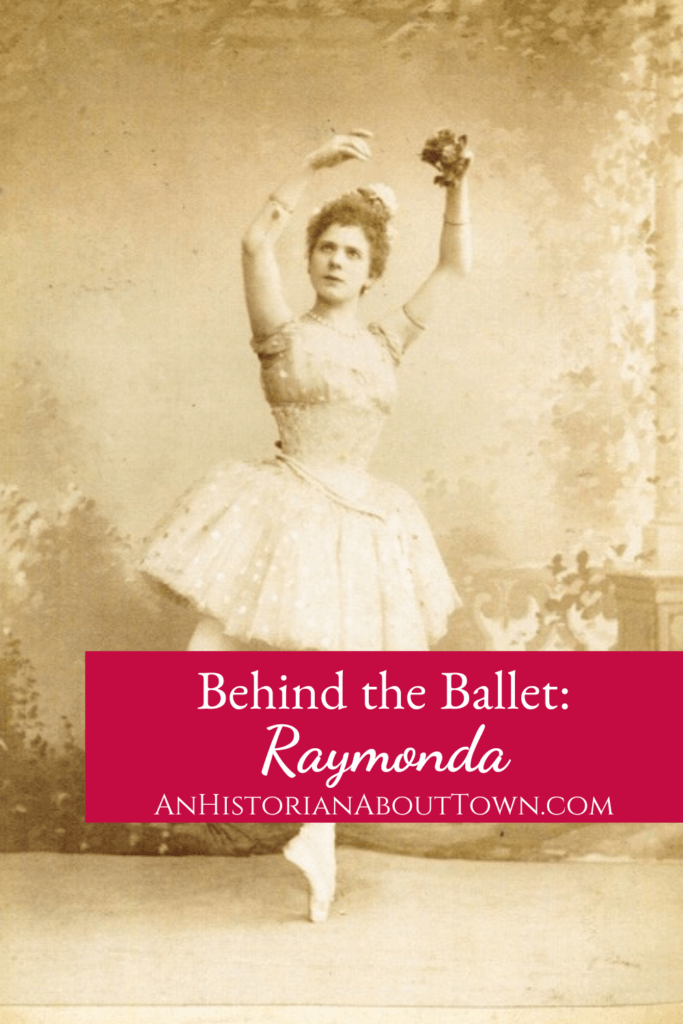
The success of a ballet can largely depend on the dancers in particular roles. If a dancer is not right for their role, it can make a massive impact on a production and thankfully, Petipa was successful in casting. He chose Italian dancer Pierina Legnani for the titular role, one of the most talented dancers of her generation.
Legnani began her training and career at La Scala in Milan but established herself as a sought-after dancer across Europe. She first performed at the Imperial Ballet in 1893 and Petipa quickly promoted her, giving her the title of Prima Ballerina Assoluta, the first dancer to ever receive the honour. (Only thirteen dancers have ever received the title, so it is incredibly rare.) Her abilities were rivalled by few and one of her major accomplishments is being the first dancer to complete thirty two fouetté turns on pointe in Russia.
Legnani’s dancing in Raymonda was widely praised by critics and was considered a crucial element of the ballet’s success.

An Overwhelming Success
Not every ballet is immediately loved. The Nutcracker was panned by Russian audiences on its premiere, as hard to believe as that may be. However, Raymonda was a resounding success. Legnani’s talent paired with Petipa’s choreography and Glazunov’s score made for an audience favourite with St. Petersburg society flocking to see it.
A Continually Evolving Raymonda
While many nineteenth century ballets have somewhat (or entirely) been lost, Raymonda has actually had a fairly steady evolution. It was first performed by the Bolshoi Ballet in 1900 who used Petipa’s choreography and production. In 1908, Alexander Gorsky created his own version for the Bolshoi which was also popular but lacked some of Petipa’s elegance.
Anna Pavlovna was the first to stage Raymonda in the west with her 1915 production, and Mikhail Fokine and other dancers and choreographers staged their own versions.
Konstantin Sergeyev created a new Raymonda for the Mariinsky Ballet in 1948, and this now remains the most popular version. Rudolf Nureyev had learned the ballet and was able to teach it to the Royal Ballet after he defected, as well as the Australian Ballet, the American Ballet Theatre, and the Zurich Ballet. Nureyev then created his own Raymonda in 1983 for the Paris Opera Ballet, an extremely popular version.
George Balanchine created shorter Raymonda variations for the New York City Ballet, and these shorter pieces are often frequently performed.
Tamara Rojo created a new version of Raymonda for the English National Ballet in 2022 to immense praise. Rojo’s Raymonda was set during the Crimean War allowing for the problematic storyline to be updated but keep the original feeling of Petipa’s ballet.
Curious about other ballets? You can read more!
Behind the Ballet: Swan Lake
Behind the Ballet: Giselle
Behind the Ballet: Don Quixote
Behind the Ballet: Sleeping Beauty
Behind the Ballet: La Fille mal gardée
Behind the Ballet: Coppélia
Behind the Ballet: The Nutcracker
Behind the Ballet: The Firebird
Behind the Ballet: Mayerling
Behind the Ballet: Jewels
Behind the Ballet: La Sylphide

Were you familiar with the history of Raymonda?
Cheers,
The Historian
Facebook | Twitter | Instagram | Pinterest | Threads