I do not know about anyone else, but I am always drawn to supernatural ballets in the darker parts of the year. And luckily for me, there is no shortage of ballets based on supernatural stories. One of my favourites that is not performed enough is one of the oldest surviving ballets in the world. (Obviously ballets were performed for centuries prior but choreography rarely survived into the modern period.) Welcome to Behind the Ballet: La Sylphide– the history of one of the spookiest ballets!
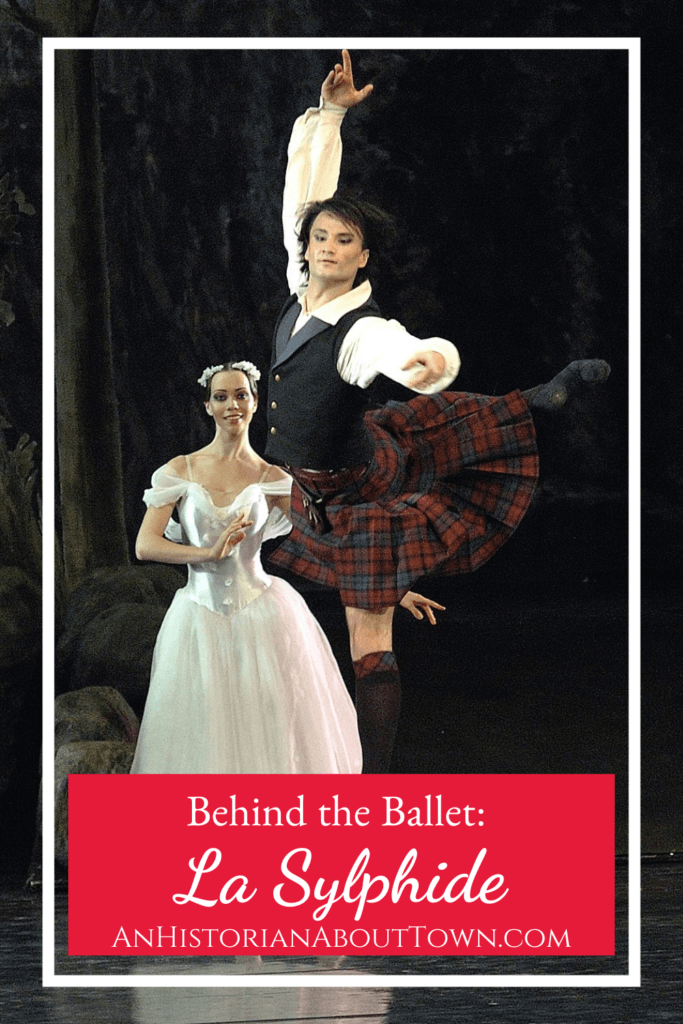
La Sylphide Synopsis
From the English National Ballet,
Act I
Young James is shortly to marry his betrothed, Effy. He slumbers in his armchair. The Sylphide sits by his feet. She is in love with James and wakes him by kissing his forehead before vanishing through the chimney in the fireplace. James is spellbound and searches for the Sylphide, and his preoccupation with an invisible world confounds him. He barely notices Effy, who is courted by another young suitor, Gurn.
Preparations for the wedding are under way but are brought to a standstill when the sorcerer Madge suddenly appears. Despite James’s protest, the young girls including Effy, have their fortune told. According to the soothsayer, Gurn rather than James is to wed Effy. This rouses James’s anger and he sends the sorcerer on her way.
When James is alone in the living room, the Sylphide appears again. She lets him know that her destiny is forever tied to his and declares her love for him. James hesitates but only for a moment and is once again infatuated by her charm. Gurn has witnessed the scene and seeks to reveal the nature of James’s true love to the wedding guests. They brush his accusations aside and the ceremony, James has disappeared. He has left for the woods with the Sylphide and the poor bride-to-be is heartbroken.
Act II
Madge has summoned the witches for a gathering in the misty forest. They concoct a magic potion and weave a pink veil. Meanwhile the Sylphide has led James to her kingdom in the woods. When she asks James if he loves her, he hesitantly declares his love. The Sylphide’s many sisters dance for him.
The wedding guests search for James in the woods. Gurn finds his cap while Madge tells him of James’s infidelity. Gurn then plucks up the courage to propose to Effy who reluctantly accepts.
James is alone in the forest. He is torn between the Sylphide and Effy. Madge appears and promises to make the Sylphide return. She gives him the pink veil and tells him that the veil is to be used to capture the Sylphide. When the Sylphide returns, James follows Madge’s instructions. He wraps the Sylphide round in the veil and her fate is sealed. She has lost her freedom, loses her wings, and dies. Madge is delighted, and while Gurn leads Effy to the alter, the Sylphide is carried through the air by her sisters. James is shattered and sinks to the ground.

Ballet Blanc
La Sylphide is considered a ballet blanc, also known as a “white ballet”- they are known as such for the white, Romantic tutus that all of the female corps de ballet members wear. La Sylphide is arguably one of the first ballets to introduce this concept that would be repeated in Giselle and Swan Lake. (Think 20+ female members of the corps all in white, bell-shaped skirts typically embodying a supernatural figure.)

A Ballet for a Pointe Pioneer
The Italian choreographer Fillipo Taglioni created this ballet for his daughter, the famed Marie Taglioni. (If only we all had a parent who could put us front and centre in our industry!) Marie was a talented and beloved dancer from a very young age, and in the 1820s she quickly became a star at the Paris Opera. From the beginning of her career, she was known for her pointe work. (Pointe is what we call dancing on the tips of your toes.) At that time, it had never been seen before for any long stretch of time- dancers would go en pointe for a few seconds, but nothing longer.
Fillipo created La Sylphide with Marie as the star to capitalise on her pointe work. This was the first ballet to have substantial pointe work where it wasn’t simply a trick to draw attention. Marie’s shorter, scandalous skirts also allowed the audience to focus on her footwork. It was the best dancer performing a new technique, and it took everyone by storm.

A Bournonville Version
In 1836, Danish choreographer August Bournonville wanted to stage Taglioni’s Sylphide for audiences in Copenhagen. However, with licensing fees being prohibitively high, Bournonville decided to create his own version of La Sylphide. (It turns out that people have been unwilling to pay licensing fees for centuries.) If you see the Royal Danish Ballet perform La Sylphide, you will be seeing this Danish version. And this is the oldest surviving Sylphide choreography; Taglioni’s is lost.
A French Master Restages La Sylphide in St. Petersburg
French ballet master and choreographer Marius Petipa decided to restage the original 1832 Taglioni production of La Sylphide at the Imperial Theatre in St. Petersburg in 1892. The ballet (and the opera) played a significant role in Russian society in the late nineteenth century. It was the place to see people and be seen, and many noblemen would take company dancers as mistresses.
It is important to note that Russian choreographer Mikhail Fokine created a ballet, Les Sylphides, that was inspired by the original ballet but should not be confused with La Sylphide.
♠
Curious about other ballets? You can read more!
Behind the Ballet: Swan Lake
Behind the Ballet: Giselle
Behind the Ballet: Don Quixote
Behind the Ballet: Sleeping Beauty
Behind the Ballet: La Fille mal gardée
Behind the Ballet: Coppélia
Behind the Ballet: The Nutcracker
Behind the Ballet: The Firebird
Behind the Ballet: Mayerling
Behind the Ballet: Jewels
Were you familiar with the history of La Sylphide?
Cheers,
The Historian
Facebook | Twitter | Instagram | Pinterest