As live ballet and theatre performances are in full swing everywhere, I am excited to get back into my Behind the Ballet series. With it being October, I thought that it would be fun to look at a classical ballet with a supernatural plot. (I mean, there is no shortage there…) The nineteenth and early twentieth centuries were goldmines for these ballets. Michael Fokine, in particular, drew on many Russian myths and fairytales. Let’s get into Behind the Ballet: The Firebird!

The Firebird Ballet Synopsis
From American Ballet Theatre,
Searching for his lost love, Ivan finds himself in a mysterious and ominous place. A flock of firebirds descend. Ivan hides and watches the mythical creatures in their nightly ritual. He starts to chase one and captures her as the rest scatter in fear. The captive Firebird struggles to free herself and finally breaks away, leaving him with a magical feather which will summon her in times of danger.
A group of maidens suddenly appears. Ivan wonders if his love is among them but cannot be sure as they are transformed under a spell. He reveals himself to the maidens who seem to resent his intrusion. Slowly, they accept his presence. He is drawn to one particular Maiden, and she too seems taken with him. They come together but are interrupted by the arrival of Kaschei, the evil sorcerer who controls the maidens with his magical power. As the group greets their master with blind adoration, the Maiden attempts to hide Ivan but is unsuccessful. Angered by Ivan’s presence, Kaschei exerts his power and initiates a deadly game. Ivan uses the feather to summon the Firebird to his rescue.
The Firebird arrives and begins an infectious dance, compelling everyone to participate until they collapse from exhaustion. She lulls the maidens to sleep, and she and Kaschei struggle over the fates of Ivan and the Maiden. In a trance, the Maiden is unable to recognize Ivan as her true love and allows herself to be seduced by Kaschei. Ivan feels lost and betrayed, but the Firebird shows him a way to break
the spell. He shatters an egg containing Kaschei’s soul and power, killing him. Kaschei’s kingdom disintegrates, and the maidens awake from his spell as victims of his past curses are liberated, free to reunite with their lost loves.

Michael Fokine’s The Firebird
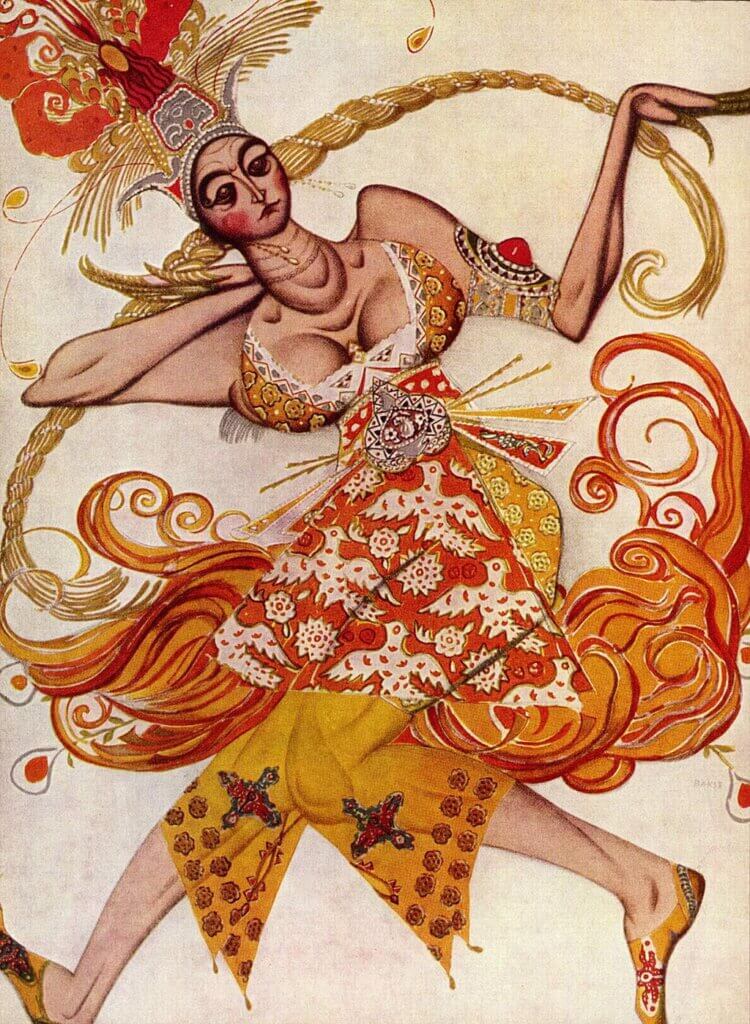
Serge Diaghilev’s Ballets Russes dominated ballet across the world in the 1910s and 1920s. Alexandre Benois was a designer for Diaghilev’s company, and he had been inspired by the Slavic fairytale of The Firebird. He turned to the then-unknown composer, Igor Stravinsky, for the music and to Michael Fokine, a Russian “choreographer, for the actual choreography. (Stravinsky was not the first choice, but I would say it worked out for the best).
Fokine drew on both the fairytale and the Russian myth of Koschei the Deathless for the ballet. Like most Ballets Russes productions, the choreography blended classical ballet, folk dance, and contemporary. The role of the Firebird is an incredibly demanding role that still tends to go to a principal dancer, as the range of skill and emotion required is remarkable. Starting with the 1910 version and forward, you will most often see this ballet described as “virtuosic”.
A Dazzling Paris Premiere
The production premiered in June of 1910 at the Palais Garnier. And the Paris audience loved this ballet. In the Ballets Russes mould, it was a feast for the eyes, taking a maximalist approach to choreography, costumes, music and sets. Tamara Karsarvina was praised in the titular role, and Stravinsky in particular was lauded for his unique score. Many critics called for a “sequel” ballet (not a common occurrence) which led to the creation of The Rite of Spring, where Stravinsky paired with Vaslav Nijinsky in 1913.

A Flock of Firebirds
Several companies and choreographers have created their own versions of The Firebird ballet. George Balanchine and Jerome Robbins created a new Firebird production in 1949 for the New York City Ballet. The ballet premiered with Maria Tallchief as the Firebird, and used a shorter score. Balanchine also made changes in 1970, 1972, and again in 1980, with that version staying fairly consistent for NYCB now.
The National Ballet of Canada, the Royal Ballet, the Mariinsky Ballet, and the American Ballet Theatre have all created their own versions as well. The NBC version was made for broadcast in the 2010s. Interestingly, it is not the most common ballet production, though. If you can find it in a season schedule, this is a must-see event!
♠
Curious about other ballets? You can read more!
Behind the Ballet: Swan Lake
Behind the Ballet: Giselle
Behind the Ballet: Don Quixote
Behind the Ballet: Sleeping Beauty
Behind the Ballet: La Fille mal gardée
Behind the Ballet: Coppélia
Behind the Ballet: The Nutcracker
Were you familiar with the history of The Firebird ballet, or the ballet itself?
Cheers,
The Historian
Facebook | Twitter | Instagram | Pinterest