As a performing art, ballet holds an interesting place in society. It isn’t quite as divisive as opera, where people feel like they need to know other languages to enjoy. (You don’t, though- there are subtitles!) However, people will still balk at paying ticket prices. Many people attend The Nutcracker every holiday season, but don’t consider it at any other point in the year. And it is a shame, because ballet is long established in North America. So, today we continue on in my History of Ballet series- we are looking at the history of ballet in North America!

Here is where I need to clarify something- I am Canadian, and it bothers me to no end that ballet scholars look at the history of ballet in the US and ignore Canada like it doesn’t exist. Jennifer Homans actually doesn’t mention Canada at all in Apollo’s Angels: A History of Ballet. So, this post is very much a history of ballet in North America, not a history of ballet in the US.

Touring Ballerinas and European Culture
Like many aspects of life in North America, ballet was brought to North America by immigrants. In the nineteenth century, European dancers and groups would tour in North America. Fanny Elssler, the adored Austrian ballerina, toured the US from 1840 to 1842, to great success. It was limited to particular dancers and smaller groups, rather than larger companies touring as they do now, though. Some historians have argued that ballet wasn’t popular because it is associated with royalty and their courts, which went against the American ethos. (See Apollo’s Angels, chapter 11.) However, the dancers were always heartily welcomed, and crowds continued to draw. (Not to mention that European culture was often welcomed and celebrated in many large cities, and American elites still strove to marry their daughters and sisters in European royalty…)
The Early Beginnings of North American Ballet
There were a handful of companies formed in the early twentieth century in North America. Unfortunately, none of them lasted more than a few years- outside of a few major US cities, ballet hadn’t taken a hold in North America. In the 1920s and 1930s, many ballet schools opened across the continent, and we can see the fruits of those schools in the following decades. In 1929, the Atlanta Ballet was formed, as the Dorothy Alexander Concert Group, and it is still operating today as the Atlanta Ballet. (Interestingly, the Atlanta Ballet does assign dancers any sort of ranks.)

The Royal Winnipeg Ballet and Canadian Ballet
I again must admit my bias here, as I am from Winnipeg and the RWB is my local company. However, the Royal Winnipeg Ballet is the oldest (continually operating) ballet company in Canada, the second oldest in North America, the only North American ballet company to hold a royal designation, and the first ballet company in the Commonwealth to be granted a royal designation.
In 1937 Gweneth Lloyd and Betty Farrally, two English ballet teachers, founded the Winnipeg Ballet Club. The Club had its first big break when they performed as part of pageant for King Goerge VI and Queen Elizabeth’s 1939 Royal Tour of Canada. In 1941, it was renamed the Winnipeg Ballet, and then received their “Royal” in 1953. (The Royal Ballet in Covent Garden only received their royal charter in 1956.) The RWB is still operating today, and it is a world-renowned company and pre-professional school. They have commissioned several notable ballets in the twenty-first century, including Dracula, The Handmaid’s Tale, and The Wizard of Oz.
The National Ballet of Canada in Toronto and Les Grands Ballets Canadiens in Montreal are Canada’s other major ballet companies. There are several smaller regional companies as well, like the Alberta Ballet, Ballet BC, and Ballet Jorgen. Most Canadian companies tour and perform a mix of styles.

New York City and Ballet
The history of ballet in North America must include NYC. New York was one of the places to be for ballet in the second half of the twentieth century. While there are several notable companies across the US, New York is home to both the American Ballet Theatre and the New York City Ballet. ABT was founded in 1939, and now calls the Metropolitan Opera House home. The company performs a mix of classical and contemporary ballets, and two notable choreographers created many works on them- Anthony Tudor and Agnes de Milles. The first two directors, Lucia Chase and Oliver Smith, sought to create a company to celebrate older classical works while supporting new and younger choreographers. ABT maintains this balance today, and carries out an intensive touring schedule every year.

The New York City Ballet is the result of several companies coming together, under the direction of George Balanchine. Balanchine is known as the Father of American ballet to this day. He trained at the Imperial Ballet School in St. Petersburg, and then joined the Ballet Russes as a choreographer in the 1920s. He immigrated to the US in 1934 with the express intent to open a school. The Balanchine method is particularly gruelling- with a punishingly quick barre, and very specific lines. (You can always recognise a Balanchine dancer by their “lobster claw hands”- see here.) NYCB consistently performs Balanchine’s neoclassical works, with the trademarks of exaggerated and strong lines, fast speed and a deep plié, pirouettes from fourth position, and an open hip in arabesque. NYCB has had serious issues in the last decade, with several dancers sued for sharing nude photos of another dancer, and allegations of sexual misconduct against former director Peter Martins.
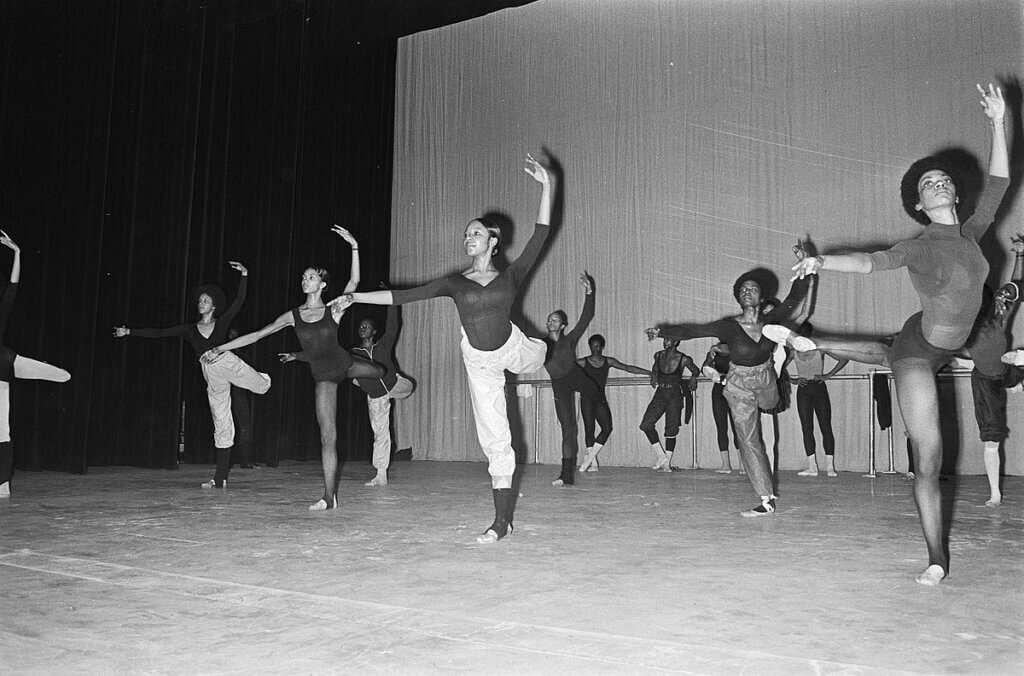
Dance Theatre of Harlem
The Dance Theatre of Harlem, a predominantly Black ballet company, was founded in 1969 by Arthur Mitchell and Karel Shook. Mitchell was the first African-American principal ballet dancer, for NYCB, and after hearing about the assasination of Dr. Martin Luther King, Jr. decided to found a ballet school for African-American students in Harlem. The company performed their first pieces in 1971, and would go on to premiere groundbreaking pieces such as Creole Giselle (set on an 1840s plantation). DTH does an incredible amount of outreach- their Dancing Through Barriers program offers free instruction to over 1,000 students of all ages every year. They also visited South Africa for the program in 1992, with a lasting legacy.
Although there are more and more BIPOC dancers and choreographers in ballet, it is still an overwhelmingly white field. It isn’t only the cost of lessons, costumes, etc., but also barriers like not being able to find tights and pointe shoes that match your skin tone. (These products are now finally coming out!) The Dance Theatre of Harlem is a crucial company in ballet- it shows that ballet belongs to everyone, and should not be limited to any one group.

History of Ballet Series
If you are interested in catching up, here are the early posts in my History of Ballet Series:
The Origins of Ballet
A New Star and Different Schools
And if you are looking for more sources on the history of ballet, I’ve shared my favourite history of ballet books here!
What surprises you about the history of ballet in North America?
Cheers,
The Historian
Facebook | Twitter | Instagram | Pinterest | Bloglovin’