Kensington Palace is most often associated with the modern royal family, specifically Diana, Princess of Wales. And while modern royals (including the Cambridges) certainly do live there, the Stuart and Georgian history of Kensington is even more interesting. No matter what my other plans are, a visit there is a guarantee. The Queen’s Apartments at Kensington Palace is an incredibly touching area in the Palace, as both Queen Mary II and Queen Anne led rather tragic lives, and endured illness and heartache there. This is a tour through the Queen’s Apartments, and some of the history you can find there.

I’ve heard from countless people that Kensington Palace is the girly palace. From several HRP employees (of different genders), London residents, and visitors to the UK, it is the “female” palace. And while it’s usually not said with a negative tone, it has never sat well with me. I know that this is blasphemy, but I find the Tower of London to actually be quite boring. You get several centuries of military history, you get the men behind the Royal Mint, you get the overwhelmingly male prisoners (who may have escaped and/or been executed), you get a quick snapshot of Tudor women who were sent there by men, and you have the Crown Jewels that are used by both male and female sovereigns. It almost feels like women don’t exist at the Tower.
Because Kensington Palace was home to several female monarchs and now tends to focus on female stories (including royal fashion), it gets written off a lot. So, I challenge you- if you are one of the people who has written it off, or called it the girly palace, think about why the overwhelmingly “male” palaces are worthy of your time but Kensington isn’t. Now, onto the Queen’s Apartments!

Kensington Palace
Now run by the charity Historic Royal Palaces, Kensington Palace does have the modern associations, and then of course, Queen Victoria. (FYI, Kensington was Victoria’s childhood and adolescent home. Once crowned, she quickly moved away from Kensington to escape her mother.) The Stuarts and Georgians have a far more interesting history at Kensington, in my opinion, though. The Stuart period seems to be largely forgotten; they aren’t as murder-y as their Tudor compatriots, and they aren’t internalised in the same way as Victoria. Mary and Anne seem to be ignored as female rulers, but both were fascinating queens. When I visited Kensington Palace in 2013, the Queen’s Apartments were presented in the time of Anne. However, when I visited in 2019, they are now showing the court of Mary, and I very much enjoyed the change.
The Queen’s State Apartments are quite different in feeling to the King’s State Apartments at Kensington. The King’s are ornate and monarchical, but the Queen’s are calmly elegant. The Queen’s Apartments are the oldest surviving part of Kensington Palace, so it is a must-see for anyone visiting. (Many people will skip the Queen’s and King’s Apartments in favour of the modern exhibition, but you are missing out.)

The staircase leading to the Queen’s Apartments is arguably nicer than what most of us have at home, but doesn’t have the grandeur of the King’s Staircase at Kensington. However, the wood panelling and red rich carpeting is quietly sumptuous. If you happened to see The Favourite, the Queen’s Apartments will look quite familiar- that dark wood look was common in the later Stuart period.

You start and end the exhibition with the Stuart family tree, and it is quite stark when you visually see how quickly all of the branches died. Tulips were fairly popular during Mary’s reign, so I think using the tulip motif in this family tree was a wonderful choice- it is also just beautiful to look at. (To the Americans who were talking, no- none of these are the monarch “that gave away America”.) I would love to see a full family tree connecting the dynasties in the main atrium of Kensington, but perhaps it is in the works…
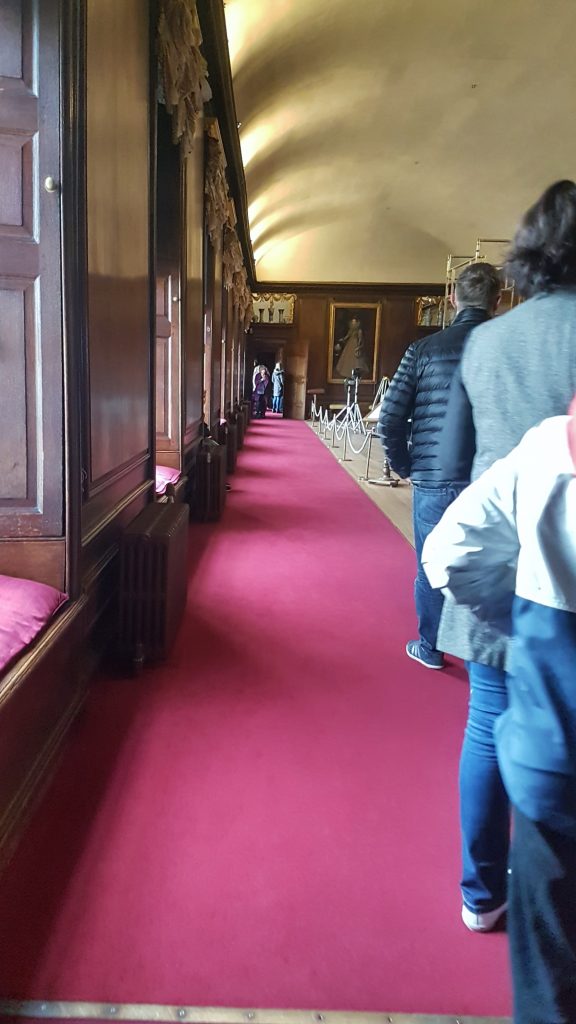
The Queen’s Gallery
The Queen’s Gallery is the perfect example of how a Palace works- it is essentially a very long hallway that has different rooms off of it. They get smaller as you move along the hallway, and you have to be a trusted courtier to be able to progress. Mary ascended the throne in 1689 at the age of 28, and was quite a cosmopolitan women (from her time living in the Dutch court). The Gallery was the perfect place for her to display all of her collected pieces of artwork, including pottery, paintings, and miniatures. One famous visitor to the Gallery? Peter the Great visited in 1698 while he was staying in London, and the Kneller portrait typically hangs there.

Fireplaces are largely decorative for us now, but they served a crucial role- as a source of light and heat for much of the day, you will find them everywhere in palaces. Nowadays, they are mostly used to display things, and I think it is a great use of them. This is only a tiny fraction of Mary’s porcelain collection, and I can only imagine what the room would look like filled it. (I’m guessing somewhat like Charlottenburg…) The gold detailing on the mirror is simply stunning in person!

The Queen’s Closet
Although these apartments are showing Mary’s court, the Queen’s Closet is most closely associated with Anne. This closet is where one of the most prolific and meaningful arguments between Anne and favourite Sarah Churchill occurred with lasting consequences for both. This isn’t what most of us North Americans would refer to as a closet, if you are wondering. The Closet is simply a smaller room for the Queen (or King) to retire to for some privacy away from peering eyes. And if you were wondering, that portrait above the cabinet? That would be Queen Anne. It isn’t a particularly flattering portrait, but this 1702 portrait was used as the model for all of her coinage and medals. (At least the crown looks good?)

The Queen’s Eating Room
The Queen’s Eating Room is actually remarkably small. You could probably put a third person at the table, but that is about it- it really is a private room. This room especially makes me wonder on the hallway design of palaces. Because each room is rather a bubble off of the hallway that is part of the hallway, there isn’t always a lot of actual room left to use. While I can understand it is a private room and wouldn’t need to hold many people, I would guess it would have been quite crowded with two to three people at the table and any needed servants. (It did make me wish that The Favourite was filmed at Kensington so that we could have actually watched a confrontation scene in the actual room, but it would have shut down the Palace for days.)

As a point of reference, this is from my 2013 visit, with Queen Anne’s 17 little losses illustrated with chairs. The room was indeed, quite full! (It is still one of the most poignant and thought-provoking scenes I’ve ever seen in an exhibition!

The Queen’s Drawing Room
This desk may not be overly large, but it is incredibly ornate, and is really the focal part of the room right now. You will notice that this room and the next room look slightly different to the other rooms in the Queen’s Apartments. That would be because in 1940 the Palace was bombed, and for the restoration work, they decided to wallpaper the rooms. Originally, this was another room that Mary used to showcase all of her ceramics.
A list made in 1694 by Simon de Brienne, the palace housekeeper, shows that Mary II had filled this room with porcelain. Mary’s enthusiasm for ceramics led Daniel Defoe to make his famous comment, ‘The Queen brought about the custom… of filling houses with China-ware which increased to a strange degree afterwards piling their China upon the tops of Cabinets, Scutores, and every Chymney-Place to the tops of the ceilings. (Historic Royal Palaces. Discover Kensington Palace. Historic Royal Palaces: Hampton Court Palace, 2012, p. 29)
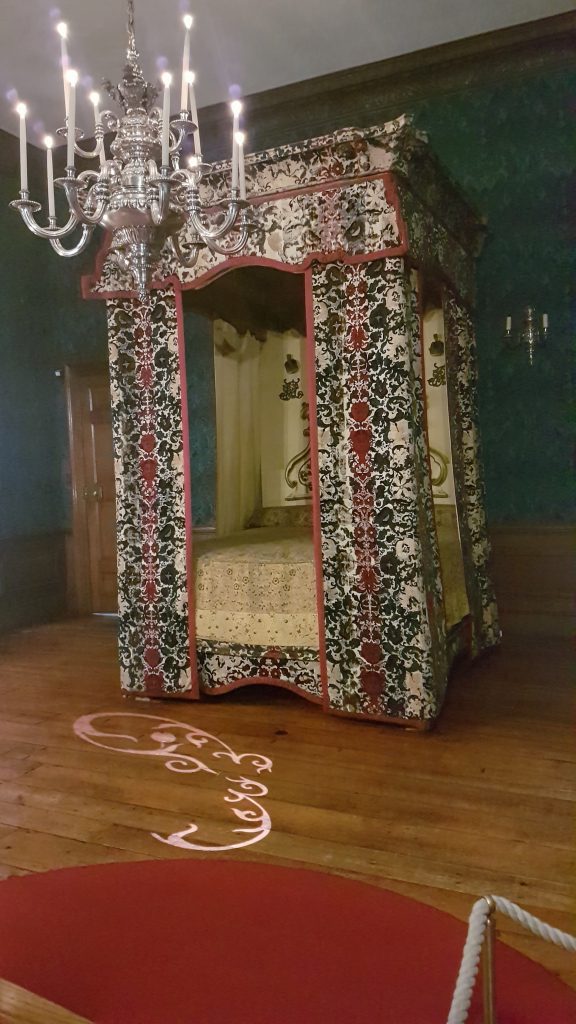
The Queen’s Bedroom
I’ve got to say: I understand that lighting is controlled for preservation but this room was quite dark. Normally I wouldn’t care too much, but the green damask wallpaper is gorgeous, and you can’t really see it unless you are standing a few feet away! Still, the bed is something else. The floral patterned bed hangings and coverings are stunning in person, and it truly is quite an imposing bed. This was originally the Queen’s State Bedchamber, meaning that she typically didn’t actually sleep here. Mary did have her apartments extended, though, and this room became an extension of the Drawing room. I will admit, it feels quite empty with only the bed and a few pieces of furniture, but if the Queen was in the State Bedroom, there would have been several people attending her.
♠
Have you visited the Queen’s Apartments at Kensington Palace? Is this where you picture a queen living?
Cheers,
The Historian
Facebook | Twitter | Instagram | Pinterest | Bloglovin’