31 October is arguably one of the most otherworldly days of the year, with both Halloween and Samhain falling on the same day. In honour of these days, I wanted to share a historical site that felt very otherworldly to me- Kilmainham Gaol. That isn’t to say that I saw ghosts or anything like that, but it was one of the heaviest and most sombre sites that I’ve ever visited. So, today I’m going to spend some time with the history of Kilmainham Gaol.

What is Kilmainham Gaol?
Kilmainham Gaol (pronounced: jail) is one of Dublin’s historic prisons. It was built in 1796 in Kilmainham, Dublin as the “New Gaol”, as the older gaol was overcrowded and falling apart. At this point in history, Dublin was colloquially known as the “second city of the Empire”; the Anglo-Irish aristocracy held power and authority over the large majority of the population, who were Catholic. Dublin is still a Georgian city, you can see the last architecture throughout the city.
Originally, most prisoners who ended up at Kilmainham were there for stealing or debt. However, the prison quickly became linked with Ireland’s independence movement.

The Panopticon
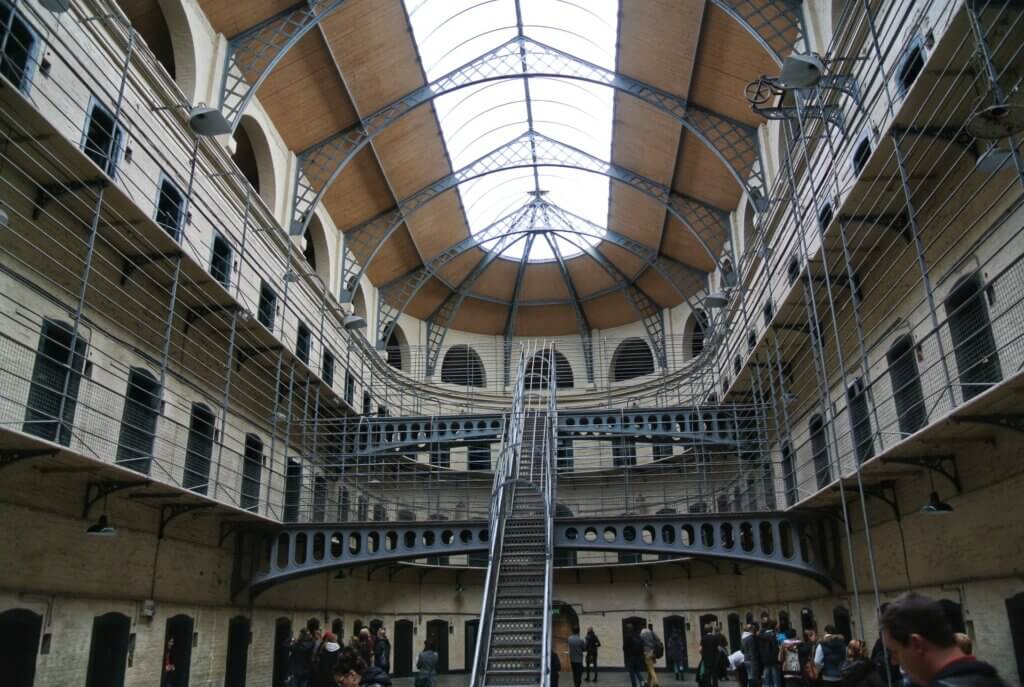
You may or may not be familiar with the panopticon- English philosopher Jeremy Bentham designed this prison, the panopticon, where prisons can be watched at all times. It is a circular design and the guard(s) standing in the middle can theoretically watch any prisoner at any time.
The east wing of Kilmainham Gaol was built in this style in 1864. It is striking to walk through the centre space- it feels incredibly immense, almost like an amphitheatre or lecture hall. Once you look into a cell however, you realise just how little space prisoners had.
Kilmainham and Irish Independence
If you are able to visit Kilmainham Gaol, you will quickly start spotting different names (typically with a year) marked on different cells. Many of the names will stand out if you know your Irish history: Countess Markievicz, Robert Emmett, Eamon de Valera, Charles Stewart Parnell, the list goes on. If Irish history is new to you, these people were all involved with the Irish independence movement at various points throughout the nineteenth and twentieth centuries.
I focused on Catholic Emancipation in Ireland in my Honours degree, so I spent a fair amount of time studying it and am probably more interested than most people. That being said, I think that even if you only know the bare minimum about modern Irish history, the fact that these men and women were held in this prison for trying to end English rule in Ireland is difficult to know. And when you walk through the prison and you see the cells they were held in (knowing what was happening outside), it is even more heartbreaking.

The Leaders of the 1916 Rising
One of the most difficult areas of the prison to visit (at least for me) is Stonebreaker’s Yard. While there were very few hangings at Kilmainham, there were several executions. The 1916 Easter Rising saw several Irish nationalists proclaim a free and independent Ireland with an armed insurrection. The Rising began on Monday 24 April with 1,200 members of both the Irish Volunteers and the Irish Citizen Army taking up arms and seizing the city centre of Dublin. The GPO (post office) was their headquarters for the weeklong seige, and while the Irish nationalists made significant progress throughout the week, the British seized control and the leaders were arrested.
Fourteen of the sixteen leaders were executed at Kilmainham in the Stonebreaker’s Yard. On 3 May 1916, Patrick Pearse, Thomas Clarke, and Thomas MacDonagh were executed at dawn by firing squad. On 4 May, Joseph Plunkett, Edward Daly, Michael O’Hanrahan, and Willie Pearse were shot at dawn. And then on the 5th, John MacBridge was executed. Eamonn Ceannt, Michael Mallin, Sean Heuston, and Con Colbert were killed by firing squad at dawn on the 8th, and Sean Mac Diarmada and James Connolly on the 12th.
You can now stand in that yard, where these men were executed. There is a small cross on the ground to mark the spot where the men were made to stand (or sit, in the case of Conolly).

The After-Life of the Gaol
Kilmainham Gaol was decommissioned by the Irish Free State in 1924. It was largely linked with British rule and occupation, and was left to quietly fall apart. However, luckily in the 1950s, a group decided to campaign for its restoration after learning that there was a proposal to demolish the site. Restoration and clearing work began in 1960 and the museum/former gaol opened to visitors in 1966.
If you find yourself in Dublin, I would recommend that this be one of your must-visit places. It may not be as light-hearted as the Jameson Distillery and the Guinness Storehouse, but it has seen some of the most important people and moments in modern Irish history. It is near impossible to visit Kilmainham Gaol and not feel a connection to the past. And when you do visit, allow yourself to be present and to take in what the guide is saying- they share some incredible stories of the past.
The Complexity of British History
Although I do cover a lot of British royal history on the blog, I do want to stress that British history is a complex and dark subject, particularly in the last 300 years. While many historians will celebrate the achievements of the British Empire and its far reach, the Irish spent centuries fighting for their independence. Edward VII and George V may have been at the helm of a glittering Britain but there were atrocities* committed by the British government and by the British military that should not and cannot be ignored. It is not straightforward, “this person was monarch and was fully responsible”- it is unfathomably complex. However, the next time that you are reading a book about British history or the royals, cast your eye further to think on what was happening beyond their court.
*This obviously is not limited to Ireland; no area of the Empire was spared.

Have you visited Kilmainham Gaol in Dublin?
Cheers,
The Historian
Facebook | Twitter | Instagram | Pinterest