Last week’s Style File Friday post explored court dress in England/ the United Kingdom. The English court went through very specific styles throughout the decades and centuries. However, Russian court dress is rather the opposite- for over 80 years, Russian court dress remained unchanged. I’ve always been fascinated with the styles of the Russian court, and have always wanted to dive into the topic. So, I was thrilled when I was able to get a hold of Russian Splendor, an in-depth look at court dress under the Romanovs. So, I’m sharing my Russian Splendor review today, and looking at Russian court dress!

What is Russian court dress?
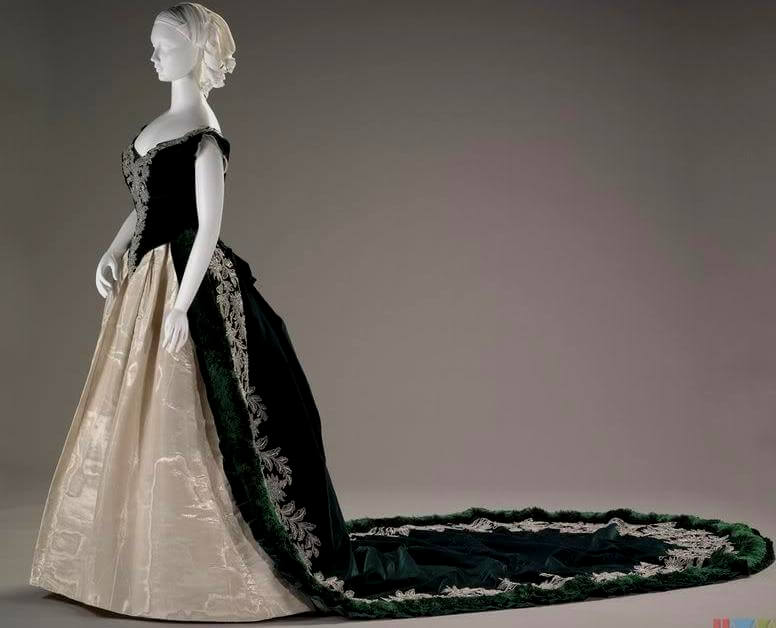
Before I read Russian Splendor, I could have told you that I loved Russian court dress and pictured it, but that is about it. I love that it really was a customisable uniform which women usually don’t have. And that as soon as you see it, you recognise it immediately. Admittedly, I originally recognised it from seeing Anastasia as a child, but it arises everywhere when you study the Romanovs at any length. This paragraph perfectly describes it:
In the reign of Nicholas I the official ladies’ court costume, known as the “Russian” dress, consisted of two items. The outer velvet swing dress with train and long folding sleeves with an open slit was worn over the inner dress, called a sarafan and consisting of corsage with short bell sleeve and wide skirt of white satin. Gold embroidery went along the “tail and side” of the dress, “the same as the embroidery of formal uniforms of the court officials”. Analogous embroidery was supposed to be “around and in front of the skirt.” In the mid-nineteenth and early twentieth centuries, the ladies’ court costume (the so-called court train) consisted of three items: velvet bodice-corsage, white satin skirt, and removable velvet train. The cut, texture, and color of the velvet, the design of the embroidery, and the length of the train were determined by the lady’s rank at the court. The longest train belonged to the empress”. (RS, 58)
Russian Splendor: Sumptuous Fashions of the Russian Court, Dr. Mikhail Borisovich, Georgy Vilinbakhov (Contributor), Evelina Tarasova (Contributor), Tamara Korshunova (Contributor), Nina Tarasova (Contributor)
A stunning volume showcasing the magnificent court dress of the Russian Empire, culled from the authoritative collection at the State Hermitage Museum in St. Petersburg, photographed with the Winter Palace as a backdrop. Prerevolutionary Russia was renowned for the glamorous and luxurious lifestyles of the nobility, with their opulent palaces and glittering social life. Now, this lavish volume reveals the incredible clothing they wore, from everyday dress and ceremonial attire (traditional holidays outfits and military uniforms) to dress for special occasions, including elaborate evening wear for theater and musical events and fancy masquerade balls. Celebrated for luxurious materials and impeccable craftsmanship, the dress of the Russian nobility was haute couture at its finest. With beautiful photography and details highlighting the hand-spun silks and lace and jeweled embroideries, Russian Splendor highlights the glamour of this gilded age and offers a fascinating window into a vanished world. Essays by Hermitage Museum curators, alongside historic Russian paintings and photographs, place the clothing in a historical context, revealing the rich cultural layers and artistic influences of czarist Russia.

Why You Need to Read Russian Splendor…
This is an incredible book, one of the most comprehensive and detailed fashion history resources I’ve found. It does have quite a price tag on it, but it is worth its (literal) weight. The book starts with a section on the different court events that people would have attended, and what attire was expected. That in itself is a useful read if you are looking at anything to do with the Russian court. It also examines all of the different kinds of dress that a Russian aristocrat might wear, not only their Russian dress. The magnificent costume ball ensembles are included, as well as hunting clothing, military uniforms, and clerical garments.
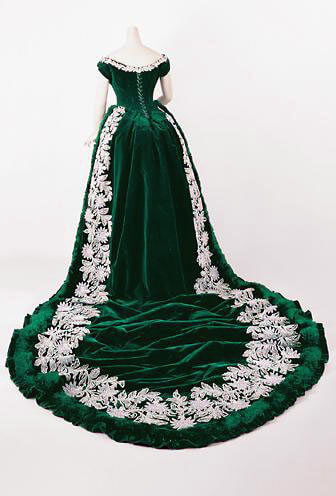
Given that it was written in association with the State Hermitage Museum, there are several images of garments and pieces in Russian Splendor that we have never seen before. Russia isn’t the easiest place to visit (even pre-Covid), so this is a true treasure chest of royal fashion history. The large majority of the book is images, so it isn’t quite as difficult a read as you might think when first looking at it. There are often two or three pictures of the same piece from different angles, so you can see quite a lot of detail. This may have been written as more of an academic resource but it would also make a gorgeous coffee table book, too.

The Alexander Palace has a fantastic page on Russian court dress, if you want to read more right now.
If you are interested in the Romanovs, you can visit my post on the Russia: Royalty, and the Romanovs exhibition at the Queen’s Gallery!
And if you are an Anastasia fan, you can visit my thoughts on the musical and my book recommendations!
Have you read Russian Splendor yet?
Cheers,
The Historian
Facebook | Twitter | Instagram | Pinterest | Bloglovin’