If you missed my post from yesterday, I finally fulfilled a childhood dream and saw Anastasia on stage! The royal mystery of history that lead me down the path of becoming an historian? Obviously, I had to. However, it isn’t just the movie and the musical that have held my interest. The sad but fascinating history behind the Romanovs is also captivating. (There is a reason we are all still reading it, no?) This post is going to focus on non-fiction books, but please let me know if you would like a fiction list, as well. Now, what to read after you see Anastasia….

These books all focus on the last generations of Romanovs aside from one, rather than earlier periods and monarchs. Peter the Great and Catherine the Great are both fascinating, but if you have just seen Anastasia, you are probably in the mood for the later Romanovs. Although they are often lumped together as a single group, they very much were individuals. These books look at different members of the family through different lenses, and offer great insights into the tragic Imperial family. While both the musical and movie Anastasia take liberties with what happened to the family, these books are going to show the history (as heartbreaking as it is).

Nicholas and Alexandra, Robert Massie
In this commanding book, Pulitzer Prize–winning author Robert K. Massie sweeps readers back to the extraordinary world of Imperial Russia to tell the story of the Romanovs’ lives: Nicholas’s political naïveté, Alexandra’s obsession with the corrupt mystic Rasputin, and little Alexis’s brave struggle with hemophilia. Against a lavish backdrop of luxury and intrigue, Massie unfolds a powerful drama of passion and history—the story of a doomed empire and the death-marked royals who watched it crumble.
Massie is, without a doubt, one of the pre-eminent Romanov historians. Sadly, he passed away on 2 December 2019, but his books are a lasting testament to his skill. He wrote only non-fiction biographies of several Romanovs, but they read like novels. Few authors can bring history to life like Massie. This particular biogaphy looks at the doomed Tsar and Tsarina, and how their early lives and personalities contributed to their outcome. This is one of the pioneer biographies of the couple, and those that followed are compared against it. Although you may come to this study with biases in one way or another, Massie will make you consider the Romanov couple from a new position. I wasn’t able to put this book down, and am actually planning on doing a re-read of it soon. (His Catherine the Great biography is also amazing, if you are looking for earlier Romanov history.)

The Romanov Sisters: The Lost Lives of the Romanov Grand Duchess, Helen Rappaport
They were the Princess Dianas of their day—perhaps the most photographed and talked about young royals of the early twentieth century. The four captivating Russian Grand Duchesses—Olga, Tatiana, Maria and Anastasia Romanov—were much admired for their happy dispositions, their looks, the clothes they wore and their privileged lifestyle.
Over the years, the story of the four Romanov sisters and their tragic end in a basement at Ekaterinburg in 1918 has clouded our view of them, leading to a mass of sentimental and idealized hagiography. With this treasure trove of diaries and letters from the grand duchesses to their friends and family, we learn that they were intelligent, sensitive and perceptive witnesses to the dark turmoil within their immediate family and the ominous approach of the Russian Revolution, the nightmare that would sweep their world away, and them along with it.
The Romanov Sisters sets out to capture the joy as well as the insecurities and poignancy of those young lives against the backdrop of the dying days of late Imperial Russia, World War I and the Russian Revolution. Helen Rappaport aims to present a new and challenging take on the story, drawing extensively on previously unseen or unpublished letters, diaries and archival sources, as well as private collections. It is a book that will surprise people, even aficionados.
Rappaport is also known as a leading Romanov historian, and has published multiple books on the family. What I enjoy about her books is her sources- primary sources are her go-to. The Romanov Sisters still reads quite smoothly; it isn’t one quote after another, but touching and in-depth examination of the four sisters often treated as one. This book doesn’t only cover their tragic end, but from their births to their end in 1918. (It has also spurred me on to read the collections of surviving letters and correspondence from the Grand Duchesses!)
If you enjoy Anastasia, this book will be of particular interest to you. I do find it fascinating that during their life, the sisters were quite often downplayed and ignored for their younger brother, but they have held more of our interest in death. It may be that some of us can relate to a sibling who is in the spotlight, or simply being in a group. In any case, they are given their deserved attention here.

From Splendor to Revolution: The Romanov Women, 1847- 1928 , Julia P Gelardi
The early 1850s until the late 1920s marked a turbulent and significant era for Russia. During that time the country underwent a massive transformation, taking it from days of grandeur under the tsars to the chaos of revolution and the beginnings of the Soviet Union.
At the center of all this tumult were four women of the Romanov dynasty. Marie Alexandrovna and Olga Constantinovna were born into the family, Russian Grand Duchesses at birth. Marie Feodorovna and Marie Pavlovna married into the dynasty, the former born a Princess of Denmark, the latter a Duchess of the German duchy of Mecklendburg-Schwerin.
In From Splendor to Revolution, we watch these pampered aristocratic women fight for their lives as the cataclysm of war engulfs them. In a matter of a few short years, they fell from the pinnacle of wealth and power to the depths of danger, poverty, and exile. It is an unforgettable epic story.
This is one of my favourite books, and I recommend it any chance I get. Alexandra also tends to hog the Romanov spotlight, so-to-speak, and four different but key Romanov women are given their turn to “speak”. Gelardi’s work is masterful, and weaves together four women across multiple generations to give a grounding to the later Romanov years. Because the Empresses are often the focus, and marry into the family, Marie Alexandrovna and Olga Constantinovna are particularly interesting as women born into the family. The Romanov family is more insular than some other royal dynasties, with those married in often losing their identity in Russia and Orthodoxy. A look from the inside is refreshing, and Gelardi ties them together comfortably.
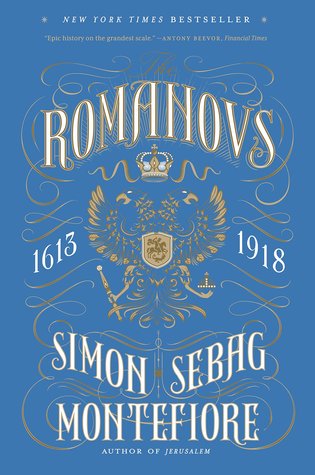
Romanovs: 1613-1918, Simon Sebag Montefiore
The Romanovs were the most successful dynasty of modern times, ruling a sixth of the world’s surface for three centuries. How did one family turn a war-ruined principality into the world’s greatest empire? And how did they lose it all?
This is the intimate story of twenty tsars and tsarinas, some touched by genius, some by madness, but all inspired by holy autocracy and imperial ambition. Simon Sebag Montefiore’s gripping chronicle reveals their secret world of unlimited power and ruthless empire-building, overshadowed by palace conspiracy, family rivalries, sexual decadence, and wild extravagance.
Drawing on new archival research, Montefiore delivers an enthralling epic of triumph and tragedy, love and murder, that is both a universal study of power and a portrait of empire that helps define Russia today.
This is the one overarching Romanov history on this list, and it is a time investment of a book. At over 1,000 pages, you are going to be reading for a while. However, Montefiore’s history of 300+ years of Romanov rule has quickly become a favourite. He turns his eye to each Tsar and Tsarina with equal attention, and ushers you through the centuries. Russia has had its fair share of odd, interesting, and mad rulers, and Montefiore doesn’t shy away from them. And although it is quite a hefty read, it does give you a longer term idea of how the Romanovs ended up where they did. I would recommend reading it in chunks and breaking it up, generation by generation. (If you are looking for the audiobook, it is just shy of 30 hours.)
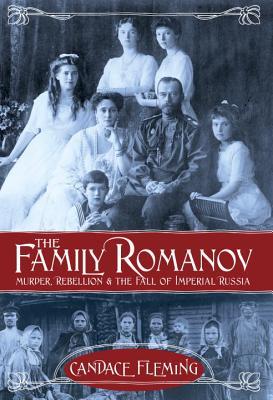
The Family Romanov: Murder, Rebellion, and the Fall of Imperial Russia, Candace Fleming
Here is the tumultuous, heartrending, true story of the Romanovs—at once an intimate portrait of Russia’s last royal family and a gripping account of its undoing. Using captivating photos and compelling first person accounts, award-winning author Candace Fleming (Amelia Lost; The Lincolns) deftly maneuvers between the imperial family’s extravagant lives and the plight of Russia’s poor masses, making this an utterly mesmerizing read as well as a perfect resource for meeting Common Core standards.
Fleming’s book is aimed at young adults, but is a great read. It moves quickly, and draws on some unique first-hand sources of people around the Romanovs. She also places the Romanov family in the wider context of twentieth century Russia; without that, it can sometimes be a bit bewildering to read about their end. (Not that it was justfiied in any way, but certainly helps explain how you arrive at brutally murdering a family in a cellar….) If you want a fast read, or have a younger reader interested in the Romanovs, pick this up!
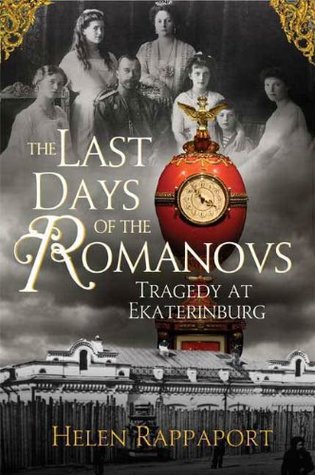
The Last Days of the Romanovs: Tragedy at Ekaterinburg, Helen Rappaport
This is the story of those murders, which ended three hundred years of Romanov rule and set their stamp on an era of state-orchestrated terror and brutal repression.
The Last Days of the Romanovs counts down to the last, tense hours of the family’s lives, stripping away the over-romanticized versions of previous accounts. The story focuses on the family inside the Ipatiev House, capturing the oppressive atmosphere and the dynamics of a group—the Romanovs, their servants, and guards—thrown together by extraordinary events.
Marshaling overlooked evidence from key witnesses such as the British consul to Ekaterinburg, Sir Thomas Preston, American and British travelers in Siberia, and the now-forgotten American journalist Herman Bernstein, Helen Rappaport gives a brilliant account of the political forces swirling through the remote Urals town. She conveys the tension of the watching world: the Kaiser of Germany and George V, King of England—both, like Alexandra, grandchildren of Queen Victoria—their nations locked in combat as the First World War drew to its bitter end. And she draws on recent releases from the Russian archives to challenge the view that the deaths were a unilateral act by a maverick group of the Ekaterinburg Bolsheviks, identifying a chain of command that stretches directly, she believes, to Moscow—and to Lenin himself.
This is the newest read for me; I finished it just yesterday and knew I had to add it (I was saving it for Anastasia, I enjoy reading related history when I see a show.) Rappaport has once again captivated me with her study of the Romanovs. I think like many, I find it difficult to read about the last days of the Romanovs. However, she methodically goes through each day of the last ten days in Ekaterinburg while weaving the immediate past in. What I’m enjoying most is getting to know the servants that stayed with the family until the end, as I still didn’t know much more than names and positions. If you want to know what truly happened to the family, this book is sad but helpful. As it was written in 2008, I find it better than the Massie book on the last days of the Romanovs, simply because discoveries of bones and genetic testing has provided many answers that were missing in earlier studies and the wondering isn’t there. (Not to fault Massie at all.)
If you are looking for more Romanov history, visit my post on the Russia, Royalty, and the Romanovs exhibition in London! And of course, my Anastasia review!

So readers, what are you recommendations on what to read after you see Anastasia? Are there any favourites that I have missed?
Cheers,
The Historian!
Facebook | Twitter | Instagram | Pinterest | Bloglovin’