There are many different aspects of fashion history that interest me. I find modern designers- of the twentieth and twenty first centuries- to be fascinating, as there are a wide variety of pieces held in collections and shown in exhibitions. However, I’m also drawn to court dress, and formal garments that largely do not exist in our modern world. There are some incredible collections of court dress. The Royal Ceremonial Dress Collection, under Historic Royal Palaces, contains pieces from the eighteenth to the late twentieth centuries, and pieces often go on display at Kensington Palace. Today I’m going to be looking at a few fascinating surviving court dress garments in the UK!

What is Court Dress?
Court dress is defined as “formal clothing worn at a royal court”. Although it is often described colloquially as a “uniform”, it is typically not a uniform, but rather custom pieces that fit into a specific set of styles. Those that come closest to a uniform are pieces that “were created for grand state ceremonies such as coronations and the State Opening of Parliament… They include coronets and robes worn by members of the peerage, with their ancient symbols instantly signalling to those in the know the position and rank of the wearer.” (Historic Royal Palace, Discover Kensington Palace, 2012, p. 53) However, I am more interested in the pieces that were unique to the individual.
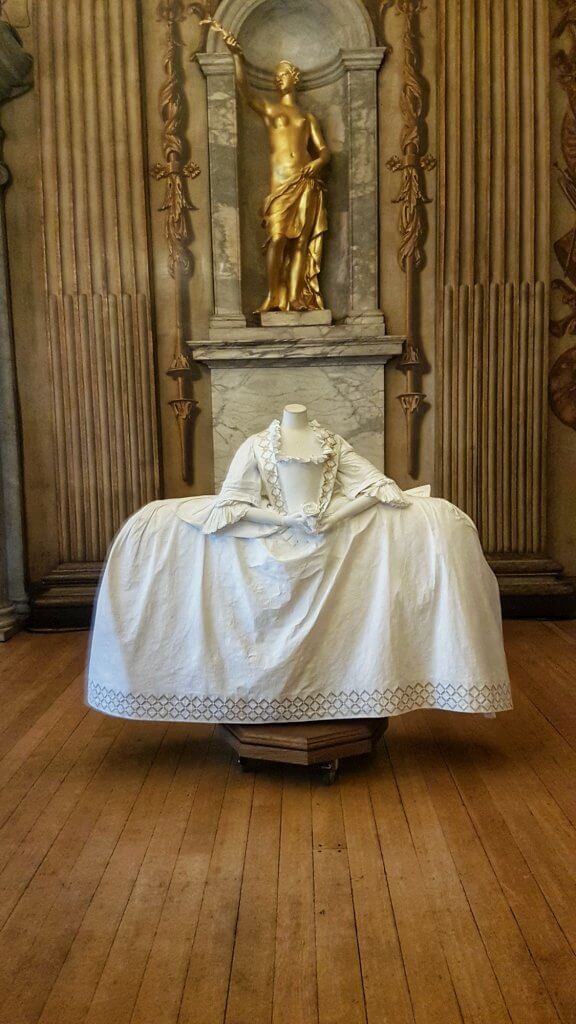
Georgian Court Dress at Kensington Palace
Kensington Palace is largely associated with the modern royals, like the Duke and Duchess of Cambridge and the late Princess of Wales. However, it actually began its royal life as the host of the Stuart court, and then the Georgian court. If you visit the King’s State apartments, you can actually see some very creative replicates of Georgian court dress- made of paper!
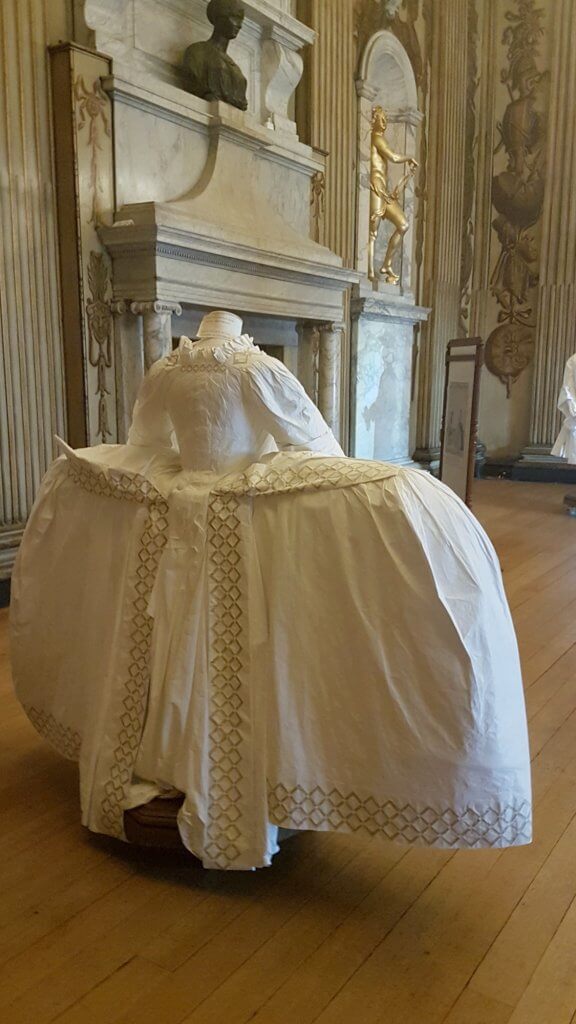
The Court Mantua
You can see that this paper mantua still is quite a large and impressive garment. Yes, this particular mantua is probably lighter than a real Georgian mantua, without the many layers of silk, petticoats, stays, hoops, and more. But it still takes up an incredible amount of space. Mantuas were popular in the late seventeenth and early eighteenth centuries, but stayed as court dress until the nineteenth century. Earlier mantuas were a more manageable size- they would have still had several pieces, but one could have moved around normally. However, by the mid-eighteenth century, they had reached these extreme proportions that you can see here. As you could imagine, one would need to move through doorways and smaller spaces sideways, but this very formal gown was the only appropriate way for a woman to appear at court. (The question of bodily functions always comes up- you can easily fit a chamber pot under a skirt like that…)

This is a 1750’s court mantua, held at the V&A, that perfectly illustrates the span. According to the V&A Collections,
the gown consists of a bodice with a train at the back. A very wide petticoat of matching silk completes the ensemble along with a triangle of silk known as a stomacher, in the centre front.
Although considered stylish daywear in the early 18th century, the mantua had become very old-fashioned by the 1750s and was worn only for court dress. Wide hoops were beginning to go out of style, but kept their extreme width at court. To make up for its conservative cut, court dress was always made from the most fashionable as well as expensive fabrics and trimmings.
This mantua is the perfect example of only needing to look the part to gain entry to court. If you can afford to buy a gown like this, you have the money to take part in court events and obligations (in theory).

The Twentieth Century Court Dress
This 1900 court dress, at the Fashion Museum in Bath, is a particularly gorgeous gown. It is beautiful cream silk satin with delicate embroidery, and you don’t really see that now. Although the royal court is quite different now, at the turn of the century, people were still formally presented to the monarch. This court dress was made by the court dressmaker, Welborn of Regent Street, and much like the earlier mantua, would have been made of higher end materials.

What you might notice is that while this dress does not have the span or diametre of the mantua, it does have an exceptionally long train. According to the exhibition, trains “had to be more than three yards long from the ankle”, meaning that there is a higher cost to ensure a long enough train. This would have dated back to the end of Queen Victoria’s reign, but is very much in line with Edwardian fashions. (Think a decade before Downton Abbey starts, very much in the style of the Princess of Wales, later Queen Alexandra.)
One no longer needs to be formally presented to the court to attend royal events now, so there is no formal “court dress” that is observed now.
What do you think of these court dress garments- would you be able to wear them if you had to?
Cheers,
The Historian
Facebook | Twitter | Instagram | Pinterest | Bloglovin’